Small business: Short-term fixes lend a hand to small firms
A planned increase in corporation tax to 22 per cent is put on hold
Small businesses are set to get a series of short-term boosts to help them get over the recession – although the Chancellor was already outlining the ways he will exact repayment in future years.
Alistair Darling tried to dent the impact of the slowdown on small and medium-sized enterprises (SMEs) by announcing several measures aimed at providing them with access to cash loans and tax breaks, as well as promising flexibility from the Government to help them adapt to the downturn. He also announced a rise in National Insurance rates from 2011.
"If this Budget is about giving small business a boost now, then it appears to deliver, with specific targeted measures," Simon De Young, an accountant at PricewaterhouseCoopers said.
"The projected increase in National Insurance from 2011 will be one of the ways this saving is clawed back in future years."
A planned increase from 21 per cent to 22 per cent in the corporation tax paid by small businesses will be put on hold. The Government will also set up a fund that will allow taxpayers' money to guarantee a £1bn temporary Small Business Finance Scheme to offer credit to firms that are struggling to access loans.
Banks, who have been spooked by the credit crunch, have started to pull back on their lending. Mr Darling took the time to welcome Royal Bank of Scotland's announcement at the weekend that it will freeze overdraft rates for small businesses.
Commentators pointed out the Government will need other banks to follow RBS's example and work with it to help small business.
"The deferral on the one percentage point increase in corporate tax for small business will ease the burden for many companies," the accountancy firm Ernst & Young said in a statement. "Similarly, from a cash-flow perspective, the enhancement of the small loan guarantee scheme and the extended opportunity to carry back losses will provide some relief.
"However, any improvements to the small business loan guarantee scheme will still rely on the high street banks to make it work in practice."
In another effort to boost small business's access to finance, Mr Darling said the Government has agreed a £4bn deal with the European Investment Bank to provide money to UK banks to pass on to small businesses. He added that £1bn will be available to banks' business customers by the end of the year.
The Government will also take measures to help UK exporters, and will offer a temporary facility to support the availability of short-term investment for smaller exporters. That will mean another £1bn of support, "to help ease the financing constraint faced by firms trading in current circumstances," he said.
Mr Darling also announced several tax relief measures, such as a temporary increase in the threshold for empty property relief. In the 2009-2010 tax year, empty commercial properties liable to payment of local property taxes with a value below £15,000 will be exempt from business rates. The Chancellor added that the exemption covers about 70 per cent of all empty properties.
The UK will show flexibility in levying small business tax, and will allow SMEs to defer payments indefinitely at times when they are struggling. "From today, HMRC will enable firms facing difficulties to spread their tax on a timetable they can afford," he announced, adding that this measure will cover VAT, corporation tax, income tax and National Insurance.
The Government will also put off cracking down on so-called income shifting, whereby someone on a high income transfers part of their income to someone – their spouse, for example – who is on a lower tax rate. The Government will not address this issue at the next budget as it had planned but will instead keep it under review.
Controversially, however, the Chancellor said he will raise National Insurance contribution rates for both employers and employees by half a per cent in 2011 – by which time he expects the economy to be in recovery. That measure sparked an outcry among some small business organisations.
"The proposal to increase National Insurance contributions is wrong," said David Frost, the director-general of the British Chambers of Commerce, which represents small business. "At the very time when the economy should be coming out of the recession, businesses will face an extra tax on employing people. This is not the way to reduce unemployment."
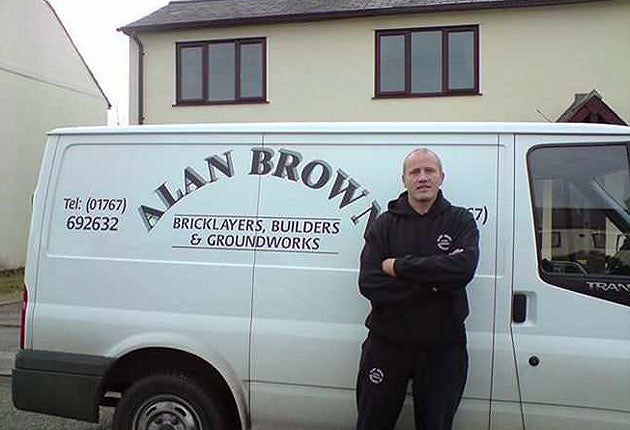
Brown on Brown: Private jobs have dried up completely
Alan Brown, 46, runs his own bricklaying company in Sandy, Bedfordshire, and employs up to 25 workers at any one time.
I've been in the building industry for more than 20 years now. I can honestly say that I've never seen things as bad as they are today. Most of the new work we've taken up this year has come through government contracts, refitting schools or housing association projects. In the past eight to nine months, the private contracts have completely dried up, there just simply isn't the work. To make matters worse, the banks simply won't lend us any money. That makes me very angry considering they've been bailed out by the taxpayer. I have 25 people working for me at any one time and they depend on me to give them an income. We've already had to lay off a few bricklayers just before Christmas, while most of the new government contracts won't begin until the new tax year.
I definitely approve of the 2.5 per cent reduction in VAT. I've heard a lot of people say, "Well, what's 2.5 per cent?" But I don't think people appreciate how much of a difference it will make. It helps everybody regardless of whether you are rich or poor.
As a builder, the extra cash that the government announced to build homes is also very welcome. Hopefully they will be able to take on a few of the building projects I have lying around that the banks have pulled the plug on.
Join our commenting forum
Join thought-provoking conversations, follow other Independent readers and see their replies
Comments