Book review: Grown Up Digital: How the Net Generation is Changing the World, by Don Tapscott
How Generation Y can transform companies
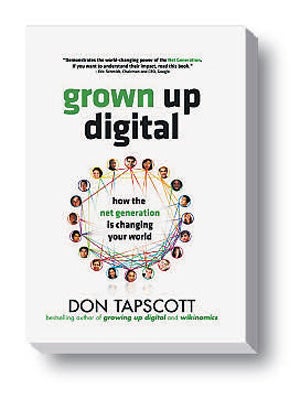
The world in which Don Tapscott wrote this book was rather different from the one in which it has appeared. A couple of years back, Britain, Western Europe, North America and most other large economies were still in the midst of a boom that some thought was going to last forever. For employers, one of the key issues was finding a way of engaging the attention of a generation of young people whom many social critics regarded as being almost unemployable – at least in the traditional sense.
As Tapscott relates at the beginning of this book, people aged between 11 and 31 have tended to be looked down upon by their elders (in other words, would-be employers) as ignorant, easily distracted, self-obsessed and work-shy – among many other none-too-complimentary things. He rebuts all these arguments, claiming that, just because the youngsters usually referred to as Generation Y behave differently to the Baby Boomers they are not necessarily undesirable members of the workforce.
On the contrary, he suggests that the people he prefers to label the Net Generation have the ability to transform the fortunes of organisations because they have an almost intrinsic understanding of the new technologies that their predecessors lack. While Baby Boomers and, to a certain extent, the Generation X-ers who followed them use technology to help them in their work and in their leisure life, the members of the Net Generation have "grown up digital" and are therefore totally immersed in technology and its possibilities.
He writes: "Sure, you're as cyber-sophisticated as the next person – you shop online, use Wikipedia, and do the BlackBerry prayer throughout the day. But young people have a natural affinity for technology that seems uncanny. They instinctively turn first to the net to communicate, understand, learn, find and do many things."
Tapscott is a Canadian, but he has the enthusiasm associated with people from the big country to the south of his own and has devoted much of it in recent years to chronicling the development of this tech-savvy generation. A Baby Boomer himself (he was born right at the beginning of the generation, in 1947), he has clearly been inspired by watching the development of his own children – who were aged 10 and seven in 1993, when he began the work that led to his 1996 book, Growing Up Digital. He has amassed a mountain of evidence to support his case. He is not afraid to spot trends, particularly when they involve technology. In 1992, he co-authored a book called Paradigm Shift, which was one of the earlier attempts to assess the growing influence and promise of information technology. For better or worse, this contributed to a popularising of the concept of the "paradigm shift" – a term that had previously been restricted to describing scientific revolutions. Later, he collaborated on Wikinomics, which set out to explain how collaboration was changing everything.
As he rather charmingly points out, Growing Up Digital originally came out of his belief that his children's ability to play computer games, send emails to Santa Claus and surf the internet made them prodigies. When he discovered that all their friends could do it, too, he realised something was happening.
The new book continues the process out of his more recent conviction that what started with technology has become more all-encompassing. There are contradictions that cause confusion – for example, the Net Generation professes to be less interested than their predecessors in so-called "good jobs" and yet is much more aware of brands and, perhaps most famously, appears to be uninterested in politics and yet has embraced President Barack Obama, who connected with them on their own terms – via the internet and mobile communications.
But, add up all these changes and trends, and you see, argues Tapscott that "these young people are remaking every institution of modern life, from the workplace to the marketplace, from politics to education, and down to the basic structure of the family" – because they are using technology to change old models, whether it is how they are taught or how they keep in contact with friends and family.
Because of the economic crisis in which we now find ourselves, many in business and elsewhere will be tempted to ignore these messages as the sort of fancy that can be indulged in when the going is good. With unemployment rising, many parents and other older people will encourage university graduates and others of their generation to knuckle down like they did. This might well be what employers are looking for.
But challenging times call for new approaches and just as Obama seems to be offering politics something new so these young people championed by Tapscott could offer businesses a way ahead. Among their ranks are bound to be many new entrepreneurs. Existing business owners could do well to try to understand what is happening. As the man says, "If you understand the Net generation, you will understand the future".
Join our commenting forum
Join thought-provoking conversations, follow other Independent readers and see their replies
Comments