Free school: Conservatives eye the Swedish model
Meet Robin Bhuna, a diligent Swedish schoolboy who only spends an hour a day in class. If the Tories are right, all British children should have the chance to learn like this. Richard Garner in Stockholm reports on the experiment that the Conservatives want to import
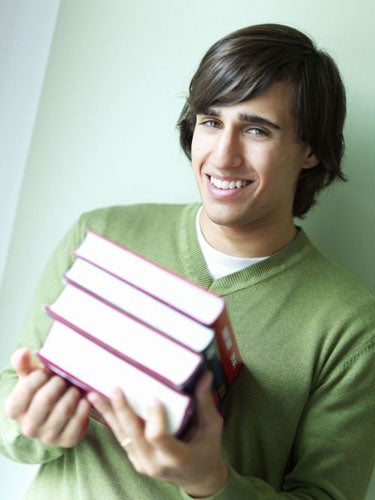
For Robin Bhula, a 17-year-old student studying natural sciences at a Swedish independent "free" school, the choice was simple. "The old system tied me," he said. "I like to study at home. I can take responsibility for my own assignments."
With the blessing of his parents, he transferred from a public (local-authority-run) school to a Kunskapsskolan school in Stockholm at the age of 14. Kunskapsskolan is one of the largest providers of independent "free" schools in Sweden, with 30 on its books.
"In the ordinary school you have to spend the time right through from 8am until 4pm in the school," he said. Then [after the transfer] I had one lesson per day and the rest of the time was free time. It was much more flexible."
When Michael Gove, the Conservatives' schools spokesman, announced at his party conference that he wanted to adopt Swedish-style education in the UK, it was Kunskapsskolan that caught the eye.
Kunskapsskolan believes in developing – to use words much bandied about by David Miliband when he was schools minister – a "personalised learning plan" for every pupil. Each youngster is set weekly goals and gets a 15-minute briefing with their own tutor at the end of the week to check on progress and discuss how to reach the targets setfor the following week.
But both Robin and Cecilia Carnefeldt, a member of the Kunskapsskolan board, acknowledge that this style of learning may not suit every pupil. The big difference between the education system in Sweden and the UK is that, in Sweden parents are given an educational voucher for each child, and they use that voucher to apply for any school they want to.
It has certainly led to a wide variety of providers, with Waldorf Steiner, Montessori, confessional (faith schools) and traditionally-run schools which emphasise the basics and are strong on discipline.
Bertil Ostoberg, the Swedish Secretary of State for Education, summarised the scheme as "providing freedom of choice for the parents and the pupils, much wider freedom of choice". He added: "They have to compete to provide a high quality to get pupils. We think this competition has led to a higher quality in the system."
Mikael Sandstorm, the Prime Minister's chief adviser, said his daughter was attending a traditional school where the pupils all had to stand up when a teacher entered the room "Not usual for Sweden".
Schools run by private companies that are allowed to make a profit out of them predominate. In past years, according to headteachers' leaders, the number of these schools has increased dramatically. But some teachers complain that Swedish taxpayers' money is being used to subsidise the barons of private industry.
"After doing some work for quite a few years, providers can come to a point when they make a profit in the real sense," said Claes Bromander, vice-chairman of the Swedish Association of Independent Schools and principal of Vaxjo Fria Gymnasiet. "They reinvest most of the profit. Swedish TV has done some research: the 60 biggest providers that are run as companies have a turnover of about 10 billion kroner (£804m)."
Under the present system, a provider has to submit plans 18 months in advance of opening a school. Given the green light, they get paid for every pupil they take in. Parents are given a voucher to pay for their children's education which they can exchange at any school they want. The voucher can vary in value from municipality to municipality; for example, a school might be paid 60,000 kroner to take a child from one area but 85,000 to take a child from somewhere else, although both children gain the same education.
The Swedish government has made a determined effort to make the admissions system for its independent "free" schools fair. They operate a "first come, first served" policy, announcing the date for the start of admissions and closing once they have filled up all the places.
Research for the Swedish National Agency for Education shows it has caused increased segregation, with better-educated parents more likely to opt for an independent "free" school place. Not surprisingly, pupils at the independent schools tend to get higher grades than those in the municipal schools. But Mervyn Benford, a former primary school head from the UK who has spent years in Sweden advising ministers on their inspection system thinks there could be another reason for the "free" schools' higher results. "They are smaller than the municipal schools," he said. "They can give pupils more attention." At the Kunskapsskolan-gymnasiet (upper secondary school for 16- to 19-year-olds) where Robin Bhula is studying, there are 580 pupils, large by independent "free" school standards. Municipal schools could have 1,500. All political parties – the Conservative-led coalition in government at present and the opposition Social Democrats – are committed to maintaining the system, although the Social Democrats have called for a freeze on new schools, with pupil numbers falling. "We have to shrink the system," said Maria Sellberg, vice-principal of Norre Real High School, a top-performing public school in Stockholm. "Shrinking such an organisation costs a lot but the number of students [nationally] is decreasing. You squander taxpayers' money on this over-capacity; there is a great bleed-away of taxpayers' money."
As the Swedish National Agency for Education put it: "To provide choice, you have to over-provide."
Join our commenting forum
Join thought-provoking conversations, follow other Independent readers and see their replies
Comments
Bookmark popover
Removed from bookmarks