Fury as examiners are told to fix A-level results to match last year's
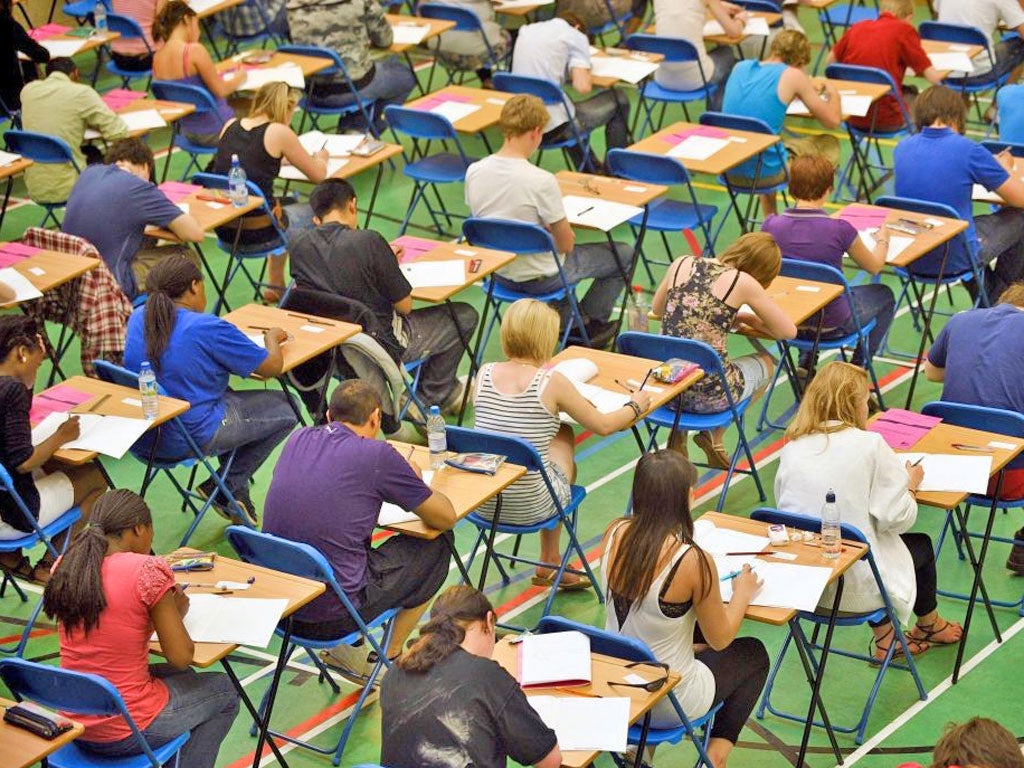
Exam boards have been told they should fix pass rates and grades for this summer's GCSE and A-level exams to match last year, causing fears some pupils will be held back from reaching the highest level possible, The Independent can reveal.
The move, outlined in a policy document from the exams regulator Ofqual, is intended to halt year-on-year rises in exam success. But some say it could hold students back and hard-working schools won't see their efforts rewarded.
Academics and headteachers claim say the move is a return to the days when A-level results were "norm referenced", for example, a fixed percentage of pupils was awarded an A grade pass (10 per cent) every year.
Since this was scrapped in 1987, the percentage of A grades awarded has steadily risen from 10 per cent to 27 per cent – while the pass rate has gone up from 70 per cent to 97.8 per cent.
Adrian Prandle, education policy adviser at the Association of Teachers and Lecturers, said there were concerns about the approach.
"If exam boards can ensure that pupils who sit an exam this year won't get lower grades than they deserve then we welcome it," he said. "However, if as a consequence of tougher rules on grade boundaries, pupils are denied the opportunity to gain the highest grade of which they are capable and which they would have got in another year, then they will be unfairly disadvantaged. In these tough economic circumstances, that will hit pupils' future chances hard."
Ofqual's chief executive Glenys Stacey denies this is the case and insists that genuine improvements in teaching and learning standards will still be recognised by higher grade passes.
The policy of "comparable outcomes" was in fact introduced at A-level last year and was one of the reasons why there was not the anticipated rise in the awarding of A* grades (they were up from 8.6 per cent to 8.7 per cent) and the percentage of A-grade passes was pegged at 27 per cent.
This year is the first time the policy will be extended to both GCSEs and A-levels. Exam boards will be urged to predict A-level and GCSE results based on the past performance of pupils. At A-level, GCSE performance will be taken into account while – for GCSE – performance in national curriculum tests at 11 will be looked at.
Exam boards will compare any improvements in performance with those achieved by pupils in the previous year. If the interim awards prove higher than predicted, the Ofqual document says: "If necessary we will require exam boards to change their grade boundaries." The key passage in Ofqual's document says that the policy – dubbed "comparable outcomes" – means "roughly the same proportion of students will achieve each grade as in the previous year". Exam boards will face increasing hurdles if they seek to justify year-on-year rises.
Professor Alan Smithers, director of the Centre for Education and Employment at Buckingham University, said: "The awarding bodies are going to be asked to account for any big deviation upwards.
"I think it is a useful interim measure to tackle the gross inflation in A-level results but it can only be temporary.
"In essence we've brought about a new form of norm referencing by setting the levels at where they were in 2010 – but there is nothing to say this is the most appropriate distribution of grades and we need to examine this."
Headteachers have been alarmed by the policy – warning its implementation will make it impossible to deliver on Education Secretary Michael Gove's insistence that schools increase the percentage of top A* to C grade passes at GCSE in maths and English.
"It does create a difficulty," said Malcolm Trobe at the Association of School and College Leaders. "The Secretary of State is wanting to have his cake and eat it. There is a real possibility that a number of people will be surprised and concerned that examination results will not show the improvements they had anticipated."
A Department for Education spokeswoman said: "Ministers are clear it is only fair to every hard-working young person there is no grade inflation or dumbing down in the exam system."
TESTING TIMES: PASS OR FAIL
A-levels were first introduced in 1951. They were awarded a pass or fail. A grading structure did not emerge until 1963 when pupils could be awarded an A, B, C, D, E, O or F grade. O was equal to an O-level pass, F was failure. Grades were norm referenced – 10 per cent received A grades, 15 per cent got C grades, etc. The pass rate was 70 per cent with the rest awarded O or F. The system was abolished in 1983 and grades were awarded according to merit. A grades have since risen from 10 per cent to 27 per cent and the pass rate from 70 per cent to 97.8 per cent, fuelling claims of grade inflation.
Join our commenting forum
Join thought-provoking conversations, follow other Independent readers and see their replies
Comments