I think, therefore I am: Philosophy in Year Three
Philosophy lessons in primary schools teach children how to think
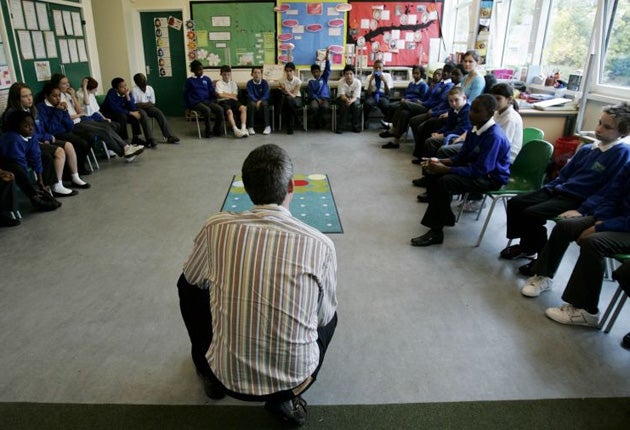
"Eyes closed, take a deep breath through the nose, hold it and breathe out through the mouth," the teacher tells the class. "Now think of that place that makes you feel happy and relaxed."
This may not be what one would normally expect to hear from a teacher at the start of a primary school lesson in these days of concentrating on raising standards at every opportunity.
But the seven- and eight-year-olds being given the instruction were at one of several schools in the country pioneering new lessons in philosophy for children of primary school age.
The plan is that they should clear their minds so they can think, something some teachers would argue is a novel idea in the modern educational world of the three Ts, tests, targets and [league] tables.
Their teacher, Peter Worley, who studied the subject at university, has just set up a company, The Philosophy Shop, dedicated to bringing philosophy lessons to primary school pupils and business is beginning to mushroom.
From modest beginnings at Eliot Bank primary school in Lewisham, south London, his company has now reached the stage where it has four teachers, all philosophy graduates, delivering lessons, and schools in Portsmouth and the Isle of Wight on his books.
Kathy Palmer, the headteacher at Eliot Bank, is in no doubt about their value in a primary school world still dominated by SATs, especially now that Ed Balls, the Secretary of State for Schools, has decreed that the national curriculum tests for 11-year-olds are here to stay.
"Children love it," she said. "When we started it, there were far fewer schools saying this rigid curriculum with the teacher as the fountain of all knowledge just isn't working. This gives them the opportunity to really explore what they think about things. We've got a very broad range of pupils in terms of their background."
The programme, she said, helped pupils of all abilities to develop their thoughts and improve their self-esteem and also had an impact on how they approached other lessons.
In Year Three, the budding Jean-Paul Sartres were deliberating on the story of the frog and the scorpion. The scorpion had seen members of his family on the other side of a river and wanted the frog to ferry him across. The frog was reluctant. "You'll sting me." The scorpion promised he would not but succumbed to the temptation half-way across. "That's what I do," he told the frog as both slid to their watery grave.
"That's evil," cried one of the pupils. But during the debate, most felt no one was to blame because the scorpion could not help himself. One said: "It might have been the frog's fault a little bit for letting the scorpion on his back."
The story was then changed by Peter Worley, known as "The Philosophy Man" to some pupils, to include two humans: a robber with a knife and a ferryman. Again, a similarity, with the robber knifing the ferryman half-way across. Who was to blame this time?
"It's the robber's fault – the scorpion, it's his nature but the robber needn't have done it," said one eight-year-old.
In another classroom, a group aged 10 and 11 were shown four works of art and told two were by the same painter. Then they were told by "The Philosophy Man" that one of them was the most beautiful. He was pointing out the difference between facts and values.
There is a difference, argued Aidan. "Five times five is 25 and that's a fact," he said. "My age is 11," added Connor. "If anyone said my age was 10, they would be wrong." In the end, the class largely agreed it was a fact that two of the paintings had been done by the same artist but which was the most beautiful was a matter of opinion.
Philosophy lessons The questions pupils will face
*Year Three (aged seven and eight)
Problem: The class is told of the frog and the scorpion, who asks the frog to ferry it across the river, promising it will not sting. Half-way across, it does and both slide into a watery grave, the scorpion saying: "It's what I do." The class debates who was in the wrong. The characters are changed to a robber with a knife and a ferryman who meet a similar fate. Debate continues.
Answer: There is no answer. Different people have different views.
*Year Six (aged 10 and 11)
Problem: (a) The class is shown four paintings and told two are by the same artist. Can this be right?
(b) The class is shown four paintings and told one is the most beautiful. Is this necessarily right?
Answer: This is a lesson in the difference between facts and values.
(a) It can be a fact that two of the paintings are by the same person.
(b) Not necessarily. Beauty can be in the eye of the beholder.
Join our commenting forum
Join thought-provoking conversations, follow other Independent readers and see their replies
Comments
Bookmark popover
Removed from bookmarks