Is it time for Hitler and Henry to make way for Cromwell?
Speech by former Cabinet Secretary sparks debate on teaching of history
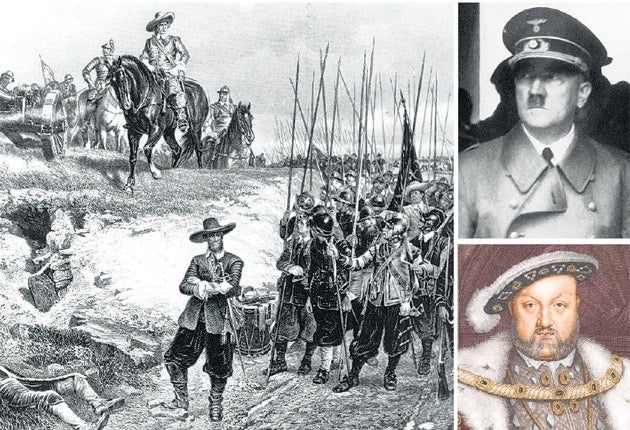
Secondary school pupils are being taught too much Hitler and not enough about subjects such as the English Civil War, a conference of history teachers has been told.
The claim came in a keynote address to the history section of Prince's Teaching Institute annual conference as ministers prepare for a radical revamp of the curriculum.
Lord Wilson, the former Cabinet Secretary and historian, who made the claim, put forward plans for a more methodical and chronological approach to history. "No one in public life should be in a position of power unless they have some grasp as to why we are where we are," he said. Wilson argued there should be a sharper focus on subjects such as the 1832 Great Reform Act, which paved the way for today's democracy, and the English Civil War (1642-1651).
He was speaking before the Education Secretary, Michael Gove, sounded out teachers, pupils and academics at the Cambridge University conference about history's place in the classroom as part of a proposed review of the national curriculum.
Pupils at the conference singled out lessons about the Tudors and the Nazis as some of the most memorable. Valerie Boateng, an 18-year-old from St Angela Ursuline school in Newham, east London, who hopes to study history at university, said: "The Holocaust stood out. You get to empathise with what happened."
Hannah Swindells, from Cardinal Wiseman Catholic school in Brighton, was fascinated by Henry VIII. "What a guy," she said. "I really love him and so much of what we can see from his reign is here today."
Many teachers in the audience said the girls' preferences confirmed their view that the concentration on isolated periods gives little insight into narrative history.
Mr Gove has already indicated that he would like the historian Niall Ferguson to play a key role in reshaping the history curriculum. During a recent address at the Hay Festival of Literature and the Arts, Mr Ferguson lamented an apparent obsession with "Henry VIII, Adolf Hitler and Martin Luther King", arguing that we need, "more of a sense of narrative history – of how [these figures] fit in with the rest of history".
Bernice McCabe, co-director of the Prince's Teaching Institute and a headmistress at North London Collegiate School, agreed the pendulum may be swinging in the direction of traditionalists like Ferguson."He [Gove] has already consulted us about curricular developments," she said. "My greatest worry... is that a diminishing number of children in our schools are now getting the benefit of studying in depth."
Expert views: How to give our schoolchildren a sense of history
Professor Richard Bessel is a lecturer on 20th-century Germany at York University and has just completed a book on Germany in 1945.
It wouldn't be a bad idea considering our position and the make-up of the country to learn about South Asia and China. One ought to teach the societal, political and economic history of India under British rule and the transition and partition, and the subsequent history of South Asia. People there are much more aware of our history than we are of theirs. There also ought to be more American history.
Dr Natalie Zacek lectures in Latin American and Carribean history at Manchester University.
It would be good if students knew more about the early modern period – what historians call the great divergence, when the West began taking the lead in technology and imperialism. I still have quite intelligent students coming to university thinking that Africans were a bunch of savages before British colonisation. They should learn more about China and India because they're important players in global politics. We don't equip young people to comprehend our globalised world by teaching that Hitler and Stalin are the only important things to know about.
Professor John Hatcher tutors students at Corpus Christi College, Cambridge, on early modern economic and social history.
Medieval history is neglected in schools. The 14th-century is quite easy to sell as the world's worst century: it involved climactic deterioration, the world's worst famine, the Black Death and subsequent revolts and disorder. Viewing a century in the round chimes with contemporary concerns about climate change and disease. It also explains how society came together and survived. Teachers need to explain why people believed what they did at the time That would breed tolerance and awareness of the importance of knowledge.
Bettany Hughes presents 'The Ancient World' on Channel 4. She is working on a book about Socrates.
We can only understand history if we start at the beginning and work forwards. I have just got back from Siberia, investigating Bronze Age cities decorated with swastikas. I can only understand the power of that symbol because of thousands of years of history. I was recently on the Iraqi border and some dirt-poor children came up to me and gave me the names of Plato and Socrates. I think we'd be hard-pushed to find 10-year-olds doing that in Britain.
Robert Harris has written several best-selling historical novels, including 'Imperium', set in Ancient Rome, and 'Fatherland' about Nazi Germany.
I remember being fascinated by the Corn Laws and 19th century British political history at school.I think as a general rule we should be wary about going too far into the 20th century. I think we have an enormous amount to learn about Ancient Rome, which has a great relevance to today.
Dr Alice Rio lectures on medieval history at King's College, London.
One way to teach history would be to pick themes like religion, social structures, political or economic factors and study those over a few centuries. By connecting history, we can give pupils broader minds and teach them that nothing about the current state of the country or world is inevitable.
Tristram Hunt has presented TV series on the English Civil War and Protestantism. He was elected as MP for Stoke-on-Trent Central last month.
I think they should be looking at more narrative British history and the place of the country in the world: the English Civil War, the Industrial Revolution, the growth of Empire and the world at war in the 20th century. We're often teaching what we think is sexy for kids. So students coming to university tend to know more about the American civil rights movement than they do about the fight for civil rights here.
Join our commenting forum
Join thought-provoking conversations, follow other Independent readers and see their replies
Comments