Education

Rain (AM and PM) 3° London Hi 10°C / Lo 3°C

Schools must teach pupils about babies, Aids and sex

Lessons made compulsory from the age of five but faith schools given right to dissent
By Richard Garner, Education Editor

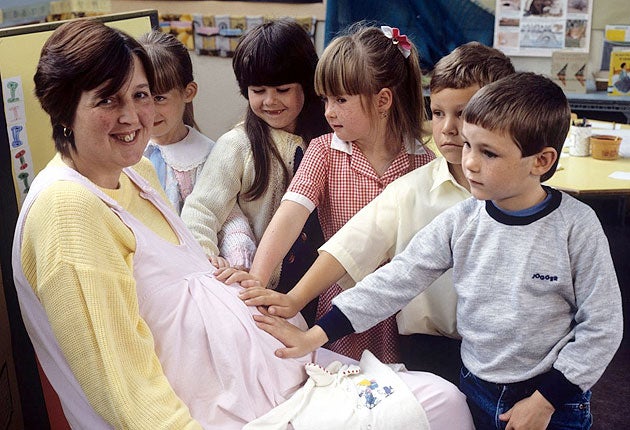
Ministers have agreed that parents' right to withdraw their children from sex education lessons will remain

ITV / Rex Features

Ministers have agreed that parents' right to withdraw their children from sex education lessons will remain

Teaching about contraception will become part of new compulsory sex education lessons, it emerged yesterday. A Government review of personal, health, social and economic education, which covers lessons about sex and relationships, ruled that sex education should be a compulsory subject in both primary and secondary schools.

However, faith schools are being told they can include in the lessons a rejoinder making it clear in the case of Roman Catholics, for example, that their religion is against the use of contraception.

In addition, ministers have agreed that parents' right to withdraw their children from sex education lessons will remain.

Figures produced by Ofsted, the education standards watchdog, show that only four in every 10,000 have exercised that right although some observers believe this will grow when sex education becomes statutory.

As a result of yesterday's decision by a review group headed by headteacher Sir Alasdair Macdonald, children as young as seven will start to learn about puberty and reproduction. Five-year-olds will also be taught how to manage strong feelings and emotions.

By the time they reach secondary school, they will be taught about contraception, HIV and Aids and pregnancy. In Key Stage Four, which is for 14 to 16-year-olds, teenagers will taught how to make assessments of different "lifestyle activities" - which could mean learning about gay relationships.

Sir Alasdair was at pains yesterday to stress that making PHSE compulsory was not only about introducing compulsory sex lessons. His report concluded: "Comments made in some parts of the media and elsewhere that statutory SRE (sex and relationships education) would mean 'sex education for five-year-olds' are inaccurate and miss the point of SRE."

In fact, there will be eight new statutory areas of the curriculum as a result of yesterday's decision.

The others are: drugs and alcohol education; teaching about emotional health and well-being; diet and healthy lifestyle, including the need to adopt a healthy eating lifestyle; safety education (teaching about the risks of getting involved in gangs rather than pure health and safety); careers education; teaching pupils financial capability, such as how to manage their finances and take out a mortgage; and work-related learning.

Sir Alasdair said that at present, while PSHE was delivered well in some schools, overall the situation was "patchy". "We want the rest to be benefiting from the kind of education that is being given to the best," he said.

Children's Secretary Ed Balls said he had accepted all of Sir Alasdair's recommendations.

"It is clear that if children are going to get a well rounded education which prepares them for life in the 21st century, PSHE has a key role to play," he said. "Most schools already follow the non-statutory curriculum but current provision can be patchy.

However, he stressed: "Parents bring up children, not government. Schools, however, can play a vital role in teaching essential skills for learning and life."

Leaders of the Catholic education service said they supported the principle of making lessons compulsory but said what was taught "ought to be in line with the wishes of parents and should uphold the ethos of the particular school".

Oona Stannard, director of the service, added: "Within the parameters of Catholic schools being able to continue with this approach, we support the principle of PSHE being a requirement for every pupil."

She said the service was also committed to ensuring that parents' rights to withdraw their children from classes was maintained. "This is a crucial right in a community where parents are the first educators of their children and because parents are responsible for bringing up their children and not the State."

The plan was opposed by secondary school headteachers, who said there was "nothing to be gained" from making the subject compulsory in schools.

John Dunford, general secretary of the Association of School and College Leaders, added that he was "concerned at the notion that new ways have to be found to assess PSHE". "Surely this is one area of the curriculum that does not have to be assessed, where young people should be able to learn without having examinations hanging over them," he said.

Simon Blake, director of Brook, the sex and contraception advisory service, welcomed the decision. However, he warned against faith schools' use of a "caveat" in sex education classes.

"All young people need to know about their legal rights – you can be gay, you can use contraception and you can have access to abortion services," he said.

He was also worried about parents retaining the right to withdraw their children from lessons – claiming it would "undermine all young people's rights to a good quality sex and relationships education".

The plan will be put out to consultation between now and the end of the summer term with a view to being introduce in all schools in September 2011.

What children should learn about sex. And when

By the age of five: How to recognise, manage and control strong feelings and emotions.

By seven: How to form and maintain relationships with a range of different people. They should also be able to name the main parts of the body.

By 11: How to manage changing emotions and relationships and how new relationships may develop. They should also – through scientific and technical understanding lessons – be able to describe and explain the structure and function of key human body systems, including reproduction. In class, they should be able to discuss some bodily and emotional changes at puberty and demonstrate some ways of dealing with these in a positive way.

By 14: Recognise and discuss the importance of relationships to sexual activity (in terms of human reproduction, using contraception and sexually transmitted diseases) and to marriage, parenthood and family life. They should also be able to discuss in class how they can recognise strong emotions and identify ways of managing these emotions positively (for example talking to a friend or teacher about feelings on divorce and falling in love).

By 16: Assess the risks and benefits associated with lifestyle activities such as sex and be able to make safer choices based on this assessment of risk. They should also state they know where they can find professional health advice (about issues like sexual diseases) and be taught how to be confident in seeking it (for example from their GP or other services).

Post a Comment

View all comments that have been posted about this article.

Offensive or abusive comments will be removed and your IP logged and may be used to prevent further submission. In submitting a comment to the site, you agree to be bound by the Independent Minds Terms of Service.

Comments

Compulsory sex education from the age of five
[info]thisuldo wrote:
Tuesday, 28 April 2009 at 01:02 am (UTC)
It is contradictory that 'sex education' is to be 'compulsory' - although parents can continue to exclude their children from these lessons.

Big Brother should leave families to decide when and what to teach their children about these subjects - parents know when they are ready for this informaiton. Teachers should stick to 'educational' issues - they barely have time for them anyway and so many children leave school struggling to read!!

Children do not belong to the state - YET.
Re: Compulsory sex education from the age of five
[info]andrea_2 wrote:
Tuesday, 28 April 2009 at 09:44 am (UTC)
I agree with you that children do not belong to the state. But neither do the belong to their parents. Parents have guardianship over their children, not ownership. I am always disturbed by parents who fail to see where their rights end and the child's rights begin. This is most apparant in religion, where the parents feel they have the right to impose a belief system on their child, sometimes to barter their children as possessions.

Donating an egg and a sperm to another human being does give ownership over them mind, body and soul.

Sensible and rational decisions by parents should always be applauded and supported, but where irrational and dangerous decisions are made, such as in medical treatment or religious practice, then the state has no choice but to step in. A child does not have a voice. The natural voice to speak on behalf of a child should be a loving parent. But not all parents are loving and children need an outside party to be on their side and be their advocate.

In the case of sex education, it should not be compulsory at Infant and Junior school level. If a parent feels happy for their child to be involved then they should be, but if a parent feels that their child is too young then they shouldn't be. But what is wrong with a child knwoing that a baby comes from its 'mummy's tummy'? As opposed to believing it is brought by the stork or found in the cabbage patch?

At senior school level sex education should be compulsory and parents should not have a say. It is irrational not to want your young adult off-spring not to know why their bodies are developing as they are. Teenagers will be developing rapidly and will have questions and concerns about those developments. A parent sould try and answer those questions and concerns themselves but if they feel unable to do so, they should stand aside and let someone else do it.
Re: Compulsory sex education from the age of five
[info]wer_wind_blows wrote:
Tuesday, 28 April 2009 at 10:19 am (UTC)
I never understand how people can on the one hand say that religions "impose" belief systems on children, but then in turn impose alternative belief systems on their own children. In fact, who says that this belief is being unpleasantly forced upon? If a child is taught, they're hardly being imposed upon.

Everyone holds a belief system, and everyone could essentially be said to be "religious" about something.

Parents are indeed guardians and are to raise up their children in the way they should go. The question is, who do children really belong to? I fail to see how a religious belief system carries on into a parent bartering their child as a possession though.

I also don't necessarily agree that a child doesn't have a voice. Do you mean a five year old a or a five month old?

I do believe there is an overstatement of a parents position in the life of a child in some cases, but what really frightens me is the diminishing of a parents significance to the child. The bond between parent and child is deep and beyond our complete understanding.

That said, I agree on your points about sex education to a point. It's essential (and in that sense compulsory) for children to know these things. But children are individuals and so I believe that personal wisdom should come into play when determining what, when and how a child should know these things.
Re: Compulsory sex education from the age of five
[info]andrea_2 wrote:
Tuesday, 28 April 2009 at 10:47 am (UTC)
Children don't have a voice in the sense that they can advocate for themselves. I know that someof then can have very loud voices indeed, when it comes to demanding an ice cream, but not when it comes to demanding their rights in law.

Some religions, though by no means all, do barter their children. Here I am thinking of forced marriages. The children are very much seen as property. And such things as circumcision, it an abuse of a child.

I have tried not to enforce a belief system on my children. They are free to chose to think and believe, or not believe, anything they want. But some fundamental religions have a real problem with their children growing up to be atheists, and it can be punishable by death in some cases.

Who does a child belong to? No one. They belong only to themselves and until, as a fully fledged adult, they can become autonomous, the law, via their parents and teachers and other such responsible individuals should watch over them and make the very best decisons they can on the child's behalf. And that is the child's behalf, not the parents behalf.

The role of the parent can only be diminished if the parent allows it, by neglect, abuse and bad decisions. No one should seek to diminish the role of a loving, caring, self-less parent who tries at all times to put their child's interests first.

We are seeing on the streets of Britain, feral children for whom no one seems to care or protect. They all have parents somewhere, but their parents are failing them terribly. What alternative is there but for the state to step in?
Re: Compulsory sex education from the age of five
[info]wer_wind_blows wrote:
Tuesday, 28 April 2009 at 11:01 am (UTC)
It should be noted, however, that instances of forced marriage and circumcision are usually down to culture and not religion. On the flipside, there are what may be termed as "religions" that are deeply cultural or a way of life.

I personally don't believe anyone, including children, ultimately belong to themselves and so that has a bearing on what I think about this kind of issue, as well as how and why a child should be raised in a certain way. That said, a child should be guided as much as possible until they reach a sufficient state to make their own responsible choices and face the consequences of those choices.

I do believe it isn't entirely true to say the role of a parent is diminshed if they allow it. What we don't see is the state stepping in to take care of "feral children" and "bad parents", but instead infringing on the rights of loving parents.
Re: Compulsory sex education from the age of five
[info]andrea_2 wrote:
Tuesday, 28 April 2009 at 01:00 pm (UTC)
In what way are the 'rights of loving parents' being infringed? Although they are saying that sex education should be compulsay they are still leaving available the option for parents to remove their children from sex education lessons.

I do not have a blind faith in the State and it's ability to remove children from abusive and neglectful homes, and it's ability to get it wrong and remove children wrongly. Look at the case of baby P. That poor little soul was utterly betrayed by the State and those who should have stepped in and protected him. But the State does have arole to play and we can only hope that it gets it right more often than it gets it wrong.

I have been having some contact with agencies who place children for fostering and adoption and I know that more often than not they get it right. And it is the cases that go catastrophically wrong that make the headlines. Children who have been removed from their parents who have been terribly damaged by feotal alcohol syndrome. Sometimes whole groups of siblings who have been born mentally and physically damaged because their mother kept on taking drink and drugs whilst pregnant. None of this makes the headlines and these cases are not few in number. Children whose backgrounds are so terrible they make for deeply distressing reading. Feral children who do actually get picked up early enough and removed. Again, none of it makes the headlines.

[info]wer_wind_blows wrote:
Tuesday, 28 April 2009 at 07:45 am (UTC)
I agree that the responsibility for this should be left with the parents.

"By the age of five: How to recognise, manage and control strong feelings and emotions."

I mean surely parents should be teaching their children these kinds of things anyways, and I'm a bit disturbed that essentially the state will be deciding how certain feelings should be recognised, managed and controlled, through this teaching.
schools
[info]pythinia wrote:
Wednesday, 29 April 2009 at 08:08 am (UTC)
How can a child of five manage to recognise and control strong feelings and emotions? their brains are no near developed their concentration span is limited - why do we believe they are cope mentally with such vexed subjects?
Faith Schools & Sex Education
[info]rendevou5 wrote:
Wednesday, 29 April 2009 at 09:57 am (UTC)
It's time someone told Brook and the Secular Society to get stuffed.

They don't want freedom of choice: what the President of the Secular Society and the director of the contraception advisory service want is to impose their low standards and their unbelief on everyone else. I understand the approach is referred to as "aggresive secularism"?

But if they try to push their Godless views into Catholic schools, I suspect they may well discover that they've bitten off rather more than they can chew.

Never forget: the parents who send their children to faith schools CHOOSE to do so!

Most popular