Tax threat could hit hundreds of public schools
£100m of benefit in jeopardy after dramatic Charity Commission ruling
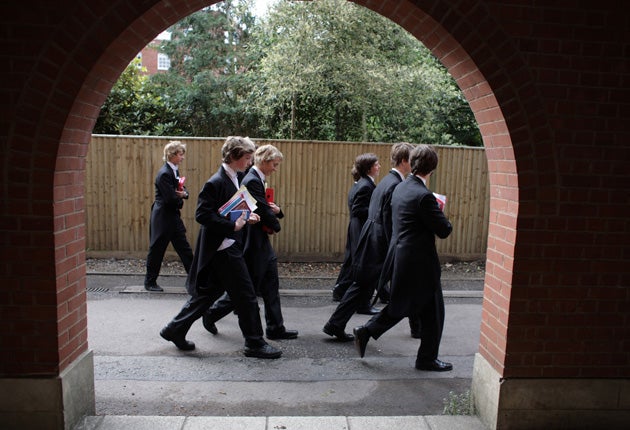
GETTY IMAGES
Leading independent schools, such as Eton, say charitable status is vital for their survival
Hundreds of independent schools will be forced to raise their fees to take in more pupils from poorer backgrounds, following a landmark ruling by the Charity Commission. Two of the first five schools investigated by the watchdog have been told they fail to meet tough new standards for retaining their charitable status – worth about £100m in tax breaks across the sector.
The leaders of Britain's 2,500 private schools fear the verdicts could be a foretaste of what is in store for all of them. Most independent schools, including Eton, Harrow and Winchester, have charitable status they say is vital for their survival.
The two schools singled out by the commissioners – St Anselm's in Bakewell, Derbyshire, and Highfield Priory in Preston, Lancashire – are ranked among the top 100 private preparatory schools. They have been given 12 months to start doing more to help disadvantaged children in their communities, or risk losing their charity status altogether.
A spokeswoman for the commission said: "All charity trustees are being required to ensure they carry out their charity's aims and for the public benefit." However, she said no decision had yet been taken about how it would proceed with future public benefit assessments.
David Lyscom, the head of the Independent Schools Council, an umbrella group representing 1,280 independent schools in the UK and Ireland, said the watchdog's ruling would inevitably lead to higher charges for most parents who paid full fees for their children to attend private schools.
He added: "We are deeply disappointed with the approach taken by the Charity Commission – which focuses on the amount of means-tested bursaries provided by each school.
"The implication of the commission's findings appears to be that many schools must aim to provide a significant but unspecified proportion of their turnover in full bursaries. This will inevitably lead to fee increases for the vast majority of parents, putting the benefits of an independent education beyond the reach of a greater number of children."
The Charity Commission's report on St Anselm's revealed that the 250-pupil school provided only two bursaries, up to the value of 90 per cent of fees. This cost £20,000, or 1 per cent of its total income. It also provided £30,800 in assistance to nine children of armed forces personnel through a Ministry of Defence grant, and scholarships offering a 10 per cent discount on fees to a further seven children. The report concluded that the school was "not currently operating for the public benefit".
Highfield Priory did not provide any bursaries, the commissioners found, concluding that it did "not ensure that people in poverty are not excluded from the opportunity to benefit". The school, however, insisted that it kept fees as low as it could – £5,975 a year – so that as wide a range of children as possible could benefit from its tuition. Simon Northcott, the headmaster of St Anselm's, said: "[The commissioners] haven't told us what they want us to achieve. We believe we can play ball with what they want but it obviously makes a difference whether they want us to go up to spending 2 per cent of our income or 6 or 7 per cent."
He said a recent fundraising drive to provide the school with more resources had not been as successful as was hoped because of the recession. The only other way to find extra money for bursaries would be to raise fees at a time when families were suffering from the downturn.
Today, the Charity Commission publishes a report setting out the key issues and offering information on how charitable organisations can meet its public-benefit test. Under a section on fee-charging, which affects private schools, it states that a charity which charges high fees that many people cannot afford must demonstrate that "there is sufficient opportunity for people who cannot afford these fees to benefit in a material way that is related to the charity's aims".
It sets out a number of ways that charities might fund fee assistance, including income from fees, from specific funds set aside for that purpose, using funds from a third party and setting fees at a "slightly higher" level in order to create a fund to assist those who cannot afford them.
But Mr Lyscom warned that small schools which had tight budgets could find themselves vulnerable in the future – a rise in fees might mean some parents could not afford to keep sending their child to the school.
He also condemned the commission for failing to specify how many bursaries a school needed to provide to meet the test. "The schools are being found guilty without knowing what innocent looks like," he added.
But Dame Suzi Leather, chairman of the Charity Commission, said: "The majority of the charities we have assessed are already providing public benefit in a variety of ways. The other charities are capable of doing so and remain registered but they must now agree with us in the next 12 months the changes that are needed."
In all, 12 charities acted as "guinea pigs" for the pilot inspections and eight passed the test. These included Manchester Grammar School, the only school to volunteer for the pilot.
The other two charities to fail were fee-paying residential care homes.
View all comments that have been posted about this article.
Offensive or abusive comments will be removed and your IP logged and may be used to prevent further submission. In submitting a comment to the site, you agree to be bound by the Independent Minds Terms of Service.
- Print Article
- Email Article
-
Click here for copyright permissions
Copyright 2009 Independent News and Media Limited


Comments
Do charitable work or - spin on that dickheads.
Fake charities are to be despised and should be dismantled.
I see no difficulty where a school is actually doing charitable work. Those doing otherwise should expect to be correctly identified to be businesses and should expect to pay business taxes. What other just outcome is possible?
Eton a charity? At those prices?
It's charity for the wealthy.
Parent who currently are stretched and make great sacrifices to give thier children as best education as they can will find that it is put out of reach.
The very wealthy will be minorly inconvenienced, but the aspiring classes - who already fund state sector education through taxes, and pay again for their own children's eductaion. will be hurt.
the registration of charities;
giving advice and conferring regulatory consents e.g. making schemes and orders; and
taking action where there is or may be mismanagement e.g. powers to institute inquiries, removing or suspending trustees, appointing interim managers, protecting charity property and/or other assets.
...couldn't spot the bit where they had authority to alter or amend taxation laws though.
Another quango - anyone care to enlighten me - anyone form the Charities Commission care to expand on their tax making laws?
Let's make it simple for you then shall we...
They decide who can be registered as a charity....
If an organisation that charges money is not registered as a charity then it is a business...
If the Charities Commission decides a school is not a charity and kicks them off the register then that school will be regarded as a business...
Businesses are subject to tax...
So, you see you the Charities Commission doesn't have to have tax making laws... they just have to apply current law and do their job....
Now that wasn't too hard was it?
My daughter attended a state primary school and enjoyed it enormously, although the whole year was held back at the end of their primary career as the school desperately coached for SATs (naturally they were excellent results), but failed to provide any appropriate introduction to languages other than English, leading a number of parents to form a small consortium to pay for teaching in German - the beginning of a slippery slope. In practice parents had no ability to influence anything at the school at all. The response from the head and the governors was always 'our hands are tied by the national curriculum and we do get good results, goodbye'.
My daughter then went on to a 'good' local comprehensive, Marlwood in South Gloucestershire. It was a disaster. In her first 3 years more than 1/3 of her teachers were supply teachers, often coming in on very short postings. There was little continuity. Science lessons were a mess - a number of boys were allowed to run a low level disruption/bullying operation ('borrowing' pencils, harassing the girls in their class) that was tolerated by the school. The school bus was a place to bully and be bullied (but naturally not a concern of either the school - no responsibility, or the council - run by a private company mate). Again, GCSE results were good (should have been for a school in a predominantly wealthy area of the country) and the school - teachers and governors saw no reason to change. (In retrospect this could simply have been the beginning of a decline we were witnessing as indicators - gcse results - have sharply dropped in the last four years).
So reluctantly we took the plunge and paid to move to a small (about 1/3 of the number of pupils as Marlwood) private school. The change was refreshing. The school had the time, the resources and the accountability necessary to challenge all of the girls. Rather than ignoring children who were going to get 5 A-C grades at GCSE and only concentrating on the very high flyers and those who could be boosted into the 'good for school league tables zone' all children were encouraged to reach their full potential. In addition, the school did not fall into the 'economy of scale' argument, retaining a size that meant teachers actually knew who the children were! The school had the freedom to innovate, in languages, exams (International Bac for example), community service (50 hours required for children in the upper school) etc...
Perhaps all parents with children at independent schools should pretend to play ball with this aim - and apply to their LEA for a state school place for their children. Be interesting to see how the government coped with that ...
Similarly, my husband won a scholarship to Haberdashers - and turned it down. He still got to Oxford via the state school route, so big deal for Haberdashers. As a teacher and lecturer, he has always refused to apply for vacancies in independent schools, preferring to serve the system that enabled him to achieve.
The simple fact is, if independent schools closed their doors tomorrow the state would have to cope because they have a legal duty to do so. Parents who send their children to independent schools elect to do so - so if you want to pay then pay, don't hide behind charitable status to offset fees. There is no argument about having to paying taxes as well as paying school fees - you pays your money... as they say. If independent schools wish to offer scholarships they should do so in the true spirit of charity, not as a honey pot.
I pay my taxes to ensure the right to health care, education, social security, etc. for all because it is the right thing to do not as a bargaining chip. So if that attitude makes me a class warrior - good.
Let's make it simple for you then shall we...
They decide who can be registered as a charity....
If an organisation that charges money is not registered as a charity then it is a business...
If the Charities Commission decides a school is not a charity and kicks them off the register then that school will be regarded as a business...
Businesses are subject to tax...
So, you see you the Charities Commission doesn't have to have tax making laws... they just have to apply current law and do their job....
Now that wasn't too hard was it?
Er, no. Assuming class sizes stay the same as fees go up, then the same number of children will benifit from private education. Mr Ls lack of logic can only be explained if he meant to add the words "of the right type" after the word "children"!
I sent my kids to private schools because I couldn't abide the lack of discipline or sports activity in the local state schools. But I was willing to pay for this from my own pocket and did not expect the taxpayer to subsidize my contrary choice. Everybody else who makes this choice should do the same.
1. pay more to maintain student-teacher ratios (and more importantly small school size)
2. pay the same and see student-teacher ratios deteriorate
3. drop out
Given the economic pressures many families are under, 2/3 looks more likely with school sizes increasing to meet nebulous 'economy of scale' arguments. 2 while they can maintain it, 3 where schools refuse to compromise class and school size.
Please re-read your post - it really should not have been let out in public. Do think before you post.
If you think private education is divisive then you haven't been to school yourselves for sometime. I loved my secondary school - full of kids that didn't want to be there and disrupted others who wanted to be. And what happened to choice - are you taking that away from me too - twats.
I'll pay the VAT just to stay out of the current government sponsored social engineering programme. Up yours Gordie.
Poacher turned gamekeeper - or - just a memeber of a quango protecting her interests.
I am not sure cherry-picking the best students, as grammar schools do, is a good way to a better society. I am assuming, of course, that we want a better society.
But I would rather close the private schools. Not because I want to hinder the children who now go there but because I want those pushy caring visionary parents to put their back into making the state schools work better.
As for faith schools and academies, they made me ashamed of Labour.
Still, at least we did not get the Super casinos.
The charitable status of private schools,
Is anachronistic to say the least.
Offering the chance to reduce fees,
For some ' poorer ' people,
Is nothing but a sop.
This privilege, granted to the most privileged,
Should be totally withdrawn.
This will force the bourgeois, middle class,
Always the experts in self interest,
Back into the state system.
In no time we would have the finest,
State education system in the world!
Lip service is given to improvement and choice in the public sector. It is a sham, schools have become too large, good schools prevented from innovating, poor schools not supported (for god's sake taking money away from a failing school is not going to help the kids), there is little joined up thinking - even from primary to secondary schools, let alone wider social support. The idea that scrapping good schools in the private sector will force improvement in the public fast enough not ruin lives is a fantasy. If it is a fantasy in a rich area such as the part of South Glos I live in, it is bizarre for an inner city school.
I have acted as a governor for two inner city schools - a specialist sports school and a technical school as well as mentoring science students. Despite their best efforts, a combination of a lack of resources, poor social support, inappropriate government standards and a demoralised teaching staff were inevitably going to fail many of our students. Even given enthusiastic support from local industry and the two universities in the city without more joined up thinking and that does not men centralisation.
Until that happens parent who do not have the opportunity to manipulate the schools their children attend (look at New Labour politicians as arch examples of that approach to 'do what I say not what I do') must have the right to do what is best for their children.
The deterioration in education is linked to the lack of accountability in many public services. Until we begin to fix that, the UK education system will remain a mess with only a relatively small amount of the public secotr and the private sector providing education that our children deserve.
Hardly justifies Gift Aid status does it.
Tax the bounders wot wot!
PS - you do have a big gob!! - but need some fillings I see.
You only sing when your winning. Economics rule and
no more money to buy middle class vote, no more money
to buy the female vote and as labour has no food bite the dogs
hand off.........
and people are.
The easy meal, paper hats and the cake party has ended .
Much much worse times ahead.
Of course disparities in background and natural qualities will still be crucial determinants of success or failure however they're measured, but we might be making a start in creating a more just society, and one in which justice actually starts to be seen as a value worth promoting.
Life chances are massively affected by education and background. There's little justice in a scenario which sees children from advantaged backgrounds further benefitting from a superior education, and later becoming part of a privileged grouping who all too often strive to ensure that only those like themselves have access to the various assets that accompany high level achievement in uk society.
There's much to be done if we want to create a fairer society and genuine democracy in this country.
but why pay taxes twice?
children of the elite will always and inevitably be better educated than the lower classes who can be satisfactorily educated by being taught to read and write and figure , as the americans say
- Why is it only money that they want? Since when is giving money to the poor the only way to be charitable? Private schools could do volunteer work or other charitable actions such as raising donations for a worthy cause. In fact, this is what many already do but it doesn't seem to make a difference. They want money, that is all that counts.
- As it will be parents who will finance this Labour envy campaign out of their already taxed income, may I suggest a tax break for that. Why do they have to pay twice for the governments incapacity to improve state schools?
- I can't see why this is so upsetting as next year this time round a Tory government may decide to drop this nonsense altogether. Dame Suzie good bye.
- Then maybe Dame Suzie can start looking at all those charities that are not supposed to get involved in politics but frankly don't care a bit about that. Red Nose Day charity posters this year featured a grinning Ed Balls. This is just as against the rules as private schools but of course, it has slipped the attention of Dame Suzie. Selective enforcement.
Ask all the life long tax payers means tested from unemployment benefit or the
old couple selling their home for care home....
Why they paid taxes ?
The whole system is nuts from head to toe.
I thank you
Firozali A. Mulla