The school that turned to Montessori to beat gangs
Richard Garner meets the head who went back 100 years to solve a modern problem
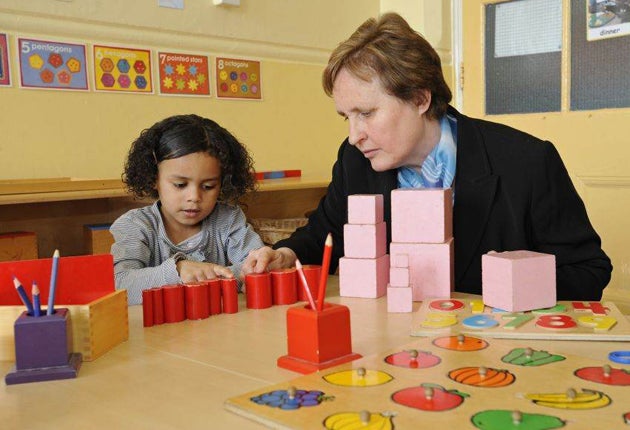
The words look so simple in a paper setting out the task ahead: "Change public face of Gorton Mount". But for a primary school in the midst of an inner city gangland area, the reality takes a bit longer.
Gorton Mount primary school in Manchester is in one of the most deprived areas of the country. It is characterised by "unemployment, high crime rates – especially amongst the youth population where gang membership is high", according to the school's own assessment.
As she opens a drawer to find a piece of paper, the first few items headteacher Carol Powell sees are two toy pistols. "We confiscate them and don't give them back," she said. The school doesn't want its children to associate with guns, even in toy form, because of where it might lead.
Against this background, Ms Powell embarked on her vision for the future, throwing out the traditional methods of teaching and becoming the first state school in the country to convert to the "Montessori method".
It is an approach to teaching developed by Dr Maria Montessori, an Italian physician, in the early 20th century. It places the emphasis on children learning for themselves rather than being taught in classes of 30. Five years on, the school is enjoying the fruits of the new approach. Last summer, there was a 20 per cent improvement in the results of early years tests for the first time. These show how well children are doing as they reach the end of the nursery stage of learning, testing their ability to build sentences, communicate with other youngsters and count up to 10.
"The school was in a terrible state," said Ms Powell. "I had to remove some teachers and change how the children were treated. Even if it was raining, the doors stayed locked until 8.45am so parents would be hanging around outside. I opened the doors at 8am and set up a breakfast club for the kids."
The school was down to 348 pupils when Ms Powell arrived – it now has 461. This increase in student numbers is partly down to the new Montessori approach, which encourages the children to learn at their own pace and develop under their own steam.
In maths, for instance, to learn number skills, children are presented with a series of boxes with the numbers nought to nine marked on them. They are then given small blocks to place in each box: one of the blocks must be deposited in box one, two in the one marked two and so on. If they come to the one marked nine and have less than nine blocks left, they have gone wrong somewhere and must correct themselves. "They can learn from their mistakes," said Ms Powell.
Pam Riley, who is on a placement at the school, has four children but only one – Olivia, seven – has been taught using the Montessori method.
"It gave her confidence as well as being independent," she said. "I think it is a good method of teaching. She seems a lot more grown up for her age than her brothers were."
The experiment is so far only half complete. Each year a new year group is added to those taught using the Montessori method so that eventually, by 2013, it will be used throughout the whole school. The UK-based Montessori charity is planning to open its first-ever "bespoke" primary school financed by the state within the next couple of years, probably in a deprived area of London.
Gorton Mount has shown that the method could go some way towards improving pupils' achievements. Some of the children are already 18 months behind in development when they arrive at nursery school at the age of three, but Ofsted, the education standards watchdog, said in its latest inspection report that the school "makes a real difference to pupils' lives and aspirations".
An assessment of the five-year experiment by the school said that "the child who has received a Montessori education is more independent in thought and action at home as well as school", adding that "their skills in reading, writing and maths are more advanced than older siblings at the same age".
Free-range thinking: The Montessori method
*Devised by Italian physician and educator Maria Montessori (1870– 1952) and first used in the early 1900s, it advocates child-centred learning rather than whole class teaching with the teacher at the front of the class.
*It focuses on developing motor and communications skills, such as strengthening the hand and wrist through exercises to help them write.
*The teacher is seen more as a "facilitator" than an instructor.
*In an ideal Montessori setting, children learn in multi-age groups. The Montessori philosophy believes children develop at different rates.
*Montessori teaches nought- to six-year-olds five categories of learning: practical learning, sensorial, maths, language and culture.
Join our commenting forum
Join thought-provoking conversations, follow other Independent readers and see their replies
Comments