Watching TV 'makes toddlers less intelligent'
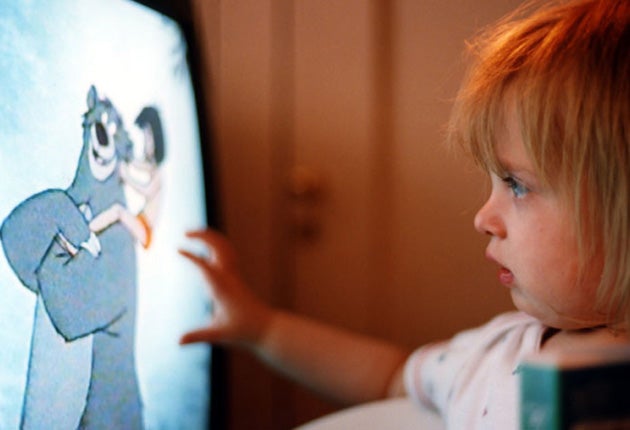
Parents, beware CBeebies: watching television makes toddlers fatter and stupider at primary school, according to new research.
Scientists who tracked the progress of pre-school children found that the more television they watched aged two-and- a-half the worse they were at mathematics, the more junk food they ate, and the more they were bullied by other pupils.
The findings, which support earlier evidence indicating television harms cognitive development, prompted calls for the Government to set limits on how much children should watch. American paediatricians advise that under-twos should not watch any television and that older children should view one-to-two hours a day at most. France has banned shows aimed at under-threes, and Australia recommends that three-to-five-year-olds watch no more than an hour a day. Britain has no official advice.
The latest study, published today in the Archives of Pediatrics & Adolescent Medicine, followed 1,314 children born in the Canadian state of Quebec in 1997 and 1998. Parents were asked to report how much television their offspring watched aged 29 and 53 months, and teachers evaluated their academic, psycho-social and health habits when they reached the age of 10. On average the two-year-olds watched 8.8 hours a week and the four-year-olds 14.8 hours.
The study found that for every extra hour of TV a week the two-year-olds watched there was a 6 per cent decrease in maths achievement (though not in reading), a 7 per cent decrease in classroom engagement, and a 10 per cent increase in "victimisation" by peers, such as teasing, rejection and assault. Each extra hour also corresponded with 9 per cent less exercise, consumption of 10 per cent more snacks, and a 5 per cent rise in body mass index.
Researchers said that pre-school is a critical time for brain development and that TV watching displaced time that could be spent engaging in "developmentally enriching tasks". Even incremental exposure to TV delayed development, said the lead author Dr Linda Pagani, of Montreal University.
She said: "Although we expected the impact of early TV viewing to disappear after seven-and-a-half years of childhood, the fact that negative outcomes remained is quite daunting.
"Our findings make a compelling public health argument against excessive viewing in early childhood, and for parents to heed guidelines on TV exposure from the American Academy of Paediatrics [no TV for children under two]." Several studies have indicated that television harms educational and social development. A New Zealand study which went up to the age of 26 demonstrated that childhood viewing was "significantly associated" with leaving school without qualifications, concluding that the link was clear regardless of early problems or socio-economic status.
The British psychologist Dr Aric Sigman, who has reviewed 30 scientific papers on TV and computer-screen viewing, said that modern television has faster editing, louder sounds and more intensive colours that of the Sixties and Seventies, and thus more dramatically affects young minds. He added that "This Government is happy to give us advice on how many sexual partners we should have, but advice on TV is conspicuous by its absence. Politicians are scared to take on the entertainment industry, because that industry also provides political news."
Join our commenting forum
Join thought-provoking conversations, follow other Independent readers and see their replies
Comments