Clearing might be a harrowing process but don't give up on a degree
A shortage of university places means clearing will be a harrowing process this year. But there are plenty of options for students who are turned away
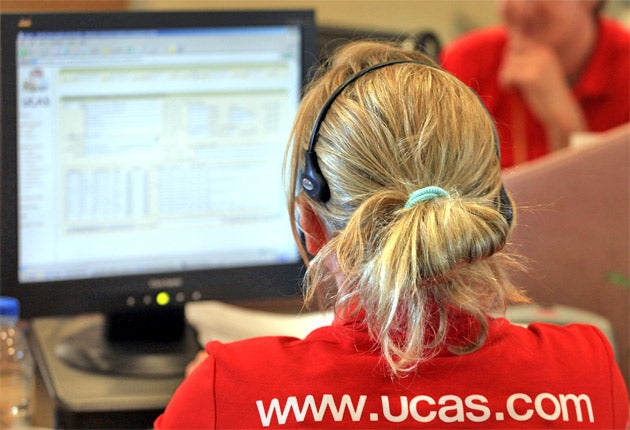
Budding undergraduates need not despair. Although the pressure on university places this autumn is unprecedented, with an 11.6 per cent rise in applications and an expected 170,000 young people unable to get into higher education, there are still opportunities for the energetic and open-minded.
The message is not to give up but to get out and do your research now. Don't wait until Clearing to contact universities that interest you. Get on the internet and look at distance learning courses, such as those at the Open University, think about going abroad to study, or taking a part-time degree. Or, be really daring, and investigate a private university such as BPP, Buckingham, the American Regent's College or Richmond International University – which have plenty of spare capacity and offer intensive tuition and flexibility.
BPP, the new private university college approved by the Universities Secretary David Willetts last month, is running three new undergraduate degrees this autumn, covering accounting, business studies and finance. Although its headquarters are in London, it has 17 centres around the country where you can get face-to-face tuition to supplement the online offerings. Buckingham offers a wide range of courses, across business, law, economics, science and the humanities, and both universities are more flexible in their entry requirements than the state-subsidised universities.
Amazingly, BPP is charging students no more than they pay at most regular universities – £3,290 a year – but is clearly hoping that the cap will come off fees after the review into funding by Lord Browne.
"In order to compete, we need to do this," says Professor Chris Brady, dean of BPP's business school. "Our degrees are exactly the same as any other university's but we have a diagnostic test that we use, as opposed to the UCAS tariff."
Buckingham's entry requirements are more relaxed than those of some universities. To study law or business enterprise, you need three Bs at A-level; for business and science, you need three Cs; and for English, CDD. These grades are not set in stone, but are treated as guidelines, according to Professor Mike Cawthorne, the director of marketing.
Both Buckingham and BPP allow you to take a degree in two years, which means that you save on living costs. Buckingham's degrees cost £8,640 a year over two years, but you can take out student loans to help towards the cost, and there are some scholarships available.
Buckingham has one staff member to every eight students. "The value we are offering is the personal contact, small group tuition, and open access to tutors," says Debbie Millns, the UK marketing and admissions manager. "We're very student-focused."
A more established distance-learning route than BPP is the Open University, which has degree courses starting in September, October and November, as well as at other times of year. There are still places available for all courses starting this autumn; anyone interested should visit the OU website, or telephone 0845 3006090. The OU has extra places in science, technology, engineering and maths this year, and the total cost of an OU degrees is only £3,660 to £4,890 – or nothing if you are living with your parents or earning less than £16,510.
Another distance-learning option for people interested in property is the College of Estate Management, which lays on online degrees and diplomas in construction, estate management and quantity surveying. Awarded by the University of Reading, the degree courses cost a mere £1,860 a year. "It allows you to earn while you learn, so it can be quite cost-effective because you are not paying for accommodation and your debt is less," says Anna Bishop, its marketing manager.
Science students will find themselves better off than their colleagues in humanities subjects because of the extra places funded at universities this year.
Newcastle University, for example, has 150 extra places in chemistry, maths and engineering; students with reasonable A-levels are invited to apply.
The minimum entry requirement will be C grades, says Dr Chris Phillips, dean of undergraduate studies in the faculty of science, agriculture and engineering. "Students have to be able to cope with the course," he says. "It would not be in our interests, or theirs, to take people who were not up to it."
Young people who want to study medicine and who have failed to get in this time round should think about taking, say, a biomedical science degree at an institution like St George's Medical School in London. It will have places available in Clearing next month. From that degree you will be able to jump on to a medical course if you achieve good marks in your exams. To get a place on this biomedical science degree you will need three grade Bs at A-level, including biology and chemistry, or alternatively an Internat-ional Baccalaureate of at least 28 points.
At the new universities that have regularly recruited students through the Clearing process there will be some places available in August, but not as many as in previous years. Beverley Woodhams, head of central recruitment at Greenwich University, says that her university will have small numbers of places in subjects such as English, history and philosophy.
She advises students who are worried about not meeting their predicted grades to look at what might be available, and to check out the grades required and where the universities are located. "Try to visit the institution," she says. "Have an informal tour, talk to some academics and students, and get a feel for the place. It's all about doing your research so that you can hit the ground running on A-level results day next month."
Open to ideas
Felicity Johnson is only 17 but has already signed up for a degree in humanities with history of art at the Open University
"I left school at 16. I was going to stay on and do A-levels, but I was offered a job at Bamfords Auctioneers in Derbyshire as an auctioneer and valuer. So I decided to take that, given the economic situation.
"My parents said that I was fine taking the job but they wanted me to have a qualification, so that I would have something to fall back on later on in life.
"Being an auctioneer is great because of all the wonderful pieces of history I deal with on a daily basis. We deal with anything from snuff boxes to taxidermy, and biscuit tins to roller coasters.
"But I signed up for the degree with the Open University at the age of 16, and am hoping to graduate at the same time as my friends who took A-levels and went to university.
"I do my studying in the evenings mainly; though I can have time off to do my OU degree during the day as well because the work is very erratic."
Join our commenting forum
Join thought-provoking conversations, follow other Independent readers and see their replies
Comments
Bookmark popover
Removed from bookmarks