Ravensbourne college gets ready to move in to eye-catching new premises
For staff and students, it marks the start of a new, hi-tech way of working
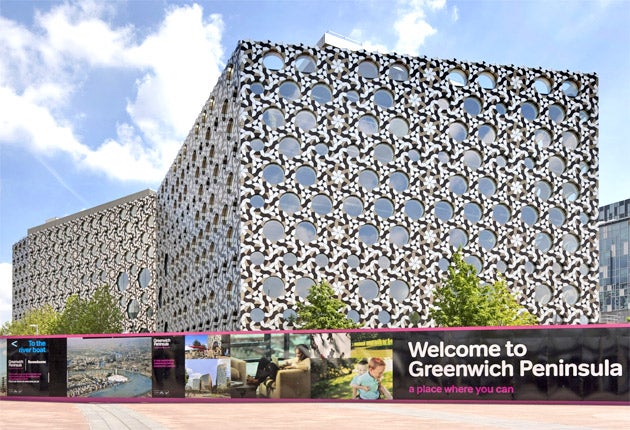
The idea that academics should no longer be allowed to occupy their own offices, or even have their own desks, filing cabinets or bookcases, may seem like taking the cuts too far. But it is actually happening at Ravensbourne, a specialist college of design and communication which moves into its new campus next to the O2 Centre in London in September.
Gone are corridors, offices and paper. In have come open spaces, atriums, technology hubs, design studios and production suites in a fantastic building designed by the edgy architects called Foreign Office.
Efficiency is the name of the game. Lecturers will have desks that they use just for that day, working in open-plan spaces at their laptops with wonderful views of the River Thames, Antony Gormley's Quantum Cloud and the Dome – and will be able to keep their possessions in a locker. "Staff will probably have their own little boxes," the principal Robin Baker suggests tentatively.
The administrative staff will do the same. The top dogs, including Baker, will also work together in an open-plan office without desks or filing cabinets of their own. "I felt I had to lead from the front on this and say that I'm prepared to give up my desk," says Baker. "I think it will work."
According to Baker, the staff are cool about giving up the privacy and all the accoutrements of academic life. But then his staff are different from most lecturers. They are not members of a union, for a start. Ravensbourne does not recognise the University and College Union. The lecturers are all professionals in their fields, with day jobs, and come in to teach part-time in subjects such as sound design, digital photography and film production. "If every member of staff came in [on one day], you would not have enough desks," explains Baker. "So, the idea is that you have a range of staff who are in on different days, doing different things, who work flexibly." This is the brave new world of higher education in the postmodern age. It has been made possible by the hard choice that Ravensbourne had to make seven years ago, between expansion or a merger with a larger institution to ensure its survival. It chose the former.
But, of course, the financial crash got in the way of expansion. Student places are now capped and Ravensbourne is no longer able to expand its student numbers from 1,400 to 2,000 as it had hoped. But it was able to secure all its funding for its amazing new building before the retrenchment began, so this autumn it is moving from Chislehurst in leafy Kent to the Greenwich peninsula in south-east London. Its eye-popping new home is right next to Lord Foster's Dome, and you get a great view of it as you exit the North Greenwich tube station. The building is chevron-shaped with porthole windows and an extraordinary decorative tessellation of the kind designed by the Cambridge mathematician Sir Roger Penrose and reminiscent of something from the Muslim world.
The building came in at £70m, a good deal more than expected. That was because the site was so polluted, having housed the biggest gasworks in Europe, that millions had to be spent making it good. Baker begged and borrowed money from a wide range of sources including the Homes and Communities Agency, the London Development Agency and the Higher Education Funding Council. "We have just about covered our costs," he says. "It was hairy. Everyone wants an iconic building but no one wants to pay for it."
This week the building is beginning to be got ready for students. The studio where students will learn high-definition TV production is being wired up with weird and wonderfully coloured cable in advance of being kitted out with £2.5m-worth of equipment, mostly donated or supplied at a discount. The two atriums, one for students to hang out in, the other for events, lectures and celebrations looked immensely spacious without the furniture they will have shortly.
The new Ravensbourne was designed as an institution that would show the way for others. The plan always was that everyone should be flexible about their use of the space, to meet the criticism that higher education makes inefficient use of seminar, lecture room and studio space.
"By coming here, we said we were going to work differently," says Baker. "From my end I wanted a new institution in a new building, not an old institution in an old building."
They decided, for example, that they would not be able to supply everything students need, but would supply a core of facilities and to help them find the rest outside. So, for example, fashion students who need to learn screen-printing will be able to attend a print centre in Bermondsey where the college has negotiated a deal.
"The space is different, the way we teach is different, the food is different, the way we access what we do is different," says Baker. A small deli for students will serve only healthy food; if they want a portion of chips, students will have to go across the way to the Dome.
Teaching will be different. That means it will be in seminar form, says Baker. "The idea of 'sitting with Nellie', where a member of staff walks round a studio and says, 'What are you doing?', 'How are you getting on?', that will not happen," he says. "We've got to get more efficient and more effective, because the cuts that are coming are going to be quite heavy."
The other pillar of Ravensbourne's work is enterprise and innovation. There will be a floor containing hatcheries and incubators: the hatcheries for hatching out companies, and the incubators for incubating those companies. At the moment, 20 companies are being "hatched" at Ravensbourne's Chislehurst site, all the result of ideas students have for small businesses.
The college intends to incubate 100 companies within a year of opening in Greenwich. The hope is that these small concerns will stay in the locality and help to rescue the area from unemployment. "And we hope we will encourage a number of other companies to relocate here." Those are high expectations, but Baker seems to think he can realise them.
The business of creativity
*Saying that he didn't see many business-savvy music graduates coming out of higher education, music promoter Harvey Goldsmith gave the college £270,000 – out of proceeds from the Led Zeppelin concert that he organised at the 02 Centre – to fund a digital music course. The course starts this October and the idea is to produce a new breed of music producer entrepreneur.
*The degree in music production for media is designed to create opportunities for young people wanting to start careers as musicians and composers in film, TV, video games or interactive media. It will show them how to license and market their work. The Ahmet Ertegun Education Fund has provided the money for state-of-the-art music and sound recording facilities, together with three music scholarships.
"Students will be taught to license and control their creative work, tailor it to a diverse range of platforms and market themselves, says Lance Dann, subject leader for music and media at the college.
Join our commenting forum
Join thought-provoking conversations, follow other Independent readers and see their replies
Comments
Bookmark popover
Removed from bookmarks