Steve Smith: 'Why shouldn't we raise fees?'
As universities await their most radical shake-up in years, the leader of the vice-chancellors' association tells Richard Garner why it's time to face financial facts
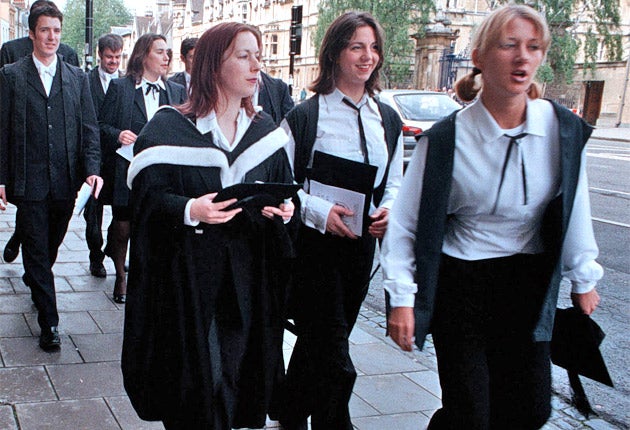
Steve Smith sounds wistful as he contemplates his two-year stint leading the body that represents Britain's university vice-chancellors. "I don't expect much will happen," the vice-chancellor of Exeter University says dryly.
He is, of course, not being serious, but his response illustrates how essential it is to maintain a sense of humour in these straitened times of a squeeze on public spending. Of course, the real answer is that his two-year stint, which reaches its halfway point when he presides over the Universities UK annual conference next week, coincides with a time when there is the prospect of one of the most radical shake-ups to the system that higher education institutions have ever seen.
The entire university world is awaiting the publication of the report of the inquiry into student finance headed by Lord Browne, the former BP boss. The inquiry was set up by the previous Labour government with the support of the Conservatives, and the publication of its report is imminent – probably at the beginning of October. Professor Smith expects it to be out before the comprehensive spending review is published on 20 October. "I would have thought the Coalition Government would have wanted to factor in its recommendations to the review," he says.
He is forthright about what he would like to see from the review. "I would like to see more of a market develop out of this," he said. "Most vice-chancellors accept the need for this. I don't believe this bullshit that there are a small number of elite universities who will charge what they like. The charge has to be internationally competitive, to maintain UK higher education's position in the world." He adds: "I think universities should be allowed to charge differential fees because they're offering differing experiences. Just because you're charging a lower fee doesn't necessarily mean you're offering a lower experience, though."
He is reluctant to talk figures – believing that, if you do talk figures, that will be the headline and the argument behind the philosophy for making the charge will be lost. However, research among students suggests that a rise from the current level of £3,225 a year to £5,000 could still preserve the status quo whereby virtually every institution charges the maximum. Raise the ceiling to £7,000 a year and you will start to get differential charges with, obviously, the most sought-after universities such as Oxford and Cambridge charging the most.
Lord Browne, it is thought, though, may do something more radical than just raising the ceiling. He may allow the most popular institutions to charge more for their most sought-after courses. Professor Smith would like a differential element to be introduced into the fees structure: "Fixing it by just upping the cap [on tuition fees] would simply mean that we'd be back here again in three to five years arguing whether we should let it be raised from, say, £5,000 to £7,000."
However, Professor Smith believes that talk of a free-for-all, with universities charging the full cost of £20,000 a year for some courses, is wide of the mark. He argues that "£20,000 is a completely ridiculous figure."
And he says of raising the fees cap: "I'm not so fixated with the headline figure. My first priority is that higher education needs to be free at the point of delivery, and secondly there needs to continue to be a link between the contribution a student makes and the institution they attend." This is to ensure that any extra revenue made from charges to students is ploughed back into their universities.
He also believes that the lifeline that students from poorer homes have, to ensure that lack of money is no deterrent to applying to university, must remain in place. "There has to still be a needs-blind admissions system," he says. One of the main boasts Labour has been able to make about the introduction of the top-up fees regime is that it has not deterred applications from disadvantaged sectors of society – mainly because they are guaranteed the funding to pay for their place.
While the Browne review will probably be the most pivotal moment of his two-year stewardship of Universities UK, one of the biggest battles he sees ahead is over public-spending cuts. He is, though, worried that ministers may use the prospect of extra revenue from students being recommended in the Browne report as a reason for increasing the level of cuts that higher education is forced to take as a result of the comprehensive spending review.
The other prospect he fears is that Lord Browne comes up with recommendations that the Government finds unacceptable – leaving universities in limbo at a time when they will be relying on the inquiry to produce extra funding streams for them. "The nightmare scenario is that the cuts are deeper than expected, but the Government is unable to come up with any way of funding the difference," he says. "Universities UK doesn't want to see the unit of resource [funding per student] cut. You are then are back to what you had between 1976 and 1998, when there was a 56 per cent reduction in the unit of resource."
Even if the Browne report opens up new methods of revenue – either by increasing interest rates on student fees or raising the cap on fees, it will be some time before universities feel the benefit from any windfall.
"It will be five years before the money comes back," he says. "Any recommended increase can't come in until 2012/2013, and they won't be paying it back until they graduate in 2015/2016." That effectively tightens the spending noose around universities – which have already suffered cuts of more than £500m in their spending this year.
It galls him that, while higher education was singled out for the first significant budget cuts under the previous Labour Government, other countries have seen the economic recession as a time to invest more heavily in higher education.
Despite the depressing economic times, he does not believe universities will be going to the wall and closing over the next few years. "My personal view is there will not be closures," he said. "I think the whole business of closing a university is difficult. You've got students on the courses, and alumni. People will be on the telephone all the time [campaigning against the closure]. So I think mergers, yes, could be on the cards – although they do not necessarily save money. You might do it to form a very strong organisation if two institutions aren't doing very well. I think there is also going to be a lot of regional co-operation, to make sure certain subjects are available regionally. But I'm not one of those people who think that institutions will be going to the wall."
Steve Smith is no stranger to the political world in which he is now mixing. In June 2007, he was appointed to then prime minister Gordon Brown's National Council of Excellence in education, set up to provide advice about the strategies and measures necessary to achieve "world-class education performance" at all levels in the UK.
Recently, too, he was also a member of the team that David Cameron assembled to take to India to promote economic ties between the two countries. "I'd like to tell you the heroic story of how I grabbed the Prime Minister on the plane over to tell him about the importance he should attach to higher education," he said. "The truth is, I didn't have to – he came out with it without being prompted. He was asked 'What is it that the British Government can bring to the table in the 21st century?' and his answer was 'a group of world-class universities'."
It is moments like these that give him confidence in the importance attached to his sector in Coalition Government circles; that, and the appointment of David Willetts as Universities minister – a man widely considered by all sides in the world of higher education to be making a thoughtful contribution to the debate over its future.
Willetts is due to address the Universities UK conference next Thursday – the same day that Professor Smith makes his keynote address. Just how far the two are capable of singing from the same hymn sheet will become clearer after that.
A brief history of university funding
1945
Most local authorities paid students’ tuition fees and provided them with a maintenance grant.
1962
An Education Act put this on a legal footing, with all full-time students entitled to receive a maintenance grant.
1990
The Student Loans Company was set up to provide students with additional help towards living costs, through low-interest loans. Maintenance grants were frozen.
1997
A Government inquiry by Sir Ron Dearing recommended that students should pay towards the cost of their university education. Labour introduced tuition fees of £1,000. In addition, maintenance grants were axed for all but the poorest students.
2004
A new Higher Education Act introduced the concept of top-up fees, with universities free to charge students what they liked up to a ceiling of £3,000. Almost all charged the maximum.
2009
The Government sets up an inquiry, under former BP boss Lord Browne, to review student finance. His report will be published next month
Join our commenting forum
Join thought-provoking conversations, follow other Independent readers and see their replies
Comments
Bookmark popover
Removed from bookmarks