Are Finnish schools the best in the world?
They have no uniforms, no selection, no fee-paying and no league tables. Yet Finland's education system consistently tops global rankings. Richard Garner finds out what we can learn from them
The task is as hard as weeding out the brightest youngsters for places on Oxford and Cambridge Universities' most popular courses. There are 16 candidates for every vacancy and somehow the 2,000 applicants have to be whittled down to 120 by the time the course starts. We are not talking about law and medicine at Britain's most prestigious universities, though. This is Finland and the applicants are desperate for a job in what is the most sought-after profession in their country: teaching.
Finland is the country that has topped the international league table of the developed world's education systems for almost all of the past decade. And England's Education Secretary, Michael Gove, has been taking a close look at its policies to see if there is anything he can glean from them to improve standards over here. Finland's top-level ranking is based on its performance in the PISA (Programme for International Student Assessment) tests of 15-year-olds around the globe in reading, maths and science. It is published by the Organisation for Economic Co-operation and Development.
Professor Jari Lavonen, the head of the Department of Teacher Education at the University of Helsinki, is the man with the enviable task, in some eyes, of whittling down the pack. He is in no doubt as to how Finland has got to this position. "We decided all teachers should have a master's degree – putting teaching on an equal footing with law and medicine," he says. "Teacher education is therefore very attractive." Figures showed that the highest-flying youngsters then started flocking to the profession because of its new-found prestige.
The applicants are all given a book to read before being grilled on their understanding of it. Then the 300 top performers are interviewed before the remaining 120 are offered places. "We want to find out how suitable a person is for teaching," he says. "Last year, it was more difficult to come on to a primary-education programme than to go to medical school. The competition was more heavy."
Mr Gove has already said he would like to go down the Finnish path. A common theme among three of the top-performing nations – Singapore, South Korea and Finland – is that they all attract the best talent into the profession by setting high standards for recruitment. Mr Gove's answer to this is to limit entrance to the profession to those who have better than a third-class degree. He has come in for a fair amount of criticism here, with teachers' leaders arguing that it would prohibit people such as the Conservatives' own maths guru, Carol Vorderman, from entering the profession. The brightest people in their subject area may not always be the best communicators in the classroom, so the argument goes.
Professor Lavonen is wary of the idea that foreign governments can "cherry pick" parts of the Finnish education system and ignore the rest. There is, he argues, a second part of the equation: the introduction of a free compulsory education system for all, which goes hand in glove with the recruitment process to create a successful education system. It is illegal to charge fees in the Finnish education system, so even those schools that are run privately take their funding from the state. Its schools are comprehensive in that there is no selection of pupils.
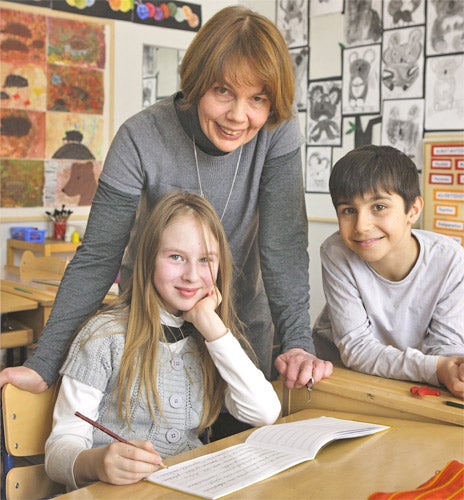
They are less formal and more relaxed than schools in the UK. The man in jeans and an open-necked shirt who greets us at the Taivallahti comprehensive school in Helsinki (an all-in school for seven to 16-year-olds) turns out to be the principal, Hannu Kosonen. His pupils – in common with those in the rest of Finland – do not wear a uniform. Discipline appears good. No one is photographing the teacher to put her picture on YouTube.
The teachers are not beset by targets, in fear of inspections or how well their schools do in league tables. There are simply no league tables or inspections. "They are academics and well trained, so we trust them," says Professor Lavonen. "This is an important feeling: they don't need any inspection. Also, we don't have a system of national testing. The teachers are trusted to assess their own pupils." This is presumably because there is no pressure to tweak the results to do well in league tables.
Class sizes are smaller than in the UK. Mr Kosonen limits them to 20 in the first two years of schooling and the sixth and seventh year (12 and 13-year-olds). They are also mixed ability, with educators believing the teachers are well-enough trained to cope with a wider range of ability in their classes. If pupils fall behind, a second teacher can be sent in to help them to catch up.
Of course, it may help that Finland as a country does not have the vast gap in household incomes of the UK, and so social mobility is not such an issue over there. The gap is just beginning to widen, though, so it may be something it has to look out for.
Mr Kosonen also points to another feature of Finnish life for producing the country's brilliant reading results: the Government's decision to ban the dubbing of all foreign films and television shows. This means youngsters can watch shows such as Dalziel and Pascoe and Anne Robinson's The Weakest Link in all their English glory in their homes of an evening and get to grips better with the language.
A visit to last month's teachers' union conferences in the UK showed a flurry of concerns about headteachers "dropping in" to classrooms to check on their teachers' standards. Mr Kosonen does this, too, and has asked each member of his staff to come up with an idea for developing their teaching. He does not see himself as an inquisitor, though.
Nina Koskinen, a primary-class teacher at the school, says: "Teachers do like to get feedback on what they do, but it is totally different over here to the UK. One of the things here is that principals should be like coaches." She says of the English system of testing and inspection: "What would be the advantage of that? It really seems to be something that gives you pressure in terms of paperwork and all that."
The differences between Finland and the English system do not stop with compulsory schooling, though. After the age of 16, youngsters decide whether they opt for an academic or vocational schooling. There is also still a divide at university level between the academic universities and the polytechnics (as the government calls them) or the universities of applied science, as they style themselves. Oh, and there is the little matter that university tuition is still free for home and EU students. A UK youngster would not have to spend a penny on tuition fees in Finland. The country is experimenting with charges for overseas students but only a handful of universities are taking part in this pilot.
Thomas Wilhelmsson, the rector of Helsinki University, ranked in the world's top 100 universities, says: "The most that has been discussed is whether we should charge fees for overseas students. Free education is seen as a very central part of the Finnish welfare-state system. The British example is a scary example. If you take tuition fees [from students], you will withdraw some amount of basic funding for the system."
This is a very different system to England's, and it would be fair to point out Finland has to deal with a school population of just under 600,000, compared with the seven million in England and Wales. But Finland's schools and universities have been besieged by Germans, Chinese, Thais, Spaniards and Austrians desperate to find out the system's recipe for success. It remains to be seen how much of the Finnish education system we will seek to ape (teachers over here would love Mr Gove to adopt the whole package).
A passing thought occurs, though, as a documentary about how Finland coped with last winter's snow flashes on to the television screen. At one stage it was 80 centimetres deep, but the under-floor heated sidewalks and streets soon had it cleared. Ice-breakers made sure the runway at the airport was cleared after 30 minutes. Maybe we should send someone over to study that as well.
KEY FEATURES OF THE FINNISH EDUCATION SYSTEM
All teachers must have a master's degree before they start teaching.
Compulsory schooling starts at seven with voluntary play-based kindergarten for younger children.
No national testing, inspections or school league tables. The government looks at an 8 to 10 per cent sample of pupils' work to check on performance.
Pupils transfer to either an academic or a vocational school at the age of 16 after nine years of compulsory schooling.
No university fees for home or EU students. Pilot of fees for overseas students from outside the EU.
KEY FEATURES OF THE ENGLISH SYSTEM
Teaching is an all-graduate profession but there are moves to allow free schools to employ unqualified teachers.
Compulsory schooling starts at five.
National tests for 11-year-olds with school league tables based on the results.
Secondary-school league tables are based on GCSE and A-level results, plus absence rates.
Students face fees of up to £3,000 a year in English universities – going up to a maximum of £9,000 in September 2012. Non-EU students can be charged full-cost annual fees of £28,000.
Join our commenting forum
Join thought-provoking conversations, follow other Independent readers and see their replies
Comments