Faith in the system: Should Muslims be allowed their own assemblies?
In some schools religious differences have become a flashpoint, with parents demanding special assemblies or that their children be exempt from detention. But Steve McCormack finds out how multiple faiths can be a virtue
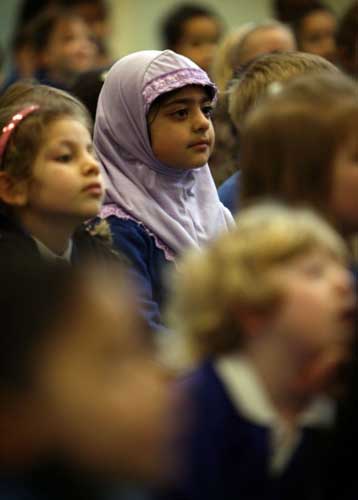
When Julia Robinson became head of Meersbrook Bank Primary School in Sheffield last year, she inherited a situation where, once a week, a group of Muslim pupils held what amounted to their own assembly, while the rest of the school gathered in the hall.
Deciding that this was divisive, she announced she was scrapping the Muslim gatherings, which provoked fierce opposition from a small number of Muslim parents. But before the matter could be resolved, Robinson left on sick leave, and has now resigned permanently.
Earlier this month, after negotiations between the acting head, governors and parents, a compromise was agreed. Some Muslim pupils will continue to withdraw from assembly for a meeting of their own. However, this will, from now on, be called a "study group" rather an "assembly".
That may be an extreme case of religious differences becoming a flashpoint in school. Many other schools manage to accommodate a big mix of pupils under the umbrella of a broadly Christian assembly. Grange Primary School in Ealing, is one – and there isn't a whiff of the kind of discord evident in Sheffield.
On a Monday in February the theme of its assembly is the Christian period of Lent. "This was the time when Jesus went into the desert for 40 days so that he could have no distractions," Karen Merison, the deputy head of Grange Primary, tells a gathering of children kitted out in hijab scarves and a Sikh topknot. She asks if anyone can explain the meaning of the word "fast," prompting her audience to note that Muslims also have a time of the year when they fast.
This is the day before Shrove Tuesday, so light relief comes in the form of some artificial pancake tossing, before Merison asks for eyes shut and a period of silent thought. "In your minds, think of how you might turn over a new leaf in some way, perhaps by being a better friend, doing more exercise or not eating as many sweets," she says.
At the second assembly, the approach is much the same. Addressing the older children, some with braided and dreadlocked hair, others with Muslim head-scarves, the school's head, Hans Formella, describes Lent as "a time to stop and think about things you can do for someone else". Over the year, Formella's aim is to mark all the main religious festivals and to give the children encouragement to lead productive lives and get on with everyone.
Formella is adamant that he would never allow any one religious group to hold an assembly of their own – as the Muslims were doing in Sheffield. "If you do that, you start marginalising them and it becomes separatist," he says. "That's not what we are about here. We try to get them to recognise and respect each other's faiths."
But there are occasions when some Muslim parents ask for special treatment, he acknowledges. "At Christmas, the songs we sing get more overtly Christian, and do mention Jesus," he says. "That is when we get requests for children to be withdrawn from assemblies, which for a school of our size does not cause a big headache."
But other Muslim families embrace Christmas traditions with open arms. "Two years ago, at our Nativity play, Mary was played by a Muslim girl," Formella says. "And her mum had tears in her eyes!"
Not all schools have such harmonious relationships with parents. The Sheffield case is one example of a disagreement escalating seriously, but there are plenty of other cases where teachers are uneasy at the way Muslim parents try to influence what happens in school.
It's a topic of such sensitivity that few will speak publicly, so, from here on, names are being withheld. But teachers are quite clear that Muslim parents do sometimes use their religion to exempt their children from unpopular activities.
"Some Muslim parents write letters to say their children can't do detentions after school because they have to go to the mosque," says the deputy head of a secondary school in the Home Counties. "And some of them are the really badly behaved ones, too."
Another teacher from a secondary school in Essex, complains about the way that Islam, and other faiths, are allowed to intrude on school life. "Every year we see some 15- and 16-year-old girls just disappearing from school," she says. "Everyone knows it is for arranged marriages. But no one makes a fuss. If they were from other families, we wouldn't let it happen."
Other parents insist their children can't do anything active, or go on school trips, during the month of Ramadan, because they are fasting during day-time. "This isn't good for their education, and I've tried explaining my understanding that it's not compulsory under Islam for children to fast during Ramadan, but they won't budge," says the head of a primary school in outer London. "I get the impression that fasting is treated as a badge of honour by these children and their parents."
When this head was asked by Muslim pupils to provide a special prayer room during Ramadan – something that would have required a member of staff to supervise – he refused, arguing that his answer would be the same if Christian children wanted a similar arrangement during Lent.
Occasionally, tensions over faith issues can lead to unsavoury scenes, as happened just before Christmas at a London C of E primary school, where 10 per cent of the pupils are Muslim. The Muslim parents of one boy had insisted he be exempt from taking part in the Nativity play, but his teacher thought it would do no harm for him to attend the rehearsal in church.
"At the end of the school day, when he was picked up from school by his father, a furious row broke out," says the teacher. "The father became angry that his son had even crossed the threshold of the church. He shouted at his son, who broke down in tears, and then marched into the head's office to loudly berate him for allowing the boy to set foot in the church."
Incidents such as this reflect a hardening of attitudes among some Muslim parents in the past few years, teachers believe. This includes parents not allowing children to play some musical instruments and preventing girls from taking part in swimming lessons.
But it's not only Muslim parents who make life difficult for head teachers. At a school near the outskirts of London, a head teacher recently found himself under intense pressure from parents of Sikh and Hindu pupils, because he allowed Muslim children to use a hut in the playground for prayers on Friday lunchtimes, under the supervision of a parent volunteer.
"When this news got out, some of the Sikh and Muslim parents were up in arms," he says. "It had an incendiary effect. I was having people coming into school and talking to me for an hour about their unhappiness at this decision. They were very hostile, but I did not change my decision."
Join our commenting forum
Join thought-provoking conversations, follow other Independent readers and see their replies
Comments
Bookmark popover
Removed from bookmarks