Switch off – and help the planet
A school in east London is leading a campaign to save energy in buildings and teach about global warming. Will others follow?
Although weather-beaten and a little rough at the edges, Langdon School's 1940s art deco lines retain a certain charm and aesthetic appeal. But these brown-brick, secondary school buildings were certainly not conceived with energy conservation in mind. In fact, the opposite appears to be the case; the metal-framed, single-glazed windows are hardly the most thermally efficient, and the windswept walkways between the buildings, with the classroom doors opening to the elements many times a day, seem designed specifically to maximise heat loss in the winter months.
So it is perhaps appropriate that this comprehensive on the eastern outskirts of London, home to 1,800 pupils, is being used to spearhead a national campaign to persuade schools to reduce their energy consumption, specifically their electricity bills.
The campaign, called PowerDown, is being run by ActionAid, the charity that champions, among other things, rural Third World communities whose existence is threatened by climate change.
ActionAid wants UK schools to reduce their electricity consumption and thereby their contribution to global warming and, while they're at it, to educate new generations of children on the link between energy use in rich countries and natural disasters caused by climate change in poor ones.
On the face of it, there's lots of potential at Langdon to save money in this area. Of its annual budget of £1m, £250,000 goes on energy bills, of which £80,000 is swallowed up by the electricity that powers the lights, computers, copiers, interactive whiteboards and countless bits of technology in the classrooms.
As a first step, ActionAid, working together with the technology firm DIY Kyoto, has installed a meter at the school, linked to the main electricity cables entering the school site. The meter monitors, second by second, the electricity being used by the whole school. The prototype meter is similar in principle to gadgets already used by homeowners to monitor their domestic electricity use.
It is situated in the school's IT control room, just down a corridor from the foyer. Since its arrival a fortnight ago, it has been watched like a hawk by the school's head of e-learning, Duncan Stickley.
"We're on a steep learning curve," he explains as he shows me the inconsequential-looking, A5-sized grey box attached to the wall. As he points to it, the red digital display changes from 217 to 223; evidence that at that very moment the school's total combined electricity usage has jumped from 217 kilowatts to 223 kilowatts. It means that somewhere on the site, someone has switched on the equivalent of about 50 computers, a few electric kettles or a couple of ovens. "How is that happening? I wonder what that is," Stickley asks out loud, scratching his head.
On the computer screen next to the meter, he calls up graphs representing the school's electricity use over the previous week or so. Peaks and troughs clearly demarcate day and night, and weekends show up as extended periods of low consumption. But not zero consumption; when the school is empty, the meter still records electricity usage of about 80 kilowatts.
The questions are: where is this power being used; and is it really necessary? The school has committed itself to finding the answers, and using the experience as a learning tool in lessons. "Something as real as this is much easier to teach than anything you can make up," Stickley says.
At an informal after-school meeting last week, teachers from a few of the school's departments got together for a fruitful brainstorming session on how the project could be used in lessons. Among the early ideas are: pupils keeping weather logs for geography and comparing them to the levels of electricity usage shown by the meter; science lessons that study the link between energy usage and carbon dioxide emissions; and investigating the exact wattages of all the appliances in the school.
And the bigger picture – the global dimension – is perfect for use in citizenship lessons. "As a teacher, it's my job to move beyond the science to the impact," says the citizenship teacher Amir Shah, who plans to use the school's expenditure on energy as a case study for the new financial literacy element of his subject, and to set his GCSE students a project to do an audit of electricity use at their own homes.
Overall responsibility for the school's participation in PowerDown is carried by the assistant head, Vince Doherty, a passionate believer in encouraging pupils to see links between their own lives and those of their contemporaries overseas.
"If you want children to look at the world, help them to look at Langdon School first," he reasons.
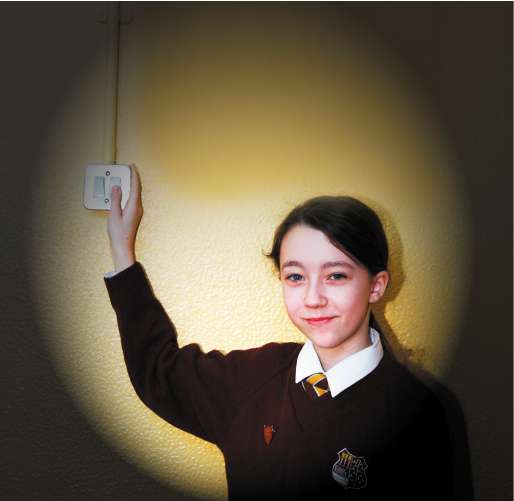
Some of Langdon's pupils star in a short DVD produced by ActionAid to promote the Power Down campaign. It features dramatic shots of an Indian boy, up to his neck in water, whose home was swept away in that country's floods last year, an event linked directly to energy usage in the Western world. The action then switches to Langdon's corridors and classrooms, with pupils zealously turning off light switches, sockets and electronic whiteboards, and exhorting their audience to "PowerDown!" A pupil in Langdon's maroon uniform is seen arriving home and persuading his mother to fit an energy-efficient light bulb to a table lamp in the living room.
One of the pupils featured in the film, Niall Doherty, 12 (no relation to the assistant head), is already implementing the PowerDown message during the school day. "Sometimes, when I'm in a lesson, I see our class is full of light from the sun outside but we still have the lights on. I said it once to my teacher and he told me to turn the lights off," Niall says.
This approach is likely to be more officially endorsed by the school as it tries to encourage pupils to drive the PowerDown campaign forward themselves.
"We might, through the school council, empower energy monitors to go round the school and challenge teachers to turn the lights off," says Andrew Dodd, who, as the school's business manager, knows more than anyone the size of the energy bills arriving at the office. On the day I visited, he was clutching the electricity bill for December, when the school was open for only two and half weeks, which came to £6,708.30.
Over the coming weeks, the school will analyse the data from the new meter more closely, and, with the help of pupils, conduct more detective work to identify where savings can be made. After that, a formal energy policy will emerge.
In the meantime, a number of informal measures have already been instituted, including: an appeal to teachers to switch off all computers when not in use; a policy of opening blinds to let natural light into classrooms when possible and switching off electric lights; switching off, or disabling, alternate fluorescent strip lights in some corridors; and escalating the replacement of old-style computer monitors with more energy-efficient flat screens.
Doherty's aim is to reduce Langdon's electricity spending by 10 per cent over the next year. If he and the children succeed, it will be a valuable learning experience – and a means of producing £8,000 more to spend on books rather than energy bills.
The PowerDown campaign
PowerDown is ActionAid's new campaign to persuade schools and their pupils to see the link between their electricity consumption and the climate changes that are causing human catastrophes around the world.
One thousand schools in the UK have already shown interest in taking part by sending off for the DVD, posters and sheets of small PowerDown stickers for positioning next to light switches and sockets. Only Langdon School has received the sophisticated meter and its supporting software.
The campaign's website (www.actionaid.org.uk/powerdown) has lesson plans and downloadable activity sheets designed to help teachers use related topics in their lessons. In the longer term, teachers at Langdon will use their experience as the lead school in the PowerDown campaign to design a tailor-made toolkit for teachers to get the most out of the initiative in education terms, as well as to save money by reducing electricity bills.
"Making it easy for schools to do this in a joined-up way is the grand design," says ActionAid's head of schools and youth, Janet Convery.
Calculating the cost of electricity:
Whether at school or at home, we pay for electricity according to how many units we use. A unit is equal to 1,000 watts of power being used for an hour. The time an appliance takes to consume a unit depends on its wattage. So, a 100-watt bulb takes 10 hours to use one unit of electricity, but a 2,000-watt kettle uses one unit in half an hour. A 10,000-watt hot shower eats up a unit in six minutes.
Join our commenting forum
Join thought-provoking conversations, follow other Independent readers and see their replies
Comments
Bookmark popover
Removed from bookmarks