The six secrets of a happy classroom
Professor Dylan Wiliam is convinced his simple but unorthodox ideas can help children to learn better. So he put them to the test for a term in a real class – with extraordinary results. By Gerard Gilbert
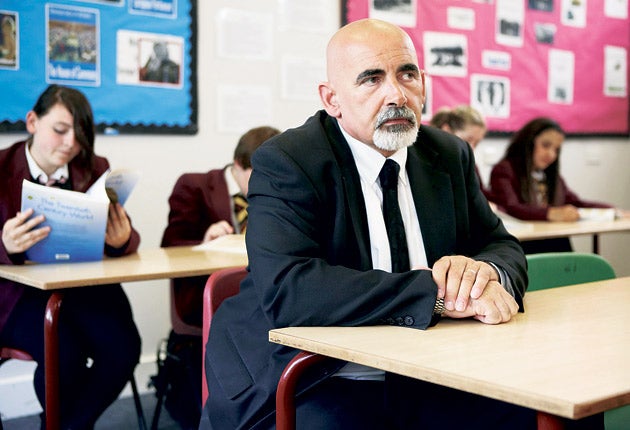
Hands up who knows one of the most common, time-honoured and, it is now being argued, detrimental teaching methods used in schools? That's right, person bobbing up and down excitedly, waving your digits in the air. It's the hands-up habit itself.
Apparently it is the same minority of top pupils, usually sitting at the front, who raise their hands to answer questions, while the majority switch off and opt out. According to the education expert Professor Dylan Wiliam, this ingrained, almost sacrosanct, classroom habit is widening the achievement gap in our schools. "Only a quarter of pupils consistently put their hands up," he says. "They can't wait to take part, while others switch off completely."
Some sort of randomisation process is required, Wiliam long ago decided, and his unorthodox solution, as demonstrated in a new BBC2 series, The Classroom Experiment (part of the channel's very welcome School Season of programmes), is to write the pupils' names down on lollipop sticks, the teacher then pulling them at random from a pot. No one can hide – everyone is potentially in the firing line.
The lollipop sticks form just one of six radical, but lo-tech, ideas (see box, right) that Wiliam was licensed to unleash on a mixed-ability class of 12- to 13-year-olds at an average Hertfordshire comprehensive, Hertswood School in Borehamwood, over the course of one summer term. The aim was to involve every pupil in the lesson. "Our education system was designed to cater for everyone, regardless of background or ability, but we still seem to struggle to keep everyone engaged," Wiliam says.
A former maths and science teacher turned teacher-trainer, Wiliam, along with Paul Black, wrote the seminal book on classroom assessment, Inside the Black Box. And as (until recently) the deputy director of the University of London's Institute of Education, Wiliam has had the ear of governments. His vast experience of teaching methods (he also spent three years in the United States) make him rather more expert in the field than, say, Gareth Malone – the choirmaster recently seen on BBC2 attempting to improve literacy levels in male primary school boys.
"The programme is a crystallisation of things I've been doing for a long while," Wiliam says. "When Paul Black and I worked with teachers in Oxfordshire and Kent in the late 1990s, we realised that research was presented to teachers in the form of bland platitudes... they were just too general to be applied in real classroom settings."
Hence the lollipop sticks. Oh, and the traffic light cups. The latter are painted red, amber and green (obviously) – students then put a cup on their desk to inform the teacher whether they understand what they have just been taught (green), whether they are uncertain (amber), or whether they haven't the foggiest (red). It's all very lo-tech and, importantly in these straitened economic times, low-budget.
"People are always pushing new technology and expensive ways of raising students' achievement, but the fact is that this is something that every school could do if it was minded to," he says. A further innovation – small, hand-held whiteboards for each student – came as a direct result of an unforeseen problem with the lollipop sticks. For deprived of the chance to show off their brilliance in front of the class, the regular hands-up brigade were getting frustrated, and had even started to become disruptive.
"The high-achieving girls were really struggling," Wiliam says. "They're used to being in the limelight, and that's causing them some pain." And what's more, used to putting their hands up only when they knew the answer (which was, admittedly, much of the time), the random lollipop method was putting some of the high achievers into the unaccustomed position of sometimes not knowing the answer.
"It's kind of embarrassing, because I've got this reputation for being smart", says one, Emily, after she has been caught out marking her disapproval by furtively removing her lollipop from the pot. Anyway, the idea with the mini-whiteboards is that the whole class simultaneously scribbles their answers before displaying their boards to the teacher – and each other.
"I think mini-whiteboards are the greatest development in education since the slate," Wiliam says. "You can get an overall view of what the whole class think." And once they got used to using them, the students in the film also approved – except the dissident who wrote "can't be arsed" on his. "I want a classroom culture where it's OK not to know the answer," Wiliam says.
Another innovation illustrated in The Classroom Experiment isn't in itself radical – even if its actual implementation in state schools would be something of a revolution – and that is getting the students to come to school 15 minutes early each morning for a PE lesson. Indeed, a growing body of research in the US shows that a short burst of exercise every morning can have an impact on students' attention and learning throughout the day.
But getting students into school by 8.30am, and changed into their gym kit, is going to be a walk in the park compared with another part of our current education system that Wiliam wants to change – and that is schools' (and therefore pupils') obsession with grades. "I don't get it unless I see my grade," says one frustrated pupil, thus illustrating Wiliam's point. The professor's own mantra is "comments, not grades".
"We're a nation hooked on grades and national curriculum levels," Wiliam says. "Kids don't work for things unless they get levels in them. It's absolutely crazy – we're like drug-pushers... we've got our kids hooked on levels and it's going to be very hard to get them off."
So much for the students. But if Wiliam's innovations are to succeed, they need to be applied with vigour, imagination and consistency by the teachers – and, as Wiliam well knows, teachers often feel they know best.
"Most teachers teach these lessons and they think the students understand it, and therefore they don't want to know that it didn't work... it's almost ostrich-like behaviour. What many of these techniques reveal is that despite your brilliant lesson, the kids didn't get it – and I think every teacher should want to know about that."
Indeed, one of the most interesting sections of an interesting series concerns the maths teacher, Miss Obi, whose somewhat inconsistent application of the new methods is leading to chaotic lessons and frustrated teacher and pupils. Wiliam takes Miss Obi aside, and persuades her to have her lesson assessed by two of her less high-achieving pupils, Katie and Sid, who are both visibly empowered by the process. "She took it on board quite well," Sid reckons, while realising, perhaps for the first time, that "it must be quite hard being a teacher".
"One of the greatest resources is untapped – the students themselves," Wiliam says. "I don't think teachers should be afraid of asking the students for advice." The idea is controversial, however, some believing it undermines the professionalism and authority of teachers. Not so the head at Hertswood, who, starting this academic year, has decided to unroll all Wiliam's innovations across the entire school.
Wiliam himself thinks that his simple and effective – if teachers persist, that is – ideas could be unrolled into every single one of the nation's 300,000 classrooms – and that lollipop sticks and traffic light cups could eventually be as ubiquitous as chalk and blackboards were in earlier times. "It's scalable across the whole country, and it doesn't require people like me to come in just to keep the change going."
And what about those bright things who were always the first to put their hands in the air? "I listen more," says Emily, previously dismissive of her less engaged classmates. "People are smarter than I thought."
'The Classroom Experiment' begins on BBC2 on Monday 27 September
Something we can all learn from: how to improve teaching techniques
* Stop students putting their hands up to ask questions – it's the same ones doing it all the time. Instead introduce a random method of choosing which pupil answers the question, such as lollipop sticks, and thus engage the whole class.
* Use traffic-light cups in order to assess quickly and easily how much your students understand your lesson. If several desks are displaying a red cup, gather all those students around to help them at the same time.
* Mini-whiteboards, on which the whole class simultaneously writes down the answer to a question, are a quick way of gauging whether the class as a whole is getting your lesson. This method also satisfies the high-achievers who would normally stick their hands up.
* A short burst of physical exercise at the start of the school day will do wonders for students' alertness and motivation. As any gym addict or jogger will tell you, it's all about the chemicals released into the brain.
* Ditch the obsession with grades, so that pupils can concentrate instead on the comments that the teacher has written on written classwork.
* Allow students to assess the teachers' teaching – they are the ones at the sharp end, after all. Letting pupils have a say is empowering and, if handled constructively, is highly enlightening.
Join our commenting forum
Join thought-provoking conversations, follow other Independent readers and see their replies
Comments
Bookmark popover
Removed from bookmarks