Tweeting vs reading: The row over technology in primary schools
A government adviser wants English primary schoolchildren to be the most hi-tech in the world. But opponents worry that skills such as tweeting and blogging might come at the expense of the basics.
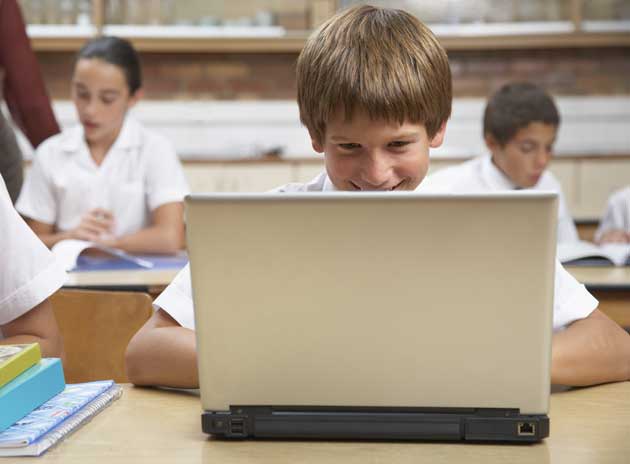
If the authors of the review of the primary curriculum have their way, children under 11 could shortly be having lessons in tweeting and blogging in a determined effort to ensure that British schoolchildren are the most technologically up-to-date in the world.
An early draft of the report by Sir Jim Rose, the former chief inspector for primary education who is carrying out a root and branch review of primary education for the Government, puts technology at the heart of the curriculum. It has annoyed a lot of people because it appears to be leaping on the latest trends, apparently at the expense of encouraging children to enjoy reading. It may seem crazy to concentrate so heavily on technology when it is usually the children who teach the parents about things like Twitter, but Sir Jim will find some support next week in a report from the University of Bristol.
According to Angela McFarlane, the professor of education who conducted the study, pupils who master 21st-century communication technology and social networking are better at organising their studies, use information from different sources more effectively and often write more extensively through the use of word processing. But some children are missing out because of the myth that anyone under 25 can miraculously and spontaneously pick up the latest technology, she cautions. The study into the use of hand-held computers – mobile phones with internet access and word processing tools – found one in five pupils did not fully understand how to use them because they had no one at home to help them.
Messages on Twitter are called tweets and can be posted on the internet or sent to mobile phones and are limited to 140 characters. Famous tweeters include President Barack Obama before he was elected and Jim Knight, the Schools minister in Britain. But encouraging the use of tweets in schools has been dismissed by some commentators. Children know more than their parents and teachers about social networking on the internet and already think a novel is a life sentence, says Phil Beadle, the award-winning English teacher and star of the Channel 4 series The Unteachables.
"Proposing that Twitter should be taught in primaries is an imbecilic attempt to be down with the kids," he says. "Learning how to use Twitter and Wikipedia will take five, maybe 10 minutes; there should be more thought and research into whether we really want to be promoting in schools a means of social networking that limits the amount of characters one can use. Using Twitter to teach children all that communication must, by definition, lack depth of any sort, and is plainly mad. Besides, it is likely that Twitter, in the faddish world of social networking, will no longer be of any interest to anyone by the time the plan to teach it is implemented."
David Laws, the Lib Dems schools spokesman, says that any change in the review which is rearranging the present 13 compulsory subjects in primary schools into six broad areas of learning, must not dumb down the curriculum.
"One in five children currently leaves primary school without reaching the expected level in reading and writing," he says. "Any reform must not prioritise headline-grabbing gimmicks over the need to get the basics right. Of course it is vital that children are able to use and understand modern technology, but they must have the basic knowledge and skills enabling them to do this properly."
There is a naive assumption that all children are digital natives and learn to use computers like they learn to walk, says David Whyley, the head teacher consultant on learning technologies in Wolverhampton, where pilot schools have been experimenting with hand-held computers in the classroom. "You have to teach them. Not all of them find it easy but it should be at the heart of what they do in school."
Children in the pilot primaries have already mastered most of the material covered in ICT lessons in the first stage of secondary school, he says. "I think the primary review is right to suggest bringing ICT into primary schools so long as it is treated as a learning tool and not as a separate subject."
Supporters of hi-tech primary classrooms sneer at the "back to basics" brigade, saying schools should be looking forward, not burying their heads in tradition and ignoring the advances in learning brought by computers and the internet. You need both, says McFarlane."It is very important that if people are going to be socially and economically successful they are eloquent in the old forms of communication as well as the new ones. But the reason it is important to introduce children to social networks, of which Twitter is the latest phase, is that they have to be fully aware of what they are doing and how to use them safely."
Her study followed the progress made by children in primary and secondary schools which have introduced hand-held devices – phones with word processing and internet capability – in Bristol and Wolverhampton.
It found that around 20 per cent of pupils in Years Five to Seven hardly used the devices for researching and planning their work. "When we talked to them about this, they said it was because they didn't really know how to use them. These are the ones who are not getting support from friends and families. If we don't pick this up in school, these will be the ones missing out, because they don't come from backgrounds where a lot of people are using the technologies," she says.
Her study found no evidence that the children were reading less since being given the devices. "New cultural processes very rarely replace the old ones," she says. "We didn't stop going to the theatre when cinemas were built and we didn't stop going to the cinema when television was invented. There was some evidence that it helped boys who were reluctant readers because they were more likely to read digital text such as e-books. After all, how many 16-year-old-boys read Jane Eyre?"
Mick Brookes, the general secretary of the National Association of Head Teachers, believes that we have to enter the world that our children inhabit. "If I want to know something, I look it up in an encyclopedia," he says. "Children go straight to Google. We have to recognise that their cyber communities are important to them and we have to teach them to use 21st-century technology safely alongside other things to feed their souls."
Join our commenting forum
Join thought-provoking conversations, follow other Independent readers and see their replies
Comments
Bookmark popover
Removed from bookmarks