Beijing doesn't like to give the world's press an inch, let alone go the extra mile
The Chinese government wanted the Olympics to be a window for the world. Instead it has persisted in keeping the curtains drawn and soured its own event, writes Isabel Hilton
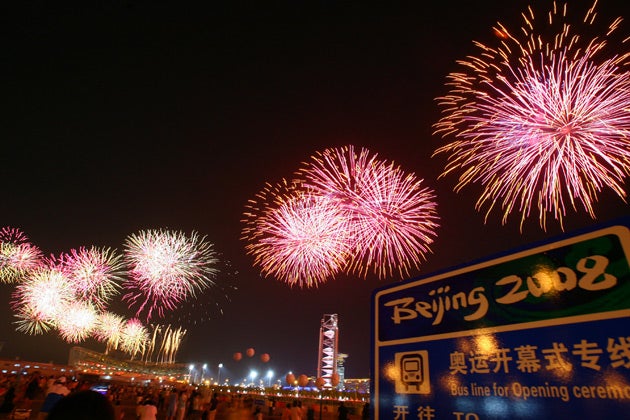
Nearly two years ago, at a dinner given for the boss of a multinational that is also a sponsor of the Beijing Olympics, the question was put on the table: what can be done to ensure that the international press does not spoil the Beijing Olympics for the Chinese government?
The boss was worried. He could see that the Olympics carried immense symbolic value for a government on whose favour his business depended. He could also see this was a perilous highwire act: a government that routinely reacted to domestic criticism by silencing the critics would have to be exposed to the less tractable, and certainly irrepressible, energy of the international media.
The guests at the dinner did their best but there was only one real answer: the international press could not be controlled. There were two possible courses of action: to meet in full the commitments Beijing had made on press freedom and human rights; or simply to learn not to mind negative coverage. Neither course was followed.
The first was always unrealistic. Failure on the second has had the perverse effect of poisoning relationships further and has not helped China's aim to use the Olympics to present a positive image to the world.
The moment when the first wave of sports journalists logged in the shiny new press facilities in Beijing last week, only to discover the International Olympic Committee's promises of uncensored access to the web were economical with the truth, China's reputation sank another notch. With a week to go to the grand opening ceremony – when Beijing might have expected warm colour pieces on the spectacular venues, the modern subway lines or the enthusiasm of the Chinese people – the big story continued to be the nature of the country's political system.
The blocked sites were no surprise to anyone who has experienced the frustrations of surfing behind the firewall. The three "Ts" – Tibet, Tiananmen and Taiwan – and the "F" of Falun Gong reliably trigger an unscheduled diversion either to a government propaganda site or the blank wall of a server error message. Add to that such apparently innocuous destinations as Wikipedia – which contains views that the government regards as unsound – or, intermittently, YouTube, and the visiting journalists begin to understand why it might be that so many Chinese citizens have such a very different perception of their recent history to interested observers outside China.
Despite a partial opening of the internet on Friday that gave access to previously blocked sites such as Amnesty International, others, mainly those of internal opponents, remained blocked. A games planned to close the gap between China and the outside world and celebrate its integration as a global player could have the opposite effect.
Even the tough-minded Chinese leadership might now be reflecting on how it all went wrong. When the bid was won in 2001, officials said the Olympics were "another milestone in China's rising international status" and would bring the "respect, trust and favour of the international community". Instead, Beijing has been plagued by disasters at home and is visibly irritated at the fin de regime rumours that these events have engendered in a superstitious people. Internationally, the event that was meant to display China as a responsible rising power, risks being judged as an exposé of authoritarianism.
This unanticipated outcome matters in Beijing. For many years the government has worked to promote China's impressive economic rise as peaceful and unthreatening, in implicit contrast to the militarism of the US. China needed time, space and access to raw materials and energy to feed its economic machine; for that, international goodwill was a prime requirement.
At home the concerns are related but slightly different: once the Party abandoned the ideology that justified its perpetual rule, China's growth was the means of keeping the loyalty of a people who had spent much of the 20th century in war and poverty. That recent misery, the story went, derived in turn from the incursion of imperial powers into China in the 19th century and of Japan in the 20th – a narrative that has fuelled the truculent nationalism that has seized so many of China's privileged younger generation.
It was only part of the story of China's historic weakness, but it was the line the Party stuck to, not least to divert scrutiny from its own less than perfect record. The last 150 years have certainly left a scar on the psyche of the nation, and so the past three decades have been experienced by many Chinese as a purging of the shame of humiliation, an embrace of relative political normality and economic success, and a reward for the long and tragic night China had endured.
That was the story the Games was meant to celebrate. As things are now, one striking aspect of this slow train crash is its naivety. The government insists it is illegitimate to politicise the Olympics, but the Games have always been a political as well as a sporting event. Leaving aside Berlin 1936 and Munich 1972: China withdrew from Melbourne in 1956 in protest against Australia's recognition of Taiwan; the Moscow and LA games played out Cold War tensions; the Seoul Olympics played an important part in the liberalisation of the South Korean regime; China has its share of people with domestic and international grievances seeking attention; and the regime's own hopes for Beijing 2008 went far beyond sport.
That the issues in contention when China bid for the Olympics were the same as they are today – the environment, human rights, press freedom – is evident from the commitments made by the Chinese government to win the deal. But instead of anticipating the degree to which it would be held to those promises, the government concentrated on the physical fabric and domestic opinion, through a prolonged propaganda campaign aimed at mobilising the people for a moment of triumph, when China's considerable achievements would be celebrated uncritically.
At home, the government can still, for the most part, create its own story – and silence those who challenge it. But it did not seem to foresee that story being challenged in the wider world.
Now feelings are hurt and pride is at stake. A fierce security crackdown has strangled business, cut the flow of visitors, alienated the international media and soured the mood. Beijing's immense investment and the popular enthusiasm for the event are felt to be unappreciated.
The best hope for Beijing 2008 is that the excitement of the event itself will soon take over, that Beijing will harvest a satisfactory crop of gold and that not too much face will be lost. If pride can be saved – if the government can salvage at least some of its original ambitions – then in the quiet of the following months some more profound lessons might be drawn from this bruising experience. But if the mood remains sour – if China were to end the month feeling resentful and unappreciated – the opponents of the past three decades of slow but steady liberalisation will gain in strength, buoyed by confirmation that China faces a hostile world and must act accordingly. That breach would take a long time to heal.
Isabel Hilton is editor of chinadialogue.net
Join our commenting forum
Join thought-provoking conversations, follow other Independent readers and see their replies
Comments