Fighter who traded his gun for a pen: A foreign correspondent's story
For years his warnings about Afghanistan were ignored, now his books are an indispensable reference. By Kim Sengupta
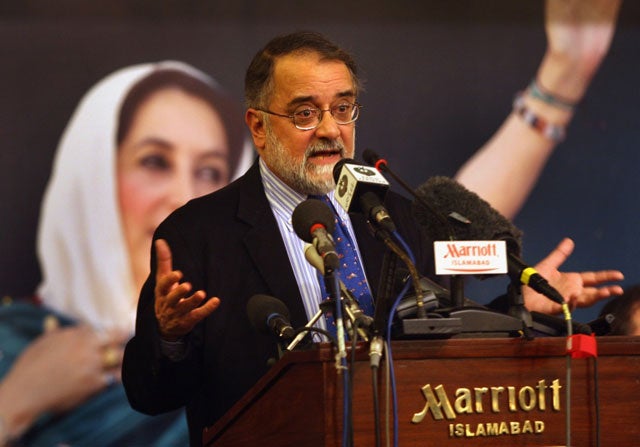
Ahmed Rashid's first contact with the media came when he was fighting alongside Balochi guerrillas in Pakistan. He had left the frontline and gone to the Afghan capital, Kabul, to organise welfare for refugees who had fled across the border to escape air strikes where he came across reporters covering the aftermath of the coup which had deposed the king, Zahir Shah.
The encounter led to Rashid abandoning the gun for the pen and a distinguished and colourful career as a reporter and writer. It was, he accepts, an unusual path into the trade. Growing up in a middle-class family in the Pakistani city of Lahore, the son of a retired senior Army officer, he had no ethnic or indeed any other intrinsic links to tribal Balochistan at the other end of the country. His parents, who had sent him off for an English education had no idea that their son's CV would end up reading –– Malvern College; Fitzwilliam, Cambridge and the Baluchistan Liberation Front.
"Well, it was 1968. I had just got a degree in political science and went to Paris where a student uprising was taking place, Russian tanks were crushing the Prague Spring, there were race riots in America. So I went off to fight for a people who were being oppressed," recalls Rashid. "We wanted to join in the struggle. We thought we were Marxists, we were radicals." Much of Rashid's subsequent career has been spent in charting radicalisation of the young, this time by Islamic extremists, and the rise of the Taliban and al-Qa'ida. For much of that time his was a lonely voice whose warnings that Afghanistan was turning into a training ground for global jihad were ignored by the West, which had lost interest in the country after using the Mujaheddin to fight the Russians in the dying days of the Cold War.
Rashid's investigations into Islamic extremists and how they were being nurtured by senior figures in the Pakistani army and intelligence services, the ISI, was a highly hazardous enterprise and triggered a brutal backlash. The military regime banned him from working in the country and Gulbuddin Hikmatyar, then the CIA's favourite homicidal Afghan warlord, declared that he was an apostate who must be killed.
"It was a very difficult time. I could get around the working ban by writing under different names, but I had to go into hiding for about three months after the Hikmatyar threat," Rashid said. "He had been responsible for killing a lot of people and he would have had no compunction about getting ridding me. I doubt if the security forces would have spent much time investigating the matter."
Rashid continued to write extensively for The Independent, The Guardian, the Far Eastern Economic Review and his current employers The Daily Telegraph, covering the conflicts and the international realpolitik of the region. Then came 9/11 and he was suddenly much in demand, as an analyst and a journalist. His book on the Taliban, published the previous year, became an essential reference for the media, the military, politicians and diplomats.
I told Rashid that many of the journalists who went to Afghanistan in 2001 were clutching copies of his book. Some of us also carried George MacDonald Fraser's Flashman, not only a roistering read but also one that gave a pretty good account of the First Afghan War in the early 19th century. "You probably found Flashman more useful than my book, it's always good to get things in historical perspective," he laughs.
"What I have always found strange is despite Britain's long history in the region there was so little knowledge about the place in recent times. There seemed to be an unwillingness to see what was going on there, they thought if they ignored the problem it would not affect them. That was never going to be the case."
Rashid recalls the problems he had in getting anyone even interested in the book after he had written it. "My agent at the time was totally dismissive, he said no one would be interested in obscure subjects like the Taliban and Afghanistan. I ended up going from one publishing house to another without much joy, but eventually a very small firm took up the offer and later they passed it on to Yale University Press and since then it has done quite well." Taliban: The Story of Afghan Warlords sold 1.6 million copies in the US alone, was published in 26 languages and pirated in a dozen countries. Other books followed, the publishers snapping them up with alacrity, as Rashid became an international public figure advising the United Nations, governments and aid organisations. In Afghanistan and Pakistan he was no longer just a journalist but a player, counting figures such as Afghan president Hamid Karzai among his friends.
With the backing of George Soros, Rashid has founded a journalism course in Afghanistan, which has been a major factor in generating the media in the country after a vacuum of three decades. He has pressed President Karzai to pardon Pervez Kambakhsh,who was sentenced to death for downloading an internet report on women's rights. A petition by The Independent to free Kambakhsh has obtained more than 100,000 signatures. "What happens to Pervez is of tremendous interest for journalism in Afghanistan, if he is not released it will be catastrophic for free speech in the country. I am glad of The Independent's campaign and I am totally behind it. I'll be reminding Karzai about Pervez next time I see him."
Rashid was in London last week to promote his latest book, a round of speaking engagements at think-tanks, colleges and public meetings and the Foreign Office following a similar trip to the US. The title of his new work, Descent Into Chaos, How the war against Islamic extremism Is being Lost in Pakistan, Afghanistan and Central Asia is self-explanatory.
Rashid points out that the West's forming of an Islamist international brigade to fight the Russians have now rebounded with a vengeance. Gulbuddin Hikmatyar, the American protégé who sentenced Rashid to death is now busy killing American and British soldiers and receives support from the Iranians, a part of George W Bush's axis of evil.
The training camps set up to train the Mujaheddin in Pakistan are now being used by the Taliban to send fighters into Afghanistan. British troops at Kajaki in Helmand, a hauntingly lovely place used for vacation once by the Afghan royal family, are now fighting out of the same bunkers and trenches once used by Russian troops. Those of us who go to Afghanistan frequently are aware of the Pakistani connection which allows the Taliban their training ground and safe havens across the border and to replenish the ranks from students in the madrassas. What Rashid gives us is a lucid and detailed description of how this takes place with official connivance and reminds us how much the West, and the Americans in particular, are authors of their own misfortune.
He found during his last visit to the US that the apathy of the outside world is still very prevalent despite the wake up call of 9/11. "The media, apart from a very few newspapers, seem to cover very little of what's going on in Iraq and Afghanistan for instance. And that's despite the fact that you have American troops fighting and dying there. In the UK there is a bit more focus on these places, there is definitely a difference in coverage."
Nevertheless, Rashid is dispirited by what he sees in the so-called upmarket papers in this country. "There are some really excellent journalists around but there is a definite drift downmarket," he says.
"It is also a shame newspaper sales are falling over here whereas they are booming in south Asia, people are getting not just one but two papers. But I remain a great fan of British newspapers. The Independent, for instance, gave me a chance to write about militant Islam and Afghanistan when this was being ignored elsewhere. Maybe what we are seeing now is just a fad, maybe serious news will come back into fashion again, I don't think you will ever have a shortage of journalists willing to do the hard stuff."
Join our commenting forum
Join thought-provoking conversations, follow other Independent readers and see their replies
Comments