Has Rupert Murdoch's paywall gamble paid off?
Advertisers don't like it. Analysts are unconvinced. The paywall at News International may not be winning many fans, but the man behind it is determined to keep it standing.
As the fugitive businessman Asil Nadir flew back to Britain from his North Cyprus bolt-hole last week, Sean O'Neill, the crime editor of The Times, scooped Fleet Street by being the only print journalist on the plane. Yet those searching Google for the latest on the breaking story that morning would have found no sign of O'Neill's exclusive – only follow-up stories by rival news organisations such as The Guardian and ITN.
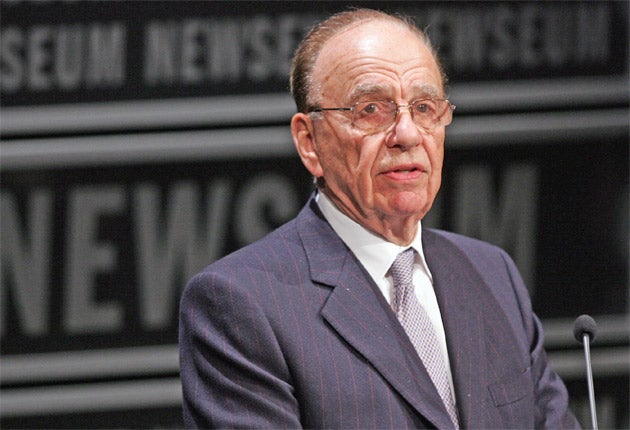
Two months after Rupert Murdoch's decision to erect a subscription paywall around the websites of The Times and The Sunday Times, thus removing their content from search engines, the bold experiment is having a marked effect on the rest of British media. There are many who still wish the 79-year-old mogul well, hopeful that he is at the vanguard of a cultural shift that will save newspapers. Yet elsewhere there is dismay among analysts, advertisers, publicists and even some reporters on the papers.
Faced with a collapse in traffic to thetimes.co.uk, some advertisers have simply abandoned the site. Rob Lynam, head of press trading at the media agency MEC, whose clients include Lloyds Banking Group, Orange, Morrisons and Chanel, says, "We are just not advertising on it. If there's no traffic on there, there's no point in advertising on there." Lynam says he has been told by News International insiders that traffic to The Times site has fallen by 90 per cent since the introduction of charges. "That was the same forecast they were giving us prior to registration and the paywall going up, so whether it's a reflection on reality or not, I don't know."
He warns that newspaper organisations have less muscle in internet advertising campaigns than they do in print. "Online, we have far more options than just newspaper websites – it's not a huge loss to anyone really. If we are considering using some newspaper websites, The Times is just not in consideration."
Others have their concerns. Adrian Drury, a media analyst at Ovum who has studied the impact of paywalls, says. "Fundamentally, at a brand-value level, you are killing the idea of times.co.uk as a channel choice for news online. That is something that is very difficult to recover." There is also a widespread lack of enthusiasm for the new look Times website. "The most disappointing thing for me is that there doesn't seem to have been any strategy to create unique, compelling content that would differentiate the online product," says Paul Bradshaw, a specialist in new media journalism.
"I think it's 'business as usual' – which probably betrays that this is really about protecting the print product rather than establishing a genuine business around online content."
Rupert Murdoch's biographer, Michael Wolff, who runs the news aggregation site Newser, is deeply unimpressed by The Times' online offering: "It has the look of 2004 about it." He is unconvinced that the paywall, or Rupert Murdoch's recently expressed enthusiasm for the iPad, are signals of cultural change within the News Corporation empire. "Knowing News Corp and News International as well as I do, I'm sure that the investment they have made in technology has been minimal. There just is not a culture, a business discipline or philosophical interest in truly embracing technology."
When the paywalls were introduced on 2 July, with charges of £1 per day or £2 for a week's access to both The Times and the newly launched Sunday Times sites, there was speculation that the strategy was designed to shield the print circulation of the titles from the loss of readers who were choosing to consume the paper for free online.
Is this working? Not according to the latest sales patterns, which show that The Times has merely maintained its market share in the quality newspaper sector at 32.7 per cent, and this only by increasing its export sales by around 10,000 copies a month. News International has so far been fiercely secretive of figures relating to its paywall. Some say that only four people within the company's Wapping headquarters in east London are privy to the information. "News International could appease concerns from advertisers about how many people have registered by releasing these numbers," says John Reynolds of Media Week. It is expected that a public statement, revealing some data, will be made by News International in coming weeks.
Furthermore, the News of the World website is set to introduce charging next month. This is seen as a "statement of intent" by industry observers, and an indication that the other paywalls have not been disastrous. The Sun may follow suit, although that would mean giving the popular and free Daily Mail site a free run.
Some believe that News International is pursuing a more sophisticated strategy. "This is not a numbers game," says Greg Hadfield, former head of digital development at Telegraph Media Group and now an executive at the media agency CogApp. "The Times and The Sunday Times have a near-unique opportunity to build a one-to-one communication with someone about whom they know their name, email and credit card number."
Bradshaw too believes that "the strategy is more about gathering consumer information than selling content", and suggests that News Corp's desire to buy the whole of BSkyB may create opportunities for bundling multimedia packages for its subscriber base.
Hostility in adland is far more uniform. Sir Martin Sorrell, chief executive of the world's biggest advertising group WPP, last week emphatically endorsed the principle of news-papers charging for their stories online. "We think paywalls are essential, because we think giving away content for free, particularly if consumers value that content, makes no sense," he said. "Consumers have to pay for content they value."
George Brock, head of journalism at London's City University and a former executive on The Times, detects a change in mood: "If there is a trend observable, it's in the direction of paywalls and not away from them." He adds that Sir Martin, "one of the biggest figures in the advertising industry, is presumably telling all his executives that you have to work out how you work with paywalls, because this is going to grow."
Despite this, publicists have told me that clients are increasingly reluctant to give interviews or stories to The Times, on the grounds that they would not be made freely available via search engines. Dan Sabbagh, a former media editor at The Times who now runs the media website Beehive City, says News International journalists are frustrated by the decline in their audience.
"There's no doubt that a lot of the reporters on the paper are unhappy, they feel that they have suffered a loss of reach and voice online," he says. "But it's not the kind of place where the reporters can have a rebellion and force management to change its mind; that's not in the culture."
Sabbagh produced figures at the outset of the paywall experiment showing that 15,000 people had subscribed to the new website, with 12,500 signing up for a Times iPad application. He was surprised by the reaction. "I didn't think the figures were too bad, but the way they were taken up was that they were catastrophic."
He believes that the project will be made to work. "It's a long slog, but I don't detect any signs of [News International] being massively ruffled by the progress," he says. "News is a long-term business, and they are going to stick at this."
Join our commenting forum
Join thought-provoking conversations, follow other Independent readers and see their replies
Comments
Bookmark popover
Removed from bookmarks