How to time travel by search engine
Millions of digitised pages of ancient newspapers can now be trawled for names and places, says Ian Burrell
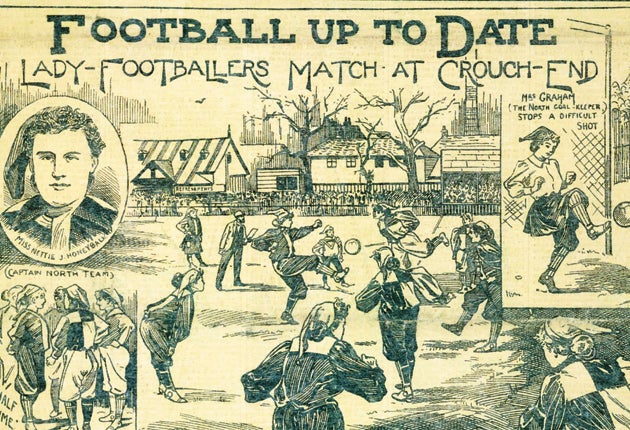
If only the appropriately named Miss Nettie J Honeyball could see the England women's football team now. Nettie, a tough-looking cookie in knickerbockers and a Wee Willie Winkie hat, pioneered the entry of women into the beautiful game during Victorian times.
You'd know that if you read your 19th-century newspapers, which you now can if you subscribe to the British Library website as it digitises millions of pages of newsprint. You can read stories from long-defunct publications that chronicled Britain as it learned news of Waterloo and the abolition of slavery, and responded to the emergence of railways and the introduction of electric lighting.
Until recently, these ancient publications could only be scoured by visiting in person the reading rooms at Colindale in the northern suburbs of London. Now they can be trawled using search engines that can pick out the mention of a surname or a place name from 49 titles, from Trewman's Exeter Flying Post to The Northern Liberator and the Illustrated Police News.
A further one million pages of the archive are about to be transferred from fragile, disintegrating newsprint to digital format. Editions of London's Morning Post and the Standard (which is tenuously linked to the existing free evening title of the same name) will become accessible online, along with a further 22 regional newspapers, including Dundee's The Courier, which is still being published.
Not least among the benefits of the programme is the potential for regional newspaper publishers, the worst-afflicted sector of an industry that is struggling to make money from the internet, to derive income from journalism that may have been published 200 years previously.
According to Ed King, head of the newspaper collections at the British Library, many regional newspaper publishers destroyed their archives a long time ago. In such cases, the library is willing to digitise its own copies, allowing the publisher – which retains the copyright – to monetise access to the material. "We can make them available in our reading rooms for our audiences in the British Library," says King. "But if it was accessed externally it would be part of the publisher's business model and users would be directed to their website."
The potential of this project is great, given that the collections contain 750 million pages for digitisation. The papers that have become accessible over the past two years include some of the great sellers of their day, such as Lloyd's Illustrated Newspaper and Reynolds's Newspaper. "These were really interesting papers because they were liberal or radical press – academics are really interested in that," says King. "Lloyd's, by the late 1880s, was selling 800,000 copies a week. Reynolds's was selling 300,000-400,000 in its heyday in the 1870s. This was big stuff, not small beer."
The readerships of many titles were disproportionately higher. "Until the relaxation of taxes on paper and publishing in the 1860s, newspapers were not cheap. So many were sold and then read out loud to audiences," says King. "Nobody has much evidence about readership because papers were read in coffeehouses and working mechanics institutes, clubs of one kind or another and possibly pubs."
The digital archive is a lesson in how history repeats itself. Witness the coverage in The Graphic of the collapse in 1878 of the City of Glasgow Bank, which is reminiscent of the Royal Bank of Scotland's recent problems. The City of Glasgow Bank went down after accruing liabilities of £6m following extensive loans on poor security and wild speculation on Australian mining stocks and American railway shares.
The Western Mail of 1894 was mocking MPs who resented their working arrangements. And as Illustrated Picture News makes clear, Miss Honeyball was attracting large crowds to women's football matches in 1895. Its depiction of a game played in Crouch End, north London, raises questions as to why the England women's team, which reached the European Championships final this summer, has not received more support over the years.
Although some national newspaper titles, such as The Times, The Guardian and The Daily Mirror, have digitised their archives, the British Library's offering, which includes one million pages from 17th-century and 18th century titles, offers unique possibilities for exploring the minutiae of everyday British life.
It is a valuable resource for genealogists who, from home, can search for the names of their relatives. "People can search 100 years of a place. There are reports of committee meetings, church meetings, and advertisements which contain the names of the family or person advertising, births, marriages and deaths, the names of people going to market, " says King.
Simon Fowler, editor of Ancestors magazine, says the digitisation of the archive has transformed its value. "Until now, researchers haven't been able to easily use this resource. Now they can and it will provide a lot of new evidence about their ancestors' lives that can't be found elsewhere, as well as leads to new avenues of research."
The project traces the growth of the newspaper, from early 19th-century operations, often based at the homes of proprietors, to the ambitious businesses that were aided by technological advances such as the introduction of the railway and the telegraph, speeding up news-gathering and distribution processes.
As well as being a chance for local papers to make money, it is also a sobering exercise that shows that the closure of newspapers is a story as old as the industry itself. "Many of the regionals even then were quite short-lived," says King. "Nobody has done the maths on how many papers went under in the economic recessions of the 1800s but it would be a very interesting piece of research."
Subscriptions to the British Library's British Newspapers 1800-1900 archive: http://newspapers.bl.uk/blcs/
Join our commenting forum
Join thought-provoking conversations, follow other Independent readers and see their replies
Comments
Bookmark popover
Removed from bookmarks