How the press ignored the Lawrence story – then used it to change Britain
The Mail's stance was driven by anger at the contempt shown by the suspects to the justice system
It is no exaggeration to say the media's coverage of the Stephen Lawrence murder was transformational, forcing an unprecedented examination of the issue of race in British society.
Despite this, the morning after Stephen’s murder in Eltham, south-east London, on the night of 22 April 1993, the tragedy made only local news. The Independent was one of few news organisations to pick up on the story the following day, with an article on page 4 that quoted the police saying it was a “racial murder” and made reference to other similar killings in the area.
Fleet Street took a while to throw off its old instincts. When political protesters linked the Lawrence murder and other racial attacks to the local presence of right wing extremists, the papers turned on the demonstrators – such as militant black group Panther UK – who congregated outside the BNP national headquarters in nearby Welling. The Daily Mail ran an editorial: “Racism is abominable…but is there not also something contemptible about professional protestors who capitalise on grief to fuel confrontation?”
Yet whereas other murder victims such as Rolan Adams, who was stabbed to death less than two miles away, were largely ignored, the Lawrence case somehow struck a chord with the national press. Years later, the BBC made a programme asking the question Why Stephen? Brian Cathcart, author of The Case of Stephen Lawrence, said there was something straightforward about the killing which appealed to the media.
“You could actually prove that Stephen was not a gangster,” he said. “This was a clean-living, honest young man with ambitions, coming from a well-ordered and law-abiding home. There weren’t any defensive excuses that the white establishment could make for his death or the failure to investigate it.”
Marc Wadsworth of the Anti-Racist Alliance claims to have had success in persuading national news desks of the importance of the case, by stressing Stephen’s lack of criminal record and his ambitions to become an architect. “We were saying ‘Stephen Lawrence is like you.’” Nelson Mandela forced the media to push the issue up the news agenda when, on a visit to London, he spoke about the case and the apparent cheap value of black lives in Britain.
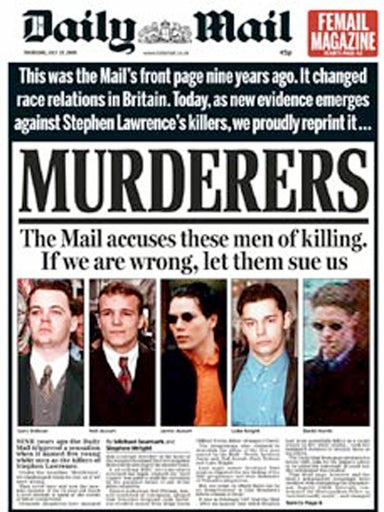
But the real step change in coverage came in February 1997 when the Mail cleared its front page to print pictures of the five suspects, under the headline “Murderers”. It was a remarkable moment, though the rival Guardian expressed doubts about the Mail’s motives. “It’s either a sincere conversion or a cynical stunt,” it said in an editorial that criticised the Mail’s previous coverage of the case.
Yesterday the Mail’s website carried an extraordinary 12 minute video in which the paper’s editor Paul Dacre – who is usually reticent to appear on camera – spoke emotionally of the decision making process in producing such a legally contentious front page. That night, he said, he had woken at 4am “drenched in sweat and convinced my career was all over”. He concluded by saying the Mail had shown a boldness “that I shall be proud of for the rest of my life”.
The extraordinary subtext was that Stephen’s father Neville knew Dacre, having done plastering work at his house. He had already complained about the Mail’s use of a photograph of his family in coverage of violent anti-racist protests. In her book, And Still I Rise, Stephen’s mother Doreen explained: “Neville was able through other journalists to reach him on the phone, and asked him, ‘How could you do that, and you know me?’ Since then the paper has been surprisingly supportive to our cause.”
The Mail’s stance was also the result of the paper’s anger at the swaggering contempt shown by the murder suspects to the British justice system at Stephen’s inquest, which ended the day before the front page article. Dacre yesterday called it a “sickening sight”.
The “Murderers” headline set the scene for the announcement by Home Secretary Jack Straw five months later of the Macpherson Inquiry, which highlighted the issue of “institutional racism” within the Metropolitan Police. Dacre said yesterday that Straw, a former Leeds University colleague, had told him that the Mail’s coverage had influenced his decision to order the inquiry.
Almost all media organisations gave prominent coverage to the case. Channel 4 invited Neville and Doreen Lawrence to give the alternative Christmas Day address in 1998. Then in the space of a few days in 1999, ITV screened a two-hour dramatisation, The Murder of Stephen Lawrence and the BBC broadcast a version of The Colour of Justice, a theatre production by the journalist Richard Norton Taylor based on court transcripts.
This prompted a media backlash from the suspects, as their mothers went on Radio 4’s Today programme to protest the innocence of their offspring. The five suspects gave interviews to ITV journalist Martin Bashir – later complaining his film had been unfairly edited. Gary Dobson also appeared on Talk Radio to take questions from the public.
But for all the media’s reporting, and the ramifications of that coverage across society, few new facts were unearthed and nobody brought to justice for the crime. When the case finally came back to court this year, The Spectator published a critical blog by Rod Liddle which has been referred to the Attorney General for possible contempt of court.
* Stephen Lawrence: How the case breakthrough came
* A shrunken family: The first journalist to interview the Lawrences recalls the scene
* The science that helped convict Gary Dobson