Jason Cowley: 'I'm beholden to no party – and certainly not the Labour Party'
The New Statesman's editor wants to publish ideas from across the political spectrum, he tells Ian Burrell
It must be a very lonely existence on the old left these days. Why, even the New Statesman, with deep socialist roots stretching back to its founders Sidney and Beatrice Webb, says it is moving away to a place where it can explore a more "plural" range of opinions, including those of the Tories.
It doesn't sound very comradely but this is the strategy of editor Jason Cowley, who took over last year and has introduced changes which have won plaudits from some, and angered others.
"I want to use the pages of the magazine to explore political ideas on both left and right. I'm prepared to believe Steve Hilton, Andy Coulson and David Cameron when they say the Conservatives want to be progressive. We want to hold the Conservatives to account to see if they will indeed turn out to be progressive."
This is not, he points out, Millbank's own journal. "The Statesman has sometimes been seen in the past as the house magazine of the Labour Party and we are absolutely not that. I'm beholden to no party and certainly not the Labour Party."
What interests Cowley are "ideas", from wherever they come in the political spectrum. "I have made significant tonal changes," he says. "Politically we remain left of centre, true to our political heritage, indeed our radical heritage, but I hope the tone is more plural, more sceptical and more nuanced."
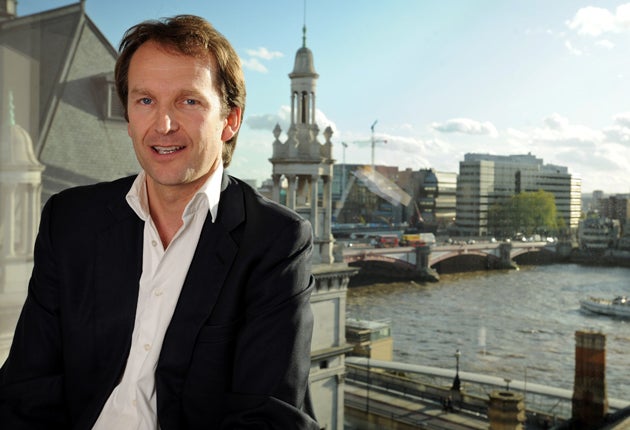
The rangy Cowley can speak with a degree of confidence, following the magazine's outright purchase earlier this year by Mike Danson, the online entrepreneur and head of Progressive Media Group. The editor is speaking from the company boardroom, which overlooks the Thames at Blackfriars, a view to rival that of Richard Desmond's, downriver at Northern & Shell.
The Statesman shares its building with the trade title Press Gazette, which is also owned by Progressive. "We can benefit from being part of a larger organisation and all the economies of scale that that involves," says Cowley. "That helps in a difficult time for the media at large."
His predecessor, the former BBC and Financial Times political journalist John Kampfner, gave the Statesman a radical and high-profile redesign, which temporarily lifted circulation. Cowley, though, felt the need to make his own changes. "It's now recognisably my magazine. I've redesigned it, I've rethought it, restructured it."
He has made a succession of key appointments, including Rebecca McClelland in the new role of photography editor. "If you are trying to produce a highly visual magazine without a picture editor then I think you are asking for some problems," he says.
James Macintyre ("an admirable figure and a courageous journalist") has joined as political editor, and put those progressive Tories under the spotlight by exposing the party's links to the far-right in Europe.
Mehdi Hasan was poached from Channel 4 as senior politics editor and has "had a startling impact in a very short time" with insightful coverage of the Afghan and Iraq crises, among other subjects.
Cowley hired novelist Will Self as a columnist, while David Blanchflower, a former Bank of England economist, has become a must-read for many. "I thought we had journalists writing on economics and what we needed was an economist who could turn a sentence and write accessibly about what has proved to be a defining subject."
But others have gone in another direction. Martin Bright, the former political editor, now writes a left-leaning blog for Coffee House, the website of rival political periodical The Spectator. Arts editor Alice O'Keefe also left, along with Caroline Palmer, the chief sub.
Two senior journalists who were made redundant, Barbara Gunnell and Ian Irvine, were last week at the Central London employment tribunal, accusing Cowley and Danson of unfair dismissal and age discrimination.
The case, which was settled amicably out of court on Tuesday, was featured on left-of-centre blog Harry's Place, in a posting that appeared to come from someone close to the old Statesman regime and described the periodical as "the increasingly absurd New Statesman".
Cowley, who is aware of the magazine's history as a platform for writers including Orwell, Naipaul and H G Wells, says he is guiding the Statesman back to the true course it followed "before it went wrong at the end of the Seventies when it became too stridently left-wing ... in some ways it mirrored the wrong turn of the Labour Party and the left in general and became a rainbow coalition of disaffected voices".
Prior to joining the Statesman, Cowley was for a year the editor of Granta, the literary magazine. He believes the political title has become "more writerly" under his leadership. "I'm publishing fewer but I hope better written and longer pieces. In any issue I hope you'll find a high-quality, ideas-based essay and a long narrative report of the kind that I might have published at Granta."
Before that, he was editor of The Observer supplement Sport Monthly. He is the author of a recent book that analyses the significance in the history of English football of Arsenal's dramatic championship win of 1989, clinched at Liverpool in the wake of the Hillsborough disaster. But that's not the sort of thing he will publish in the Statesman. "I think sport is well-covered elsewhere," he says.
Does he have a sufficient grasp of politics? "I'm very interested in domestic politics," he says. "But I always like the idea of being slightly on the outside and I think it's beneficial to the magazine because I have got insiders like McIntyre and others who love the minutiae of the Westminster village."
Though he is interested in the ideas of the right, he is also intrigued by the "excellent work" of the left-wing Compass group and published its recent essay "No Turning Back". In a nod to the traditions of New Society, a magazine once joined to the Statesman, he is publishing a series of long reads on poverty of a kind rarely found in a press that ignores it "because it's not glamorous, it's about disadvantage, failure, struggle, squandered opportunity".
A special issue in March, analysing the Margaret Thatcher era 30 years after she was first elected Prime Minister, caught the eye of the British Society of Magazine Editors, which gave him their 2009 award in the Special Interest & Current Affairs category.
Despite the stick from Harry's Place, Cowley admires the left-wing blogosphere, praising Sunny Hundal of Liberal Conspiracy and Sunder Katwala of Next Left. He has big online plans and has hired as his deputy Jon Bernstein, who formerly ran the website of Channel 4 News. Danson is also the owner of blogsite Labourhome.
"I'm working on a huge online project," says Cowley. "Over the next six to 12 months we will be rolling out a series of bespoke projects on our site which will completely transform it. Our plan is to become a hub for anyone interested in progressive politics."
Cowley is planning a New Statesman festival, featuring Self, Blanchflower and other writers. But his main concern is the magazine which, without promotion, is this year flat-lining at around 23,000 sales (having been at 29,000 in early 2007) in a market where others are losing circulation.
Cowley may not be a political journalist, as such, but as a seasoned magazine editor he says he knows what a campaigning political periodical should look like, with art-directed covers, more white space and greater use of the Statesman's distinctive red and black print. "I think it's cooler," he says. "That's minimal cool, not 'hey man' cool."
Join our commenting forum
Join thought-provoking conversations, follow other Independent readers and see their replies
Comments