Media freedoms in the balance
Cabinet to consider legislation including privacy law and regulation of social media
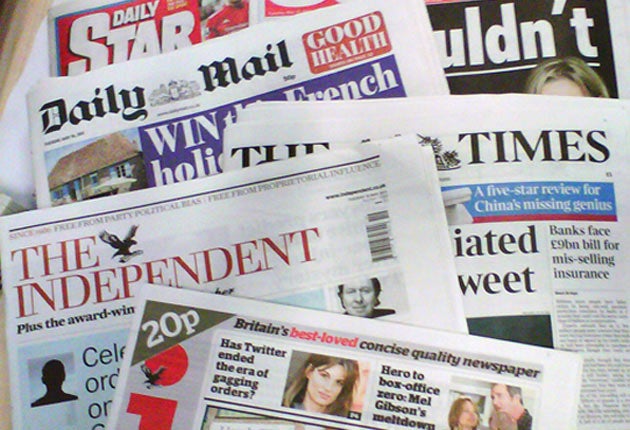
Ministers are to hold emergency talks over the celebrity super-injunction imbroglio that could pave the way to a privacy law and an attempt to regulate social networking sites.
As the names of public figures alleged to have taken out ultra-restrictive gagging orders continued to circulate freely on Twitter – and newspapers from Spain to Peru repeated their identities – Culture Secretary Jeremy Hunt said the proliferation of information on the web had made a "mockery" of current privacy rules.
Mr Hunt raised for the first time the possibility of a new watchdog to ensure that social media such as Twitter and Facebook were subject to controls similar to those faced by the press and broadcasters, saying there may be a case for converging the regulation of traditional and new media.
The ability of a single Twitter user to circumvent the authority of the British courts in the internet era by posting the names of six celebrities with alleged links to super-injunctions this weekend was underlined by data showing that the site had its highest-ever number of UK visits on Monday.
Traffic to the site increased by 14 per cent, with an estimated two million people having now viewed the names of the public figures, who include a Premiership footballer and a celebrity chef. Searches for the term "superinjunction" have increased by 5,000 per cent in the past month.
The Culture Secretary revealed that the proliferation of super-injunctions – thought to number more than 30 orders barring the publication of details of the private lives of the rich and famous – has been raised at Cabinet and that he is to meet Kenneth Clarke, the Justice Secretary, to seek a solution to the "crazy" situation.
In a signal that the Government could consider fresh legislation, he repeated David Cameron's insistence that Parliament, rather than judges, should be responsible for ruling on the balance between privacy and freedom of expression.
Mr Hunt said: "We are in this crazy situation where information is available freely online which you aren't able to print in newspapers. We are in a situation where technology, and Twitter in particular, is making a mockery of the privacy laws we have and we do need to think about the regulatory environment we have. In the end, I do strongly believe it should be Parliament, not judges, that decides where we draw the line on our privacy law."
Alarm in Whitehall at the increased willingness of a small group of High Court judges, including media law specialist Mr Justice Eady, to impose gagging orders whose very existence cannot be disclosed has grown in the last 48 hours as the alleged identities of the super-injunction-protected celebrities circulate freely in cyberspace – while the mainstream media risks criminal sanction if it repeats the information.
The first sign of an attempt by lawyers to enforce the orders on the internet came yesterday, when a blogger whose site has published the names said he had been threatened with legal action to close it down. US websites have in the past used America's strong freedom of expression laws to repel any attempt to impose Britain's more restrictive rules.
Twitter, based in San Francisco, gave a strong hint that it would not concede easily to any attempt by a British court to force it to reveal the identity of the user behind the publication of the six names, including at least one – Jemima Khan – who has not taken out any gagging order. The website said it had a "mandate" to protect its users' freedom of expression and would seek to inform any user who was the subject of legal action to disclose their personal information.
But Mr Hunt said: "In the long term, there is a big question we have to look at which is whether the way we regulate different bits of media need to start to converge. At the moment, we have different regulatory regimes for different types of media. This has demonstrated that whatever the law tries to do on privacy, the internet is a very powerful force. I'm going to sit down with Ken Clarke to see what can be done. We agree that the current situation is not satisfactory."
Campaigners have warned of the dangers of any attempt to impose on journalists, or other bodies such as charities, privacy rules which could result in the subjects of an investigation being given a right to pre-publication disclosure. Trafigura, the oil trader, was heavily criticised when it obtained a super-injunction against The Guardian which interfered with parliamentary privilege.
Mr Hunt said: "One of the options is to have a privacy law that goes through Parliament and is properly debated. That will be a big parliamentary commitment. I think what we need to look at is whether that is the only solution.
"We need to get into the situation where regulation, legislation is up to speed with technology and we get the balance right between the rights of individuals and the rights that we all cherish of freedom of expression."
MPs are expected next month to hold their first full debate on super-injunctions and privacy. The Tory MP David Davis is to table a cross-party motion urging the Government to ensure the ultimate source of privacy laws is Britain rather than Europe.
Courts fill a vacuum
At the heart of the furore over the ability of a single Twitter user to flout the orders of the High Court lies the tension between judge-made privacy rules and the historic reluctance of Parliament to interfere with press freedom.
The desire of MPs and newspapers to avoid statutory regulation of the media has created a vacuum which courts have rushed to fill by means of injunctions and rulings which many are concerned have created a de facto (and deeply unsatisfactory) privacy law without the scrutiny of Parliament.
The appearance on social networking sites of the names of celebrities who allegedly obtained super-injunctions has made a nonsense of the efforts of three senior "media" judges at the Royal Courts of Justice to distinguish between what is in the public interest and what is of prurient interest to the public.
Innocent celebrities, ranging from Jemima Khan to Gabby Logan and Ewan McGregor, have all had to deny obtaining gagging orders after being wrongly associated with descriptions of public figures who have.
Join our commenting forum
Join thought-provoking conversations, follow other Independent readers and see their replies
Comments