The Big Question: Is there no limit to the expansion of Rupert Murdoch's media empire?
Why are we asking this now?
The septuagenarian deal-doer is adding another of the best-selling newspapers in the US to his global empire, dramatically increasing his power in the highly influential media market of New York, and riding roughshod over rules designed to stop such a concentration of media ownership. Plus ça change, you might say.
What is he buying this time?
Now it is Newsday, a tabloid paper covering the commuter territory of Long Island outside the city, for which Mr Murdoch is planning to slap down $560m-$580m (£290m). The paper is currently owned by Sam Zell, a former property magnate, but he has found himself with a little too much debt on his hands, so Mr Murdoch has swooped in to take advantage. They have not signed on the dotted line yet, and there is still talk of a rival bid or some sort of tax issue that could derail the deal, but the two men have shaken hands – and Mr Murdoch has proved time and again that he has the financial power to get what he wants.
Is this a big deal?
Compared with Mr Murdoch's $5.2bn purchase four months ago of The Wall Street Journal, the mightiest organ in financial news and the second-biggest selling paper in the US, Newsday is certainly smaller. But this latest deal would mean that, in the space of a year, he has gone from controlling one of the top 10 US papers – his beloved trash tabloid, the New York Post – to owning three.
That's a lot for any man, let alone for someone who also owns the most-watched television news channel in the country, the unabashedly unfair and unbalanced Fox News. And lest we forget, he also owns one of the major television networks, Fox, home to powerhouse programming including American Idol and The Simpsons, and the movie studio 20th Century Fox.
How big is the Murdoch empire?
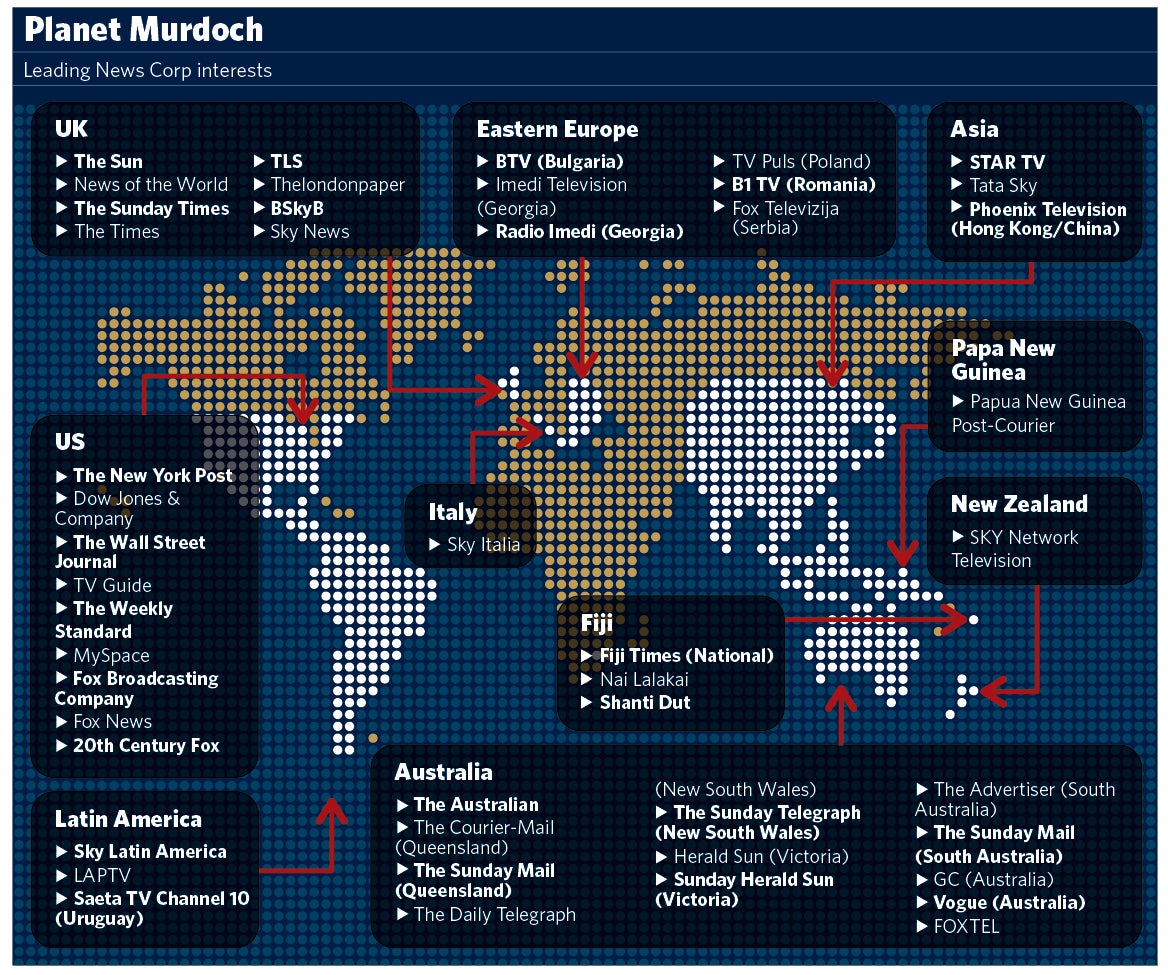
Bigger than ever. As well as all the US assets, there is MySpace, the most popular social networking website in the world. He is the UK's biggest newspaper proprietor, thanks to The Sun and The Times and their Sunday sisters. He controls BSkyB in the UK, other satellite operations in Europe, and the biggest daily paper in his native Australia, plus the book publisher HarperCollins. In Asia, he is beefing up Star TV, the satellite broadcaster. News Corp has revenues of more than $30bn a year, and Murdoch's personal fortune of $8.3bn puts him just outside the 100 richest people in the world.
Why do people fear this concentrationof power?
One need only look at Mr Murdoch's papers in the UK to see the influence they have on the political process, and how the news that readers are fed can be skewed to his own political and business desires. Thanks to a freedom of information request by The Independent, we learnt last year how Mr Murdoch had a hotline to Tony Blair at crucial moments during his premiership, and that the pair spoke three times in nine days in the run-up to the invasion of Iraq.
On two occasions, the day after a call with Blair, The Sun launched vitriolic attacks on the anti-war French President, Jacques Chirac. In the US, his right-wing New York Post called the anti-war leaders "The Axis of Weasel".
In fact, the Post has been Mr Murdoch's unapologetic bloodhound in the US for decades, waging feuds with politicians such as Teddy Kennedy ("Fat Boy", the Post calls him) who have opposed liberalised media laws, and with Mr Murdoch's business rivals. New York's elite fears nothing more than a savaging in the paper's delightfully vicious gossip column Page Six, and the Democrats are fearful of what it would do to Barack Obama if Mr Murdoch decides the Senator is too inexperienced and too liberal to be president. Merging Newsday with the Post immediately turns it profitable, giving it immense new firepower.
How does Murdoch defend himself?
Generally, he denies using his papers for political or business ends, saying that he is driven by commercial considerations. Fox News, for example, was simply exploiting a gap in the market opened up by what he says was the liberal bias of CNN. Murdoch complained during the battle to wrest control of The Wall Street Journal that opponents had reacted as if he were "a genocidal tyrant", and that he would have walked away if he wasn't so sure it was a perfect business fit for News Corp.
But he is behaving himself at the Journal?
To persuade the Bancroft family to part with the paper, he did have to introduce an independent board to safeguard the paper's editorial integrity. Staff at the paper remain nervous that the mogul will somehow skew its coverage to further his business interests, and they became even more unsettled this week when Marcus Brauchli, the paper's main editor, tendered his resignation, after just four months of working with the new proprietor. Mr Brauchli told staff: "I have come to believe the new owners should have a managing editor of their choosing."
Aren't there rules to limit Murdoch's power?
Pretty much every democracy in the world recognises the dangers of concentrating media ownership in too few hands, and have rules that ensure a diversity of voices in the marketplace. Trouble is, Murdoch and News Corp are masters at exploiting loopholes in the law. Technically, there is a ban on owning more than one newspaper and more than one TV station in major US cities, but the purchase of the Journal took News Corp up to two of each in the New York area. His ownership of the New York Post is allowed on a waiver of normal rules which he got because he rescued it from bankruptcy. He is confident of getting a second waiver for the Journal. Adding Newsday might make a mockery of the rule.
Are there moves to tighten the rules?
In fact, the rules have been progressively weakened. Until December of last year, when the one-paper-one-channel rule was introduced, they were even tighter. The Federal Communications Commission argued at the time that it would be worse for democracy if the declining profitability of newspapers pushed companies out of the business altogether. And the rise of the internet means that traditional media rules are increasingly out of touch with how many people receive their news.
In the US at least there are campaigns to strip Mr Murdoch of his local TV stations when the licences come up for review, and the acquisition of Newsday will only intensify those calls.
Is Murdoch unstoppable?
NO...
* Outrage forced him to concede independent overseeing of the Wall Street Journal's integrity
* By flouting media rules, Mr Murdoch runs the risk of making himself a target, which he would want to avoid
* Political pressures are rising now that Democrats are in the ascendancy
YES...
* News Corp has the financial firepower to buy whatever Mr Murdoch likes
* By intimidating politicians and lobbying hard, it has got round media rules in the past
* Expansion in Asia offers Mr Murdoch a big new powerbase to add to his huge interests in the US, the UK, Australia and elsewhere
Join our commenting forum
Join thought-provoking conversations, follow other Independent readers and see their replies
Comments