The Daily Mash - satirical, scatological and already profitable
Launched only last year to 'help people in offices waste time', the Daily Mash is a hit with users and advertisers, finds Tim Luckhurst
'A shattered nation longs to care about stupid bullshit again," joked the American satirical site the Onion just weeks after 9/11. "Many Americans are wondering when their priorities will finally be in the wrong place again."
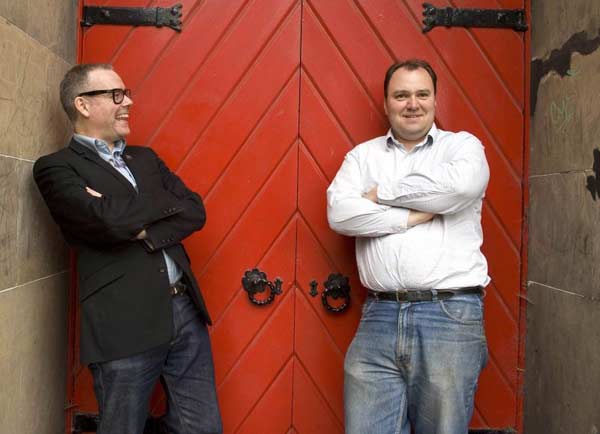
On this side of the Atlantic irreverent types laughed out loud. Among these were two seasoned journalists: Paul Stokes, a former business editor of The Scotsman, and Neil Rafferty, erstwhile political correspondent for The Sunday Times and the Scottish daily financial paper business a.m.
"We saw what the Onion was doing in the US," says Stokes. "It was really smart and really funny and we did not think there was anything like it in Britain, which left a huge gap in the market for us to fill with abuse, innuendo and smut."
The result was www.the-dailymash.co.uk, launched in April 2007 and now Britain's most successful satirical website, according to statistics compiled by the web information company Alexa. Last month it recorded 350,000 individual visits and nearly two million page impressions. Stokes and Raff-erty have signed a book deal with the publisher Constable & Robinson, and their collection of the best of the Daily Mash, Halfwit Nation: Frontline reporting for the war on stupid, will be published in October. They are piloting a radio version.
Theirs is not Britain's only satire site, but it is distinctive. NewsBiscuit, launched in 2006 by the novelist and Spitting Image writer John O'Farrell, is battling on but admits it is "still a loss-making enterprise and desperately needs outside support if it is to keep going".
The Daily Mash makes money from a combination of online ad sales, merchandising and sponsored video content hosted on its site. Its policy of "helping people in offices to waste time" has attracted an audience with niche appeal to advertisers. An online readership survey reveals that 65 per cent of users earn more than £30,000 a year and 22 per cent bring in more than £70,000. Seventy-three per cent are university graduates and 22 per cent have higher degrees. Most are regular readers of the Guardian, Independent or Times. This market has proved particularly attractive to film and television companies promoting humorous and youth-oriented products. Clients include Channel 4, Channel 5 and Virgin TV.
Stokes says: "Revenue is already big enough to pay salaries for Neil and me, and we can now afford to pay a couple of freelance writers as well. The beauty of the internet is that it allows people like us to set up a business at low cost and low risk. Our cost of content generation is very low versus normal content providers. We pull in smaller ad revenue than an equivalent circulation paper product but don't spend it on paper, distribution, phones, cars and big offices. We don't have to employ our own sales team and pay them if they don't perform; we employ an outside sales team on a pure commission basis."
But he knows that future success demands a constant supply of laughs: "It's a very harsh and competitive environment. If we weren't funny, the site would just die on its arse."
To avoid that fate, the Daily Mash satirises without fear or favour. Last week's topics in-cluded China's use of the flawlessly pretty nine-year-old Lin Miaoke to mime "Ode to the Motherland" at the Olympic opening ceremony in place of the real singer, Yang Peiyi.
Beneath the headline "West Applauds China's Treatment of Ugly Child", Stokes and Raff-erty wrote: "China was last night congratulated for its adoption of Western values after banning an ugly child from appearing on television." Invented quotes had Condoleezza Rice, the US Secretary of State, praising China for taking a "cultural leap forward" by keeping Yang Peiyi off the screen. "Wasn't she horrible," said Rice. "She also looked a bit retarded and you can't really show that sort of thing on primetime TV."
Next they imagined a Chinese official saying, "Yang has voice of angel, but face of Shane MacGowan from Pogues. We use her and world think China land of ugly troll, not hot Asian babe. So instead we get cute girl to mime to Yang's lovely voice. She honk like Peking duck, but beautiful like China doll."
Other stories included "Sarkozy Getting It Tonight", in which Carla Bruni promised the French President hot sex if he secured a ceasefire between Russia and Georgia, and "Invisibility Cloak Promises New Era in Frottage", in which the writers predicted exploitation by sex-ual deviants of a newly discovered process with the potential to make people invisible.
Their aim is to satirise news fast. "We are still working as journalists," explains Rafferty, "but in a different environment. We are writing commentary, but in a joke form. The most frequent comment you see about us on the internet is that we have really nailed an issue."
The aggression is deliberate. Academics argue that satire exists to stigmatise and discredit its targets. It does not denounce directly, rather it portrays subjects as foolish and alien, thus leaving its readers with a sense of collective superiority. Stokes agrees, but he says too little modern satire hits the mark.
Britain produced Beyond the Fringe, the satire boom of the 1960s and television shows including Monty Python's Flying Circus, That Was the Week That Was and Not the Nine O'Clock News. In the 1990s Chris Morris and Armando Iannucci challenged the establishment with the spoof current affairs show The Day Today. But the 21st century has been an arid zone for satire.
Rafferty and Stokes say writers in mainstream comedy are restricted to a limited range of topics. Satire that attacks orthodoxy on issues such as environmentalism, passive smoking or multiculturalism is condemned as heresy. Writers who challenge the consensus fear that they will be ostracised or accused of working to promote big business.
"There is enormous self-censorship in mainstream media," says Stokes. "Modern television satire is very soft and newspapers are terrified that they will alienate readers. We did not start with an audience to lose, so we're not scared." He says that the Daily Mash's challenge is to find the middle ground between extreme abuse, which is common in cyberspace, and the inoffensive predictability of shows such as Bremner, Bird and Fortune.
The Daily Mash is scatological and absurd. Sometimes it misses the mark by miles. But with surprising frequency, Rafferty and Stokes crystallise unease about politics, celebrity and sanctimony into powerful humour that surprises more often than it shocks. Occasionally, as with all excellent satire, they offer real insight into why a policy proposal or idea is bad and wrong.
The Onion had better look out. Although the Daily Mash gets 81 per cent of its hits from UK users, 19 per cent are American, and awareness is growing fast by word of mouth. That is not bad going for a pair of reporters who launched their own business because Stokes kept getting fired and Rafferty decided he would rather gouge out his own eyes than cover Scottish politics for the rest of his life.
Tim Luckhurst is Professor of Journalism at the University of Kent
Join our commenting forum
Join thought-provoking conversations, follow other Independent readers and see their replies
Comments
Bookmark popover
Removed from bookmarks