BBC chief: investigative journalism must not die
 

News in pictures
News in pictures
On Facebook
From the blogs

The ugly face of TV: How Jeremy Clarkson brought facial prejudice to a head

If you saw someone with a facial disfigurement walking down the street, would you A) Laugh at them B...

Atlantic Odyssey: Exclusive first hand account of how a world record attempt ended in near disaster

Writing exclusively for The Independent, Mark Beaumont recounts the incredible events that saw an at...

Stacking shelves won’t help career progression

Over the last week, we have seen a series of dodgy manoeuvres by the government regarding unpaid ret...

Is catastrophic global warming, like the Millenium Bug, a mistake?

"The whole idea of climate being one number driven by another number is nutty." Prof Richard Lindzen...

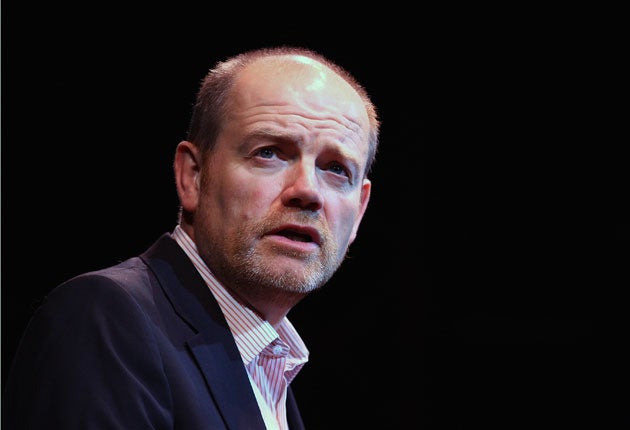
British journalism is going through a "dangerous period", the Director-General of the BBC said yesterday, as he warned of the "disturbing trend" for police forces to demand journalistic sources and materials and cautioned against state regulation of the press.

Mark Thompson warned that the response to the phone hacking scandal at the News of the World should not be to inhibit investigative journalism.

"This is a dangerous period for British journalism," he told the International Press Institute conference in Taiwan. "It would be easy to respond to the completely unacceptable actions of some jour- nalists at the News of the World by adopting such a draconian approach that even the best journalism is constrained. It would be easy for concern over the appalling invasions of privacy revealed by the phone-hacking scandal to spill over into legislation or regulation which enables wrong-doers to escape journalistic exposure."

But he also called for a future press regulator to be given powers to investigate complaints and issue fines. He said it would be a mistake to regulate press and broadcast media with a single body: "To put all journalism under a single converged regulator would potentially mean that, if ever the state wished to limit media freedom, it would have a single lever with which to do so."

Mr Thompson was especially critical of the recent treatment of news organisations by the police. He referred to Scotland Yard's use of a production order under the Official Secrets Act in an attempt to force The Guardian to reveal sources on the phone-hacking story.

"This production order is part of a wider, and in my view, disturbing trend for police forces in many parts of the UK routinely to demand that journalists disclose sources and hand over journal- istic materials," he said.

"At the BBC, we receive an ever-growing number of demands for untrans- mitted news rushes which the police seem to regard as having no more privilege or protection attached to them than CCTV pictures."

He added: "Like politicians, the police often find themselves with a conflict of interest when weighing the independence of the media with their own priorities as they conduct investigations. Sometimes that conflict leads to faulty – and dangerous – actions."

Mr Thompson predicted that the Leveson inquiry into media standards could have implications for relations between the state and the media in many countries.

"Governments and regulators will be watching what happens in Britain with great interest," he said.

Independent Comment
blog comments powered by Disqus
Career Services

Day In a Page

Can we pull the plug on the plug?

Can we pull the plug on the plug?

Wireless power is beginning to surge its way into homes, businesses and garages
The 10 Best Lecture Series

The 10 Best Lecture Series

From Intelligence Squared - possibly the world's premier debating forum - to the ICA Talks
Still making a big noise: A season of Michael Frayn plays is set to reaffirm the brilliance of his work

Michael Frayn: Still making a big noise

A season of Frayn's plays is set to reaffirm the brilliance of his work
'You could have a job like mine': How successful alumni can inspire pupils

How successful alumni can inspire pupils

Hilary Wilce sees an innovative scheme in action at a London comprehensive
The tuition paradox: You pay more money, you get less choice

The tuition paradox

You pay more money, you get less choice
The rivals: Canberra's political hate story

The rivals: Canberra's political hate story

Six years ago, Kevin Rudd was ousted as Australian PM by former ally Julia Gillard. Is he about to get his revenge?
Menswear finds its swagger to escape role as poor relation of British fashion

Menswear finds its swagger...

... and escapes role as poor relation of British fashion
'There was someone who needed it...' 60 lives, 30 kidneys, all linked in longest donor chain

60 lives, 30 kidneys, all linked in longest donor chain

Organ donation to stranger starts an amazing series of events across 11 US states
The ad that only plays to women: the future of marketing or useless gimmick?

The ad that only plays to women

The future of marketing or useless gimmick?
Sam Wallace: Chelsea's class of 2012 fail to make the grade

Sam Wallace

Chelsea's class of 2012 fail to make the grade
Lewis Moody: My five ways England can bring down the red curtain

Lewis Moody column

My five ways England can bring down the red curtain
Picture preview: Charline von Heyl, Tate Liverpool

Charline von Heyl, Tate Liverpool

Picture preview
Slow progress in Christchurch one year after quake

Christchurch a year on

Residents mark the first anniversary of the earthquake
Niceness rocks! Ballads take centre stage at the Brits

Niceness rocks!

Ballads take centre stage at the Brit Awards
Robert Fisk: 'If only hague and clinton would listen to yusuf islam'

Robert Fisk

'If only Hague and Clinton would listen to Yusuf Islam'