'Journalists must never betray a source, even a mass murderer'
Two filmmakers tell Andrew Johnson why they're standing by a promise to Pol Pot's chief killer
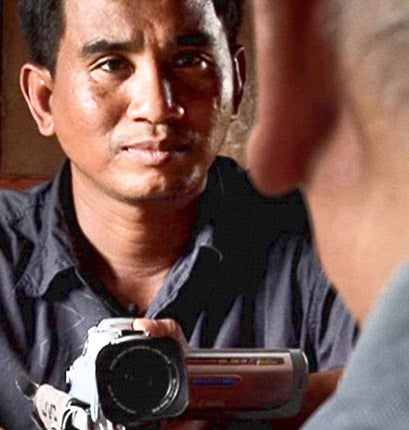
Which is more important, the story or the source? It is an age-old journalistic dilemma.
For Thet Sambath, a Cambodian journalist who has spent years investigating the war crimes of the Khmer Rouge, extracting a confession of mass genocide from Pol Pot's right-hand man was the scoop of his life.
He has spent nearly a decade befriending and gaining the trust of Nuon Chea – second-in-command to Cambodian dictator Pol Pot – who is the most senior leader of the Khmer Rouge alive since Pol Pot's death in 1998. But the confession was granted to Sambath on the condition that he promise to use it as a historical record only, and that it should not be used against Nuon Chea.
Now, the UN has requested that Sambath hand over his 160 hours of footage, to be used as evidence in its trial of Nuon Chea for genocide, which begins next year. Rob Lemkin, the Oxford-based film-maker who produced Sambath's film, Enemies of the People, has even had uninvited visits from UN representatives at his home. "They rang up and said they were in town and could pop round to pick the films up," he says. "When I refused, they told news organisations that it was because I wanted to make money from the film."
The trouble for the UN is, Sambath and Lemkin are determined not to hand over the tapes: they are honouring their promise to Nuon Chea. To some, it may seem a perverse choice, given the brutality of his crimes. It is particularly surprising given that Sambath's own family were victims of his appalling regime. "It's essential as a journalist or filmmaker, that if you give an assurance, you don't change the goal posts after you've made the film," says Lemkin. "They engage in a process with you and you must stick to that promise. As a result of not bowing to the court we are now seen as an independent party in Cambodia, and more Khmer Rouge people are talking to us and they will not talk to the court."
The interview forms part of Sambath and Lemkin's award-winning Enemies of the People, which is released in cinemas next month, and which won the special jury prize at this year's Sundance Festival. Nuon Chea, now 84, comes across as a benign old man; sitting in his simple wooden shack in a rural part of Cambodia, he weighs his words carefully. "These people were categorised as criminals," he says of his victims. "They were killed and destroyed. If we let them live, the party line would have been hijacked. They were enemies of the people." Asked about his regime's policy to kill traitors, he replies: "At the time I agreed. I just wanted to get the problem solved. It was the correct solution."
Like many architects of the Khmer Rouge, Nuon Chea has kept his head down ever since, living in retirement close to the Thai border. Known as Brother Number Two, his confession to ordering the torture, murder and arbitrary executions of up to two million people is an important step for a people still coming to terms with the atrocities of 1975 to 1979.
This spell-binding confession is just one of many that Sambath has been granted in years of speaking to ordinary foot soldiers, many of whom seem relieved finally to unburden themselves of their guilt. "After I filmed Nuon Chea I was only the third person who knew of his role, after Pol Pot and himself," he says. "It was very difficult to interview him, but over 10 years I got to know him and his family very well and we became very close. I think that was almost inevitable."
Why will he not release the films to the UN? "I don't think revenge is good for anyone. My work was focussed on gaining as complete an account of the Killing Fields as I could. Revenge has no part in that. I think the court is focussed on justice, which is okay. But I think reconciliation would be a better end result. For reconciliation to take place we need first the truth."
Nuon Chea's prosecutors have thought about legally seizing the film – a public showing cannot be used as evidence – but ran out of time. "The investigating judge did ask to look at the film," says a spokesman for the Extraordinary Chambers in the Courts of Cambodia, which is prosecuting Nuon Chea. "We wanted to see if any part of it was interesting and could be used as evidence. The request was turned down. We don't have any comment on that but the indictments have been made."
Lemkin stresses that neither he nor Sambath want to "get in the way" of the court, but says that a truth and reconciliation process, such as took place in South Africa after the fall of apartheid, is more important than bringing a handful of people to justice. "It is more important for people who suffered the kind of trauma they have suffered to have the fullest public access to what happened," he says.
"When a huge number of killings happen it's not done by one person at the top. There are thousands of people and they live in communities all over Cambodia. If there's a way those people can talk and be able to take part in genuine conversation with the victims, then that's more important than sending one or two of them to jail."
Enemies of the People is in cinemas from 10 December
Join our commenting forum
Join thought-provoking conversations, follow other Independent readers and see their replies
Comments
Bookmark popover
Removed from bookmarks