Lie detectors at war (but who's telling the truth?)
It's not just Jeremy Kyle and Trisha Goddard who are rivals: the polygraph experts on the two shows are engaged in a bitter defamation battle. Jerome Taylor reports
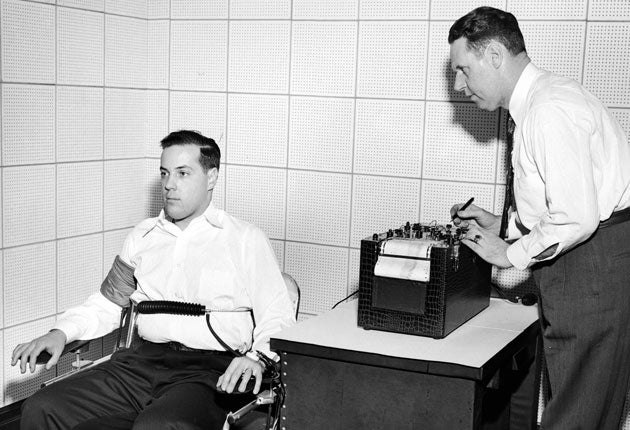
It is the kind of argument that could probably have been settled by the tools of their trade, but bosses at two of Britain's major polygraph companies are choosing to deal with their differences in the High Court rather than opting for lie detectors.
On one side is Bruce Burgess, a 64-year-old polygraph expert whose company is used to identify love rats and maintenance shirkers for ITV's The Jeremy Kyle Show. On the other side is Don Cargill, who conducts polygraphs for The Trisha Goddard Show, Five's rival show to Kyle's.
According to a writ filed in the High Court, Mr Burgess is suing his opposite number over a letter Mr Cargill allegedly wrote to the broadcasting watchdog Ofcom in which he reportedly said Mr Burgess had been sacked for incompetence from a government pilot to test sex offenders.
Mr Burgess claims he was never even hired for the government programme and has alleged that Mr Cargill was trying to discredit him because he obtained different results on a lie detector test they both conducted on the same person. Mr Burgess has now filed a defamation case for £50,000 against Mr Cargill in the High Court.
The spat between Mr Burgess's Distress Services and Mr Cargill's company, Nadac Group, began last year following an episode of The Trisha Goddard Show in which a woman was accused by her family of stealing a £38,000 Rolex watch.
Betty Hipson, a 57-year-old grandmother from Leatherhead, contacted the producers at Trisha Goddard because her family had accused her of stealing the watch. She wanted to take a lie detector test to prove her innocence. The polygraph test was conducted by Mr Cargill's company and found Mrs Hipson was lying.
Undeterred, Mrs Hipson went to Mr Burgess's company for a second test, which, unlike the previous polygraph, found her innocent of stealing the watch. Mrs Hipson then complained to Ofcom about the Trisha show and it was during correspondence between the show's producers and the Nadac Group that, according to the writ, Mr Cargill accused his rival of being fired from a government-backed programme.
The pilot programme is run by Don Grubin, a professor of forensic psychology at Newcastle University, who is testing sex offenders across the country for the Home Office to see whether polygraphs can be used to determine whether offenders seeking parole still pose a threat to the public.
According to a statement filed with the writ Professor Grubin stated that he has never hired or met Mr Burgess in any professional capacity. Speaking to The Independent yesterday Mr Burgess said he felt compelled to clear his name in court.
"In the industry I'm in, the truth is everything," he said. "I've never worked for this government programme and despite asking for an apology I have yet to receive one." Mr Cargill, who also runs the British and European Polygraph Association (Bepa), said he had been instructed by his lawyers not to talk to the media.
The High Court has yet to set a date for the hearing but if it comes to court it will shed fascinating light into the polygraph industry within Britain.
Buoyed by the success of chat shows such as those hosted by Jeremy Kyle and Trisha Goddard, both of which routinely ask guests to undergo lie detector tests, the number of companies specialising in polygraph tests is growing year on year.
Before the early 2000s there were barely three polygraph companies operating in Britain. Bepa currently has 10 UK-based polygraphers on its books and a further 49 listed abroad, although polygraphers are under no obligation to sign up to umbrella or trade bodies.
Jeremy Barrett, the managing director of Polygraph Security Services, one of the oldest companies in Britain to offer lie detector services, said more and more companies are opening up in Britain.
"I qualified in polygraphy in 1982 and for 20-odd years we were the only people operating a lie detecting company," he said. "In recent years the number of companies offering similar services has increased dramatically."
Polygraph tests cannot be used as evidence in British criminal courts but they can be used in civil or tribunal cases. They are usually used by defence teams hoping to prove that clients are not lying rather than catching out those who do lie and are usually only taken voluntarily. In the United States it is not uncommon for prospective employees to be asked to take polygraphs during job interviews.
In recent years the Home Office has increasingly toyed with the idea of rolling out nationwide polygraph tests for sex offenders after studies found up to 85 per cent of them were re-offending or breaching parole.
Critics say the tests are not as accurate or empirical as their supporters suggest and point to numerous scientific studies that have questioned how accurate polygraphs are.
But polygraphers like Mr Barrett defend the use of lie detectors as long as the right questions are asked.
"The thing with lie detector tests is that there has to be an element of gain for them to work, you have to have an important reason to lie," he said. "If I asked you whether your father's name was Henry, for instance, and you said yes, it probably wouldn't register as a lie. You would then be able to say you'd beaten a lie detector test. But say you needed your father to be called Henry because you wanted to con him out of £2.3m in inheritance, then suddenly there's something to lose and we can tell if you are lying."
No sweat: How to cheat a lie detector test
Modern polygraphers use a variety of analogue and digital machinery to measure several physiological responses that often happen when we lie. Polygraph machines measure blood pressure increases, pulse, respiration rates, iris contraction and skin conductivity as subjects are asked a series of probing questions.
During a test, polygraphers ask their subjects questions that fit into three categories and then compare the responses. The first are a set of "control questions" such as "Have you ever stolen anything?" or "Have you ever lied to your spouse?" These are questions which almost everyone should answer yes to but which may be uncomfortable. Then there are the "irrelevant questions," such as "Have you had pizza today?". They have no relevance to the interrogation but they can help distract the subject from the "relevant" questions. These are specific questions such as "Did you leak that memo to the media" that should reveal whether you are telling the truth or not.
The problem is that polygraphs only really work with those who become stressed when they lie – pathological liars can breeze through a test.
Although proponents usually say polygraphs are 90 per cent accurate, a number of scientific studies conducted in the US suggest their accuracy could be as low as 65 per cent.
It is also possible to train people to pass polygraph tests, although this has to be very carefully done as abnormal physiological responses would lead a polygrapher to the conclusion that you were lying anyway. Some people resort to placing deodorant on their fingertips to stop sweating, others are able to control their heartbeat and blood pressure. Online advice for American jobseekers who might be polygraphed by prospective employers also recommend pain techniques such as biting one's tongue during answering in order to fool the machine. Another technique often used is to contract the sphincter muscle when answering questions in order to briefly raise one's blood pressure.
Join our commenting forum
Join thought-provoking conversations, follow other Independent readers and see their replies
Comments