Rebels with a grudge and the anatomy of a damning smear
The BBC's claim this week that $95m of aid to Ethiopia had in fact been spent on weapons was incendiary, threatening to undermine future aid efforts. But, says Paul Vallely, it does not stand up to scrutiny
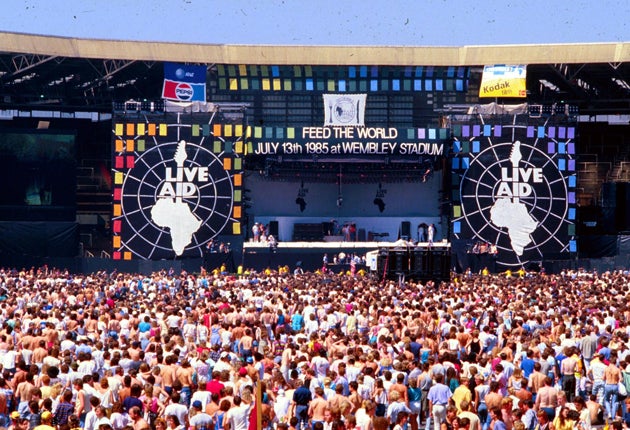
Live Aid millions spent on arms," headlines have said all over the world in the past few days after a year-long BBC investigation announced it had found evidence that millions of dollars earmarked for victims of the Ethiopian famine of 1984-85 went to buy weapons.
It was, on the face of it, a highly damaging story which could undermine the extraordinary generosity of the public to give to the appeals launched whenever a major disaster strikes, as it has in Chile and Haiti in recent weeks. But examine the BBC report and it slips like sand through the fingers. What follows is the anatomy of a slur.
The story, by the BBC World Service's Africa analyst, Martin Plaut, said that in 1985 the rebels of the Tigrean People's Liberation Front diverted 95 per cent of the aid sent to the north of Ethiopia into its fight to overthrow the government of the time. He quoted two senior rebel soldiers as saying that rebels had dressed up as merchants to trick aid agencies into handing over large amounts of cash, purportedly to buy food. To back up the claims he cited recently released CIA documents and quoted a senior US diplomat as saying that at the time they had believed that aid was "almost certainly being diverted for military purposes". It all sounds incredibly damning – until you ask who is making these allegations.
The most senior rebel is Aregawi Berhe, once a commander in the rebel army. Or at least he was until the mid-80s when he fell out with the other leaders of the TPLF, most particularly with Meles Zenawi, the rebel who went on to become the Prime Minister of Ethiopia and who – revealingly enough – is facing a general election in Ethiopia next month.
Aregawi fled to Holland, from where he has for years conducted vehement attacks on his erstwhile colleagues, Meles Zenawi in particular. "Not only did he defect under very political circumstances," said one Western aid monitor who spent years in Tigray at that time, "but he was in a different part of the country during much of this time." Indeed one partisan Ethiopian website has claimed, Aregawi left the TPLF before the clandestine cross-border import of food from Sudan even began.
There are doubts about the good faith of the other rebel official quoted in the BBC story. Gebremedhin Araya was a senior figure in the TPLF's finance department. He was photographed dressed as a Muslim merchant counting the money after selling sacks of grain which were really, he said, filled with sand. But Gebremedhin too was purged by the TPLF and fled to exile in Australia.
So the core of the BBC story rests on the claims of two individuals with a grievance against the current Ethiopian government and a track-record of attempts to discredit it – and it comes at a time when it might do maximum damage to the Ethiopian prime minister just ahead of elections. That does not mean they are wrong, but it sets up reasonable doubts. Alarm bells ought to have begun ringing at that point.
They ought to have rung louder at some of the discrepancies in detail. Aregawi Berhe claimed that the British aid worker in the photo, Max Peberdy of Christian Aid, had handed over $2m. But the charity insists that Peberdy had only $500,000 for his entire grain-purchasing mission. Yesterday Pederby said that the deal in the photograph involved only $60,000.
"We bought from different merchants each time," said Nick Guttmann, director of emergency relief operations at Christian Aid . "We paid in Ethiopian birr, not dollars, which is what international arms traders demand from those who want to buy guns. We checked the grain – not every bag – but random sampling in the techniques used by professional port surveyors. We went to see the grain distributed. The idea that we just handed the money over and then walked away is preposterous. We had proper systems in place and we always do."
The BBC report gave added credence to the rebels' claims by quoting a recently released CIA document which suggested some aid was "almost certainly being diverted for military purposes". But close scrutiny of the document shows it is dated April 1985 – three months before the Live Aid concert even happened. A later CIA document, dated July 1985, after Live Aid, makes no mention of aid cash going on arms in rebel areas.
Finally the BBC programme quoted Robert Houdek, the most senior US diplomat in Ethiopia in 1988, the year after the TPLF overthrew the Mengistu dictatorship in Addis Ababa, as saying that the former rebels told him that "some of the food coming in through the Sudan was being sold for cash". But, again, Houdek offered hearsay, not evidence. He gave no facts or figures.
So what was the truth?
Ironically, despite the lurid headlines of recent days, the money from the Band Aid Trust was perhaps the best monitored. "We put so many checks in place precisely to stop that kind of thing," said Penny Jenden, who was Band Aid's director, yesterday. "We spent our money mainly on trucks to move food, in the early stages, and then on seeds, tools and oxen. And we didn't give any money directly to REST [the Tigreans' own aid agency] till 1986."
Band Aid spent less than half a per cent of all Live Aid money in Tigray in 1985. In the six years to 1991 Band Aid's total spend there was only $11m of the $100m Live Aid raised. "We knew it was a difficult situation," said Jenden, "so our accounting procedures were doubly strict. As well as Band Aid staff we sent in independent monitors to check, and we shared all our info with the other NGOs."
Oxfam, Christian Aid, Unicef, the Red Cross and Save the Children all insist that they too had robust on-the-ground monitoring in place. They have all made similar statements. "The agencies on the ground did some serious monitoring – from purchase to delivery to distribution," one high-level independent monitor said yesterday. "I saw the grain being loaded on REST trucks and then saw it being distributed," said another.
Only a fool would suggest that it is impossible that some aid may have been subverted by the military. But ironically the most likely source of aid diversion was from the food aid provided by the US government – and it may well have been done with the connivance of the CIA who were happy at the thought of the Marxist dictatorship in Addis being overthrown. The CIA was at that time giving clandestine support to rebels in both Nicaragua and Afghanistan.
"In any aid operation you work on the basis that 10 per cent of aid will go astray," said Myles Wickstead, a former British ambassador to Ethiopia. "It's the price you pay for getting the 90 per cent through. Where lives are at stake you cut corners and take risks. You make judgements. But I'd give no credibility whatsoever to the idea that 95 per cent of aid to Tigray was diverted.
"It was too highly monitored, most particularly that of Live Aid. Some money may well have gone astray in Ethiopia in 1985. But nowhere nearly on the scale which the BBC has alleged."
Join our commenting forum
Join thought-provoking conversations, follow other Independent readers and see their replies
Comments
Bookmark popover
Removed from bookmarks