Susan Boyle 'drained' says Piers Morgan
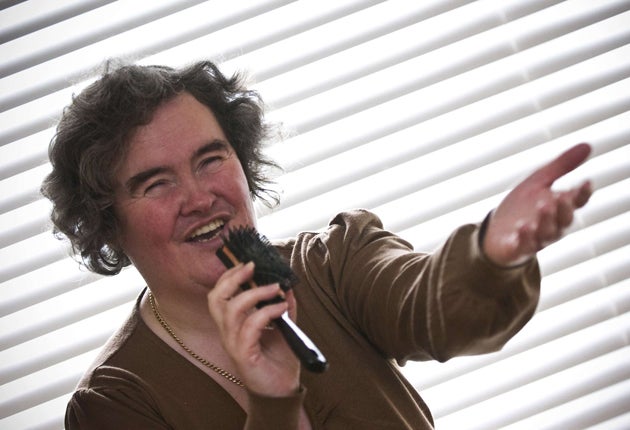
Britain's Got Talent judge Piers Morgan today said that singer Susan Boyle was emotionally drained and exhausted after being put under more pressure than any other contestant in the show.
Following today's news that the singer has been taken to the Priory clinic in London, he told GMTV: "Nobody has had to put up with the kind of attention Susan has had. Nobody could have predicted it.
"It has been crazy, she has gone from anonymity to being the most downloaded woman in history."
He said that the length of time Boyle had to wait between her semi-final performance and the final, a week later, had added to the pressure.
"It just builds and builds and builds."
He added that Boyle, unlike the other contestants, had been subject to attention from international media and added that "a little bit of negativity crept in."
But he insisted that the show's runner up was "essentially fine".
"She was very tired and hasn't been sleeping. She has just gone away to have some time to herself and to sleep and eat, doing all the things she hasn't been able to do in the last week."
The singer was rushed to the Priory clinic after she started acting strangely following her shock defeat to dance group Diversity on Saturday.
Reports claimed that she shouted backstage "I hate this show" and threw a glass of water at a member of staff who tried to calm her.
Production company talkback Thames said she was taking time out on the advice of a doctor.
Morgan denied that the defeat had shattered Boyle's dreams.
"Her dream was not to win a talent competition, it was to sing professionally and she will do that."
He denied reports that Boyle has already signed recording deals.
But Fred O'Neil, her friend and former voice coach, described her plight as "a tragedy", claiming fame had not brought her happiness.
He told BBC Breakfast: "It's such a tragic situation, a woman who really just loves to sing, an innocent woman really, who is just caught up in this fame game."
He added: "I just hope that whatever fame that she has got out of this will eventually bring her some happiness. Obviously at the present time it is not."
The Scottish star has been tipped to make millions from a singing career and bookies are already predicting a number one chart hit in America.
The church volunteer appeared on Oprah Winfrey's television show after millions of people logged on to YouTube to watch her spine-tingling Britain's Got Talent audition.
Her new-found celebrity ensured that the competition kept grabbing the headlines and the final became the most watched television programme in the UK for five years.
But recent days saw a backlash against Boyle, who was accused of four-letter outbursts at her hotel and faced speculation that she would not be able to cope with the pressure of fame.
Boyle has a learning disability and charity Mencap said this could make it harder for her to adapt to the rapid changes she has experienced.
Amy Clarke said: "Sometimes people with a learning disability, like me, find it harder to communicate and get used to new things. Susan Boyle's life has changed overnight and she, like anyone else, should have the right support to deal with this kind of pressure.
"Someone with a learning disability might need support dealing with new situations and communicating their feelings in an appropriate way."
But she added: "I like the fact that someone with a learning disability has done well on a talent show. Susan Boyle is an inspiration to me because you rarely see people with a learning disability on television and making a success in showbiz."
Andrew McCulloch, chief executive of the Mental Health Foundation, said: "As a result of taking part in Britain's Got Talent, Susan Boyle has received an unprecedented amount of attention.
"Considering that she has also had to cope with the pressure of taking part in a national television competition it is understandable that Susan is feeling exhausted. The experience can be overwhelming, especially for somebody who is not used to living in the spotlight.
"Reality television programmes and the media can very quickly propel people who lead very ordinary lives into a world that is unfamiliar and fast-paced. It is only right that Susan is being supported at this time and is getting the care she needs."
Bookies avoided huge payouts with her surprise defeat.
Meanwhile the emotional distress shown by young finalist Hollie Steel, 10, who broke down in tears during her semi-final performance raised questions as to whether an age limit should be imposed on the competition.
Diversity took 24.9 per cent of the public vote in the final, above Boyle's 20.2 per cent share. The contestant in third place, saxophonist Julian Smith, gained 16.4 per cent of the vote.
Just under four million people voted, ITV said.
Publicist Max Clifford said Britain's Got Talent offered "maximum care and protection" to performers, including Susan Boyle.
"What matters best and most importantly is her health and well-being," he told BBC Radio Scotland's Good Morning Scotland programme.
"What they've got to do is assess how things are and how she is before knowing what's best to do in terms of the future.
"This is something she wanted to do and this is something she put herself forward for and has had tremendous success world-wide out of it."
Mr Clifford said Boyle needed the support of those closest to her.
"Susan should have people around her that she's lived with for many, many years, the people that know and understand her," he added.
"That kind of protection is going to be important to her if she's going to continue in the business."
A spokewoman for the Priory Hospital said: "We never comment on individuals."
Gordon Brown revealed on GMTV that he watched the final on Saturday night and described Diversity as "absolutely wonderful".
Asked if he had voted for them, he said: "My children had different opinions ... Susan Boyle was also very, very popular."
He added: "I hope Susan Boyle is OK because she is a really, really nice person and I think she will do well.
"I spoke to Simon Cowell last night and to Piers Morgan and wanted to be sure that she was OK.
"But also to praise Diversity, just an amazing success for Britain and that will go right round the world."
Join our commenting forum
Join thought-provoking conversations, follow other Independent readers and see their replies
Comments
Bookmark popover
Removed from bookmarks