'I always thought I'd be here' insists Chancellor who won't be moved
In a passionate interview, the Chancellor talks to Andrew Grice about cuts, clashes and the reshuffle
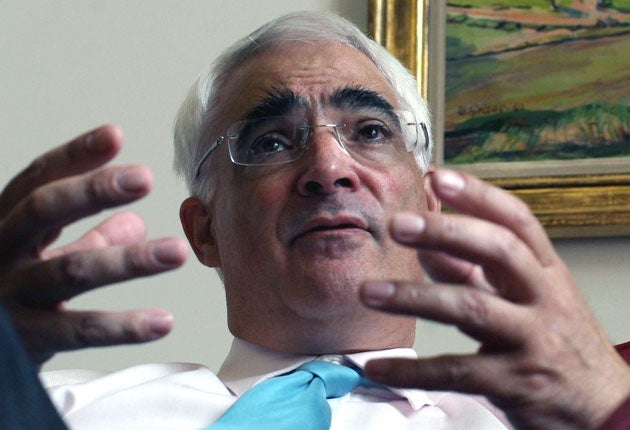
On a blisteringly hot day, Alistair Darling looks remarkably cool as he relaxes on a sofa in his Treasury office. Surely, there must have been times recently when he thought he would not be there by now, as speculation mounted that Gordon Brown wanted to install his ally Ed Balls as Chancellor in last month's reshuffle?
"No," Mr Darling smiles. "I have known the Prime Minister a long time. I always thought I would be sitting here on a hot day enjoying the fantastic view of the trees in St James's Park." He insists that his relationship with Mr Brown has not been damaged by the speculation. "If you are not grown-up about these things, you should not be in politics," he says.
Unlike Mr Balls, Mr Darling is not one to shout from the rooftops. Since the reshuffle, he has quietly been urging Mr Brown to redraw his favourite dividing line – Labour investment versus Tory cuts – by admitting that spending will have to be squeezed after the general election, before spelling out the parties' different priorities. The Prime Minister finally came round in a BBC interview on Wednesday.
The quiet man of the Cabinet becomes surprisingly loud and passionate as he talks the language of priorities. "After building up the health service for 12 years, no one is going to convince me we should do something different," he says.
But how will voters tell the difference between the two parties if the Chancellor shies away from publishing a government-wide spending review before the election, giving the Tories cover to avoid spelling out the cuts they promise?
Mr Darling insists the uncertain economic position means he cannot decide now whether to go ahead with the scheduled comprehensive spending review (CSR). He will announce his decision in his pre-Budget report, due in November. "To do detailed allocations running up to 2013-14 at the moment, with all the uncertainty, just does not make any sense," he says.
He promises that, one way or the other, Labour will make its spending priorities clear before the election, in an attempt to flush out the Tories. One option might be a mini-CSR. Another is to announce before the election which budgets would be ring-fenced, challenging the Tories to do the same.
Although he hasn't yet decided how, Mr Darling promises to ensure a clear choice. "We have to be clear, as we go into an election – and the Tories will have to be – which choices we are prepared to make," he says. He is already compiling his list of differences, citing the Tories' refusal to guarantee Labour's flagship Sure Start centres. He remains confident that, by polling day, such contrasts will enable voters to know the "big differences in priorities and attitude" of Labour and the Tories. In other words, Labour hopes people will trust its instincts on public services, not David Cameron's.
The Chancellor has a new tool as he tries to do more with less money: switching resources between departments. Several ministers chipped in unspent funds from their own budgets to finance the boost for social housing announced on Monday, and he will repeat the trick "if it is sensible".
But the idea has its limits. He quips: "Many of my [cabinet] colleagues think we should be making more switches. But when I knock on the door and say 'OK, what about this £100m', they say 'not from my department'."
While recent events have tested his relationship with Mr Brown, there has also been tension with Mervyn King, the Governor of the Bank of England, who sent shockwaves through the Treasury last week by telling MPs he had not been consulted about next week's White Paper on banking. "No one had seen it because it had not been written," Mr Darling replies. "We have talked extensively about these problems."
He is anxious to play down the damaging, repeated reports of a rift with the Governor, insisting their relationship is "absolutely fine". He portrays Mr King as a man fighting his corner as the White Paper is drawn up. "He is rightly proud of the Bank's independence," he says. He professes not to be worried about the rising "footsie index" between Mr King and the shadow Chancellor George Osborne, who wants the Bank to be in the driving seat on bank regulation. "It is in all our interests that the Bank's great strengths lie in its independence."
Perhaps optimistically, Mr Darling believes that, in a pre-election recovery, the voters will clock the difference between Labour's actions to limit the recession and the Tories' "do nothing" approach. He dismisses warnings that the signs of recovery could peter out and that Britain could face the dreaded "double-dip" or W-shaped downturn. "There clearly has been a very sharp V," he says. "But I am confident the economy will start to grow by the end of the year."
Join our commenting forum
Join thought-provoking conversations, follow other Independent readers and see their replies
Comments
Bookmark popover
Removed from bookmarks