Brian O'Driscoll: Green giant
The Ireland rugby team today go in pursuit of their first Grand Slam since 1948. For their captain and talisman, it would be the crowning achievement in a glittering career
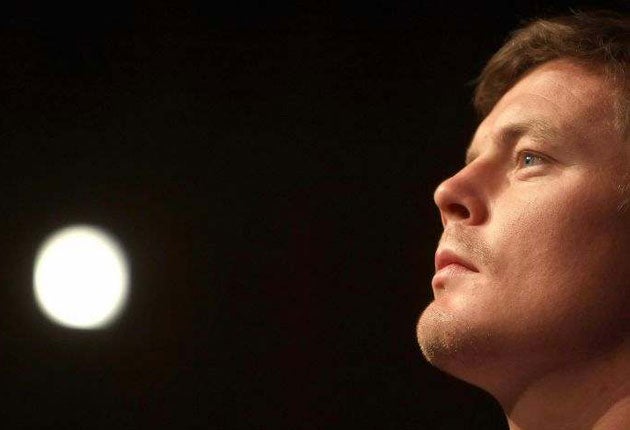
Today in Cardiff the Ireland rugby union captain, Brian O'Driscoll, stands, square-jawed, on the threshold of the defining achievement of a glittering career. If the 30-year-old Dubliner leads his country to victory over Wales at the Millennium Stadium, then he and his team-mates will have defeated all five other teams that contest rugby's annual Six Nations tournament, thereby clinching the rare and coveted Grand Slam.
The Welsh will be similarly motivated, because for them a win over Ireland will yield the Triple Crown (secured by victories over the other three home nations). But if the match goes Ireland's way in front of two of the most passionate sets of supporters in any sport, anywhere, then O'Driscoll will join an 82-year-old retired gynaecologist called Karl Mullen in the record books, for Mullen was captain the last time the Irish won a Grand Slam, 61 years ago.
One difference between then and now, however, is that in 1948, the term Grand Slam had not yet been coined. Another difference is that Mullen, fine player though he was, was not Ireland's finest. The team's transcendent, talismanic performer was the twinkle-toed fly-half, Jack Kyle. But the talisman in this Irish team is the outside-centre, O'Driscoll himself, and that has been so for most of the nine years since his scintillating hat-trick of tries against France secured Ireland's first win in Paris since 1972.
A couple of years after that famous occasion, in January 2002, I met O'Driscoll for the first time, in the lobby of a hotel in Limerick. I was there to interview him for this newspaper and it was a curious experience, both uplifting and disconcerting. Never had I felt, in the company of someone many years younger than myself, so much the junior partner in terms of self-confidence and even worldliness. There was an almost tangible aura around him of assurance and authority, and yet, unusually for a brilliant young sportsman with mountainous self-belief, it couldn't be called arrogance.
On the contrary, he has generally dispensed a kind of effortless humility. I remember asking him that day what it was like to be nicknamed God, which was intended only partly as a play on his initials. "Oh," he said, breezily. "That's only in England. And on Sky Sports."
It was true enough. In Ireland they know him as BOD. His autobiography, published last year, was called In BOD We Trust. But supporters of the British and Irish Lions found another play on his name when he jinked from the halfway line to score one of the greatest tries in Lions history against Australia in 2001, cheekily sequestering the opposition anthem. "Waltzing O'Driscoll, waltzing O'Driscoll," they cried.
Last September I met waltzing O'Driscoll again, this time in a sports centre in Dublin. I wondered whether, with six more years of experience behind him, and having been the victim of one of the most infamous assaults in the history of an often brutal game (of which more later), he might have acquired a cynical edge. But if he had, he didn't show it.
I asked him whether he was still the poster boy of Irish sport. After all, he has been voted sexiest man in Ireland. "Are you mad," he said, with the trademark crinkly-eyed smile that might give a thousand colleens cause to differ (among them his girlfriend, the lovely actress Amy Huberman). "Have you seen Kearns [the smouldering Leinster and Ireland wing Rob Kearney]? He's the ladies' choice now. I'm yesterday's news. Fish and chip paper. I just want to impress from a rugby point of view."
This he has unequivocally done. After an indifferent couple of seasons by his own stratospheric standards, and a litany of debilitating injuries, even his keenest fans were convinced that he could never recapture the form that made him, for a while, the best player in the world. But in this tournament he has dazzled like the O'Driscoll of old, tackling like the crack of doom and sniffing scoring chances like a forest animal, as one of rugby's great wordsmiths, the erstwhile BBC commentator Bill McClaren, once said of a man with whom O'Driscoll can now legitimately stand comparison, Ireland's fabulous centre of the 1960s and 1970s, Mike Gibson.
In Ireland's narrow defeat of England in Dublin, O'Driscoll was everybody's man of the match, and beforehand, just to give even fuller value for money, produced the quotation of the tournament. Asked for his view on the modus operandi of the beleaguered England manager, his former Lions colleague Martin Johnson, he memorably opined that "knowledge is knowing that a tomato is a fruit, wisdom is knowing not to put it in a fruit salad".
Three weeks earlier, in the thrilling victory over France, he had produced a vintage shimmy to weave through the defence and under the posts. There are other wonderful players in the Irish team, but if O'Driscoll fails to produce the goods in the Cardiff gloaming this evening, it is much harder to imagine the pubs of Dublin and Belfast being emptied of Guinness into the wee hours of tomorrow morning.
The reference to Belfast is significant, incidentally. Unlike its round-ball cousin, rugby football is an all-Ireland sport, melting the border and transcending religion. Over the years the Ireland team has mostly comprised Catholic players from the Republic, but Irish rugby would be greatly diminished without the input of some totemic Ulstermen, not least Messrs Gibson and Kyle. It is not fanciful to suggest that such men have symbolised a unity of passion and purpose in Ireland, even, or perhaps especially, in the most troubled of times.
The same applies to O'Driscoll. He comes from good Catholic stock, was brought up to go to mass and stopped only in his late teens, but in Northern Ireland today it will be hard to find a rugby-loving member of even the most reactionary lodge in the Orange order unwilling to lionise him. Or who, speaking of lions, did not leap out of his chair in outrage when, scarcely 90 seconds into the first Test match between the Lions and New Zealand's All-Blacks in 2005, he was savagely upended in a so-called "spear" tackle that, had it not been for his formidable upper-body strength, could have broken his neck.
As it was, it ended his tour, which he had begun as Lions captain, and left him on the sidelines for the next five months. His attackers were the All-Blacks captain Tana Umaga and the hooker, Keven Mealamu. A spear tackle is when two team-mates lift a leg each of an opposing player, then drive him head-first into the turf, and this was a particularly gruesome example. It still beggars belief that neither Umaga nor Mealamu was punished for this assault, but O'Driscoll characteristically likes to play down the incident, describing it only as "a bit disappointing" that the authorities were so feeble. And he might yet get to extend his cruelly abbreviated career as captain of the Lions, in South Africa later this year.
In playing for the Lions, O'Driscoll is following in the studmarks of his Uncle John, who toured in 1980 and 1983. John played 26 times for Ireland and another uncle, Barry, played four times, while a third brother, O'Driscoll's father Frank, played twice for Ireland against Argentina. This makes O'Driscoll the nearest thing to a genetically engineered rugby star as it is possible to find, yet he scarcely played the game before he was 12.
He was a soccer nut, and only when he went to Blackrock College in Dublin, a fanatical rugby school and the alma mater of any number of celebrated Ireland internationals, did he catch the rugby bug. Before then, Manchester United's Mark Hughes was his idol. "I loved Mark Hughes even more than I loved Manchester United," he once told me. "I loved him for his temperament, his aggression, and the fact that he just couldn't score ordinary goals."
Not many of the record 35 tries O'Driscoll has scored for Ireland have been ordinary, either. But the green-shirted faithful won't mind if he doesn't score at all at the Millennium Stadium today, as long as he inspires an Irish win, and a first Grand Slam since old Jack Kyle, who will be in the stands watching and hoping, was strutting his stuff.
A life in brief
Born: Brian Gerald O'Driscoll, 21 January 1979, Dublin.
Family: Father (and manager) Frank O'Driscoll is a former rugby player for Dublin team Clontarf. His girlfriend is Irish actress Amy Huberman.
Early life: Born in Clontarf on Dublin's Northside, he was a member of the Ireland team that won the world under-19 championship in 1998. He attended University College Dublin where he gained a diploma in sports management.
Career: Made his first appearance for Ireland against Australia in 1999, aged 20. He quickly established a reputation as one of rugby's best outside-centres. Awarded the Irish captaincy in 2003, he has played in the last three World Cups, and from 2001 has been a member of the British and Irish Lions. He was made captain in 2005 for their tour of New Zealand, but was sidelined with a shoulder injury after being the victim of a controversial tackle. He plays his club rugby for Leinster and today against Wales will appear for Ireland for the 93rd time.
He says: "As a young guy I always thought experience was overrated. As an older player I think it's very underrated."
They say: "In BOD we trust" – Irish rugby supporters.
Join our commenting forum
Join thought-provoking conversations, follow other Independent readers and see their replies
Comments
Bookmark popover
Removed from bookmarks