Chris Patten: Battle-hardened of the BBC
Drawn into a scandal that threatens to engulf one of our greatest institutions, can its chairman steady the ship?
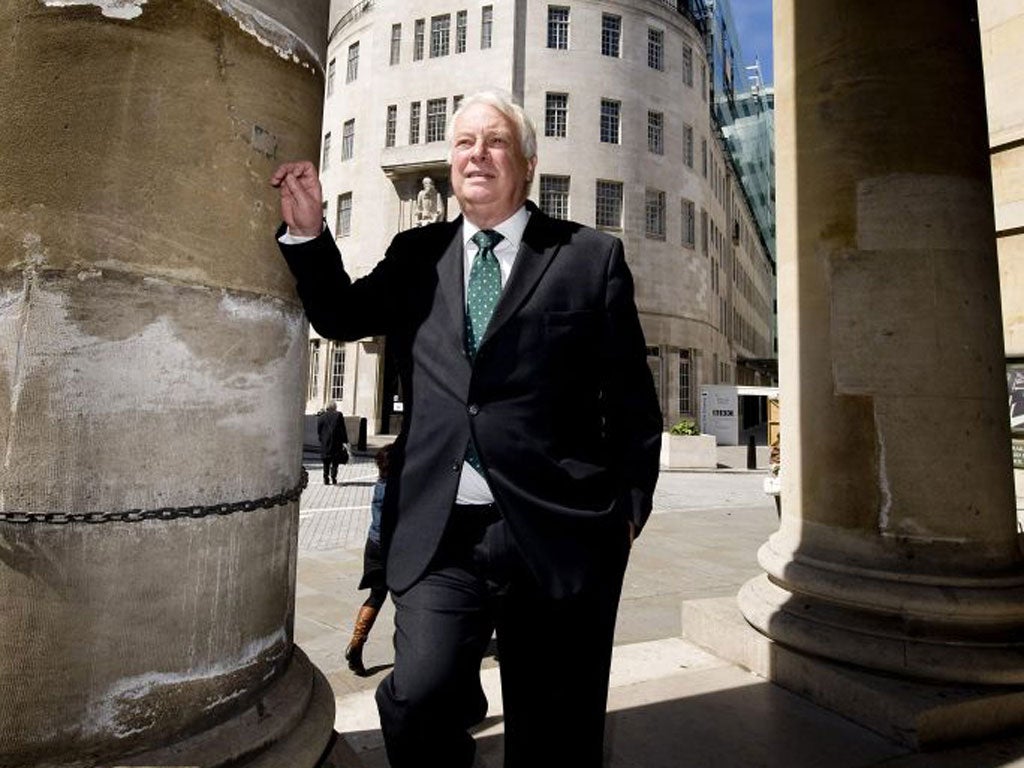
Of all the senior BBC figures floundering in the Jimmy Savile avalanche, only one knows what it is like to live through a crisis. Senior BBC managers are normally protected within a multi-layered hierarchy but the chairman of the BBC Trust, Chris Patten, faces the current frenzy after a tumultuous political career.
So it was perhaps not surprising that towards the end of another hysterical week at the BBC, it was Patten who, belatedly and after some early misjudged interventions, gave the most robust public response to events so far, acknowledging the severity of what has happened but defending as coherently as he could the haphazard reaction of the corporation. He sounded in control, even if his ambiguous chairman’s role does not allow him to take full command.
For someone who evidently enjoys life and who can give the impression of being laid-back, Patten has, almost in spite of himself, played a part at numerous historic turning points, a figure attracted to the comforts of the British establishment and yet travelling a hectic road to become a part of it.
Like many of the political stars who rose to the Cabinet in the 1980s, Patten started out, as he puts it with characteristically downbeat humour, “writing pamphlets that few read” in the Conservative research department. That was in the 1960s and 70s after a solidly middle-class upbringing in Ealing, west London, and a degree from Oxford. Patten has a theory that on the strength of one of his pamphlets, Margaret Thatcher concluded that he was dangerously left-wing. She had cause to be wary in the sense that Patten was a pro-European who was closer to the centre of the political spectrum than she was – much more reflective and forensic.
Although Thatcher was always an admirer of Patten’s political talents and communication skills, he had a longish wait to become a cabinet minister. When he finally made it, Thatcher put him in charge of the poll tax, arguably the most calamitous domestic policy introduced since the Second World War. Patten recognised the many dangers of the policy, but struggled to get Thatcher to accept significant amendments.
I was the BBC’s local government correspondent at the time, reporting each day on the Today programme the projections of the likely poll tax bills in different parts of the country. The predicted bills were comically high and totally inaccurate. Patten told me privately at the time, “I go in and see Margaret Hilda, show her the projections for the bills. She looks at them, then looks at me, and says ‘I don’t believe them’”.
The volcanic eruption over the poll tax was a key factor in the fall of Thatcher. Patten was one of the ministers who told her the game was up during those few dramatic days in November 1992 when Thatcher was forced to resign. He can be a bit of a bruiser if he wishes to be. He fought his corner and took some hits in the traumatic final years of Thatcher’s rule.
Patten’s first punishment for not being “one of us” was to be made a junior Northern Ireland minister, removed from the cut and thrust of most domestic policies. But his experience then provided the backdrop to one of his more challenging remits when he was asked to review policing in Northern Ireland as Tony Blair sought to revive the peace process after the 1997 election.
Patten is a Roman Catholic and his main task was to propose reforms to the RUC that would reassure the Catholic community in Northern Ireland without alienating Protestants, a task that makes presiding over a BBC at war with itself seem relatively straightforward. His report proposed sweeping changes, including a change of name for the RUC, a smaller force, and the inclusion of Catholics in the Protestant-dominated force. The changes, sensitively and assiduously handled, were a pivotal factor in the early success of the Blair initiative. All that came after Thatcher’s more emollient and centrist successor, John Major, made Patten his party chairman.
Once again he played a pivotal role at the centre of an intensely scrutinised saga. The party’s victory in the 1992 election remains an underestimated achievement, won in the midst of economic gloom, following an act of regicide and the scrapping of the poll tax. Major and Patten worked closely, the most effective relationship between prime minister and party chairman in recent decades. Briefly, the duo projected a more compassionate form of Conservatism, conveying a sense that the Conservatives were moving from Thatcherism to the more centrist Christian Democracy of some European countries.
Patten in particular had strong links with senior Christian Democrats in the EU. At the same time he showed how he could be a bruiser himself, adopting – in a way that was too transparently inauthentic – the language of a cockney salesman. Labour told “porkies”. Their tax and spending plans were a “double whammy”.
But in another dramatic twist, while the Conservatives won the election by a triumphantly wide margin, Patten lost his seat in Bath. When the loss was announced, senior Thatcherites, watching the results at the home of the former party treasurer Lord McAlpine, cheered with delight. National triumph, personal defeat and former colleagues celebrating his downfall were another concoction to test the spirit.
History called once more. Major, who missed him desperately as his government fell apart after the 1992 election, made Patten the last governor of Hong Kong, where he presided over the transfer of sovereignty to China, a role that was part-ceremonial yet highly politically sensitive, involving complex negotiations within Hong Kong and with the UK and China. From such a highly charged and emotionally draining role Patten moved on to become a European commissioner at a point when his party’s Euroscepticism was rampant
After Europe it seemed as if Patten, who enjoys reading, writing, music and a good glass of wine, had finally stepped aside from history and opted for the relatively quiet life of Oxford University where he was elected chancellor. He had a few directorships and a seat in the House of Lords.
Then last year Patten was appointed chairman of the BBC Trust, a role that offers many pleasures and yet leaves its occupant exposed to sudden storms, a pattern that defines Patten’s life of civilised pursuits and sweeping political drama. Someone who visited him in his office at the trust in central London recalls being in mid-discussion with him about problems at the BBC when Patten took a call from the then Director-General, Mark Thompson, to make arrangements for a pleasurable Saturday evening concert in Oxford.
Patten’s relations with the current DG, George Entwistle, are likely to be less publicly convivial for the time being, but he remains supportive of his choice. Some in the BBC believe that he rejected the women internal candidates because for some time he had regarded Entwistle as the son he never had. (Patten is the father of three daughters.) The reality is inevitably more complex.
Patten arrived as chairman of the BBC Trust aware of the need for radical change and was publicly critical of executive pay and the Byzantine management structures. Of the candidates for the Director-General job, Entwistle seemed to him most urgently determined to challenge the complacency and conservatism in parts of an institution where many people seem to have jobs for life. Entwistle’s much-criticised performance in front of the Culture Select Committee on Tuesday was one that Patten almost defended, saying that a “combination of Disraeli and Gladstone would have struggled”.
Blamed by some for the crisis, Patten faces a hugely testing challenge – to restore the BBC’s reputation. If he pulls it off, he will deserve the relatively quiet life of Oxford and the Lords without any more brushes with history.
A life in brief
Born: Christopher Francis Patten, 12 May 1944, Cleveleys, Lancashire.
Family: Son of Joan and Frank, a jazz drummer turned popular music publisher. Married, three daughters.
Education: Attended St Benedict’s School, Ealing, and read modern history at Balliol College, Oxford.
Career: Joined the Conservative research department in 1966 and was its director 1974-79. Became an MP in 1979, environment secretary in 1989 and party chairman in 1990. Lost his seat in 1992. He was the last governor of Hong Kong 1992-1997. From 1999-2004, he was a European commissioner and elected Chancellor of Oxford University in 2003. Made chairman of BBC Trust 2011.
He says: “The BBC is a moral force.”
They say: “When did you last watch EastEnders?” Tom Watson MP
Join our commenting forum
Join thought-provoking conversations, follow other Independent readers and see their replies
Comments