Christopher Jamison: The Pope has a friend in Father Christopher
The Vatican may be mired in scandal, but, in Sussex this Easter, TV's favourite monk is a model of faith and hope. Peter Stanford meets Christopher Jamison
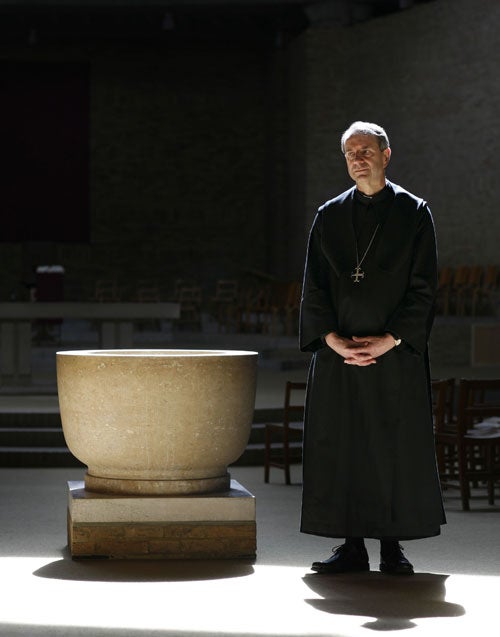
Abbot Christopher Jamison's knack for revealing a more enticing side of religion in general, and his own Roman Catholic Church in particular, is well-known. The head of the Benedictine community at Worth in Sussex made a strong impression on the national consciousness as the sympathetic cleric in the reality TV series The Monastery, where he welcomed five members of the public into his abbey. He will soon be back on our screens with a three-parter for BBC 2 exploring silence and "the contemplative urge". But even he is struggling today when discussing the recent revelations about the activities of paedophile priests in his church, and the cover-up of their crimes that, it is alleged, reached as high as the Pope himself.
"Terrible mistakes have been made," he says, his voice full of regret, "and we are paying a high price. The abuse of children is one of the most terrible sins and crimes, but it is part of what human beings do to each other. The church should have been part of the solution but it became part of the problem. Those who dislike the church have been given a great deal of ammunition." He pauses, then adds, "But I hope those who don't dislike it may want to take a broader view."
We are sitting on a sunny Maundy Thursday in twin armchairs in the window of his office as he attempts to articulate that broader view. "I worked for 25 years as a teacher before I was an abbot. When the 1989 Children Act came in, like everyone else in the profession I had to learn new approaches to children making allegations: that you had to believe that allegation until proved to the contrary. Now, as a shift for teachers, that was incredible. I sat in meetings with very good teachers from all sorts of schools who were pretty upset by this, but they have made the shift. In the process, some very unpleasant things came out into the open. The whole Catholic church is now going through the same thing, and it is just as traumatic."
He is suggesting an equivalence between priests and teachers, but some American studies have suggested there is a higher percentage of miscreants in the ranks of the Catholic priesthood than in other professions. "It could be that we have a bigger problem," he concedes, "but that hasn't been proved. If you take the British statistics over the past 50 years, 0.4 per cent of Catholic clergy have been accused of abusing children." He repeats the figure for emphasis. "There are signs that that percentage is higher in other Catholic countries, so it could be, therefore, that you start to ask if it is something to do with the local culture, not the Catholic church. We simply haven't done the statistical analysis properly yet; but what we can say objectively is that here it is a very low percentage."
What, though, does he make of the role of Pope Benedict in the whole scandal? There have been calls for the 82-year-old pontiff to resign after it was alleged he was involved, while Archbishop of Munich, in allowing a known abuser to return to parish life and prey on more children. He is also accused, when the most senior Vatican official in John Paul II's papacy in 1996, of failing to answer a plea from an American archbishop to defrock a priest who had targeted 200 deaf boys in his care.
The Vatican's response to the spotlight being turned on Benedict XVI's role has been for the papal spokesman to bemoan an "ignoble" anti-Catholic media crusade. "Father Lombardi [the Pope's spokesman] was besieged at the time he said that," Jamison, 58 – known as Father Christopher to his friends and pupils – offers in mitigation, "and he was finding it very difficult to respond, but I do not think there is any conspiracy against the church. Equally," he continues more controversially, "there is no conspiracy to create a cover-up in the church. There are one billion people in the Catholic church worldwide and they move at different speeds, and perhaps it has been true that the Vatican itself has been slower to understand the nature of the problem than, say, the bishops in this country, but it has been faster than others."
It sounds at first glance like a coded criticism of the Pope, but he then clarifies. "I would argue that it has been the Pope, the then Cardinal Ratzinger, after he was put in charge of these allegations by Pope John Paul II in 2001, who insisted that Vatican authorities must be told and involved in every case of abuse – which until then had been dealt with locally – who has therefore moved the church's handling of this forward."
Why, then, did Pope Benedict, when a cardinal, order that all investigations be cloaked in secrecy? "Because he wanted to make sure that it was dealt with properly. Any institution that employs people would want investigations into allegations of sexual abuse or harassment against them to be conducted confidentially – and if you use the word confidentially, it gives it the right tone. What he did not say, however, was that you can't tell the authorities."
The new round of allegations of abuse in Germany, Austria and Belgium, coming on top of the Pope's recent letter of apology to the people of Ireland over the handling of the paedophile scandal there, and a long line of reports of similar betrayals of trust by priests in Canada, the United States, Australia and Britain stretching back two decades, has caused some to conclude that Catholicism is fatally wounded and only a new Reformation will restore its good name. And not all the critics have been those with an existing dislike of the church. Many Catholics going to Easter Day Mass are bemused and ashamed by revelations of what has gone on behind closed doors in their church.
"The Pope is now on a journey," reflects Jamison, "and we, the church, are now on a journey to understand the real nature of the problem and how truly to become part of the solution to that. The church in England and Wales began that journey over 10 years ago and has come a long way, so that now children in this country are very well protected by the procedures introduced by the church." Independent inspectors have confirmed this verdict on new arrangements put in place by the English and Welsh Catholic bishops.
It takes only a short time in Jamison's company to understand why many in the English Catholic church regard him as one of their most effective spokesmen. His name was mooted last year when there was a vacancy for the leadership of the Catholic church in England and Wales, but this Australian-born monk makes it plain he enjoys the independence that being part of a religious order and running an abbey gives him. "The monastic tradition has a privileged place in Catholicism," he says.
Part of that privilege has been the freedom to explore in his TV work, in the retreats he gives, and the books he has written, the positive and life-enhancing aspects of faith. "My key insight in the new TV series," Jamison reveals, "is that everyone has a contemplative urge that is being suppressed by contemporary culture. We show that the Catholic tradition, along with other great religious traditions, is the guardian of this contemplative space. When people enter this contemplative space, beautiful and remarkable things happen in their lives."
Will people listen to that message, though, when they are also hearing so much that is negative about the church? The long shadow of the abuse scandal is already touching the Pope's September visit to Britain. Some secular groups have been arguing last week that the latest revelations are sufficient excuse for the Government to withdraw the invitation. "I believe that once Pope Benedict is here," says Jamison, "the real issues that the church and Britain need to address together will come to the fore."
These "real issues" he describes as the church's "significant contribution to the common good in Britain". He quotes the example of the Cardinal Hume Centre in London, a refuge for the young homeless, where he and one of his fellow monks do voluntary work. Half its costs are met by the local council, half by the church.
This Easter some 3,500 adults will, he reports, become Catholics in ceremonies in parish churches, "in spite of all this negative noise around the church at the moment". He does admit, however, that many more who are attracted by the sort of spirituality he promotes hold back from church membership. Perhaps if what appear to be out-of-touch teachings – such as opposition to women priests, condoms and gay relationships – were reconsidered, that reluctance would be reduced?
Jamison smiles. "Many of the obstacles may have been placed there by the church, I understand that," he says. "But the Catholic tradition is a robust tradition. Parts of it are in fashion at certain times and out of fashion at certain times, and then, lo and behold, it all changes. That is a reason to be cautious. The cultural assumption of the Catholic tradition and the cultural assumption of modernity are in different places."
Does Jamison feel optimistic for the future of his church this Easter, given all that has happened in recent weeks? "I refuse to label myself as optimistic," he replies. "I am full of hope, and hope begins when optimism runs out. We should all be profoundly pessimistic about our contemporary situation, globally and politically, but I have hope because the church can offer insights about what I suspect will be a very difficult coming decade."
A quiet life
1951 Born in Melbourne, Australia. Moved to UK as a child.
1973 Graduated from Oxford with an MA in French and Spanish. Later studied theology and philosophy at London University. Entered Worth Abbey the same year.
1978 Became an ordained priest.
1979-93 Headmaster at Worth School.
1994-2002 President of the International Conference on Benedictine Education.
2002 Became the Abbot of Worth.
2003 Started business ethics consultancy The Soul Gym.
2004 Published Finding Sanctuary.
2005-06 Starred in BBC 2 documentary The Monastery.
2008 Published Finding Happiness.
Join our commenting forum
Join thought-provoking conversations, follow other Independent readers and see their replies
Comments
Bookmark popover
Removed from bookmarks