David Axelrod: Political strategist
Could the baseball-loving strategist behind Barack Obama be about to score the most spectacular home run in American political history?
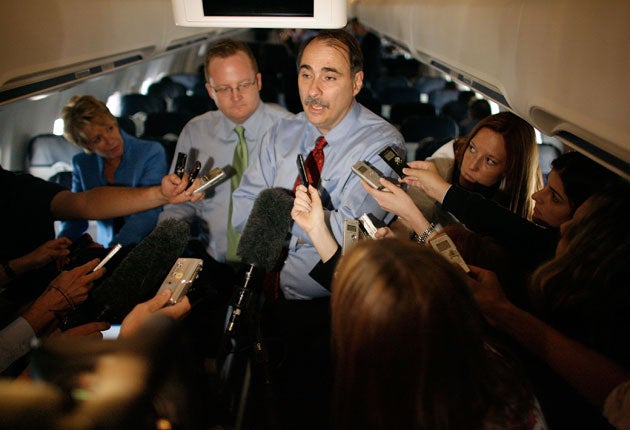
Barack Obama's sizeable army of unpaid volunteers spend their days knocking on doors and their evenings incessantly worrying. Like a Greek chorus, they fret that the great political movement they have helped to create could go wrong at any moment or that something terrible will happen in the final brutal phase of the struggle between the Illinois senator and John McCain. When this happens there is someone who always calms them down and ensures that the campaign stays on message: David Axelrod, chief adviser to the "no drama, Obama" campaign.
Axelrod is the one who deserves most credit for the fact that, over the past two years, the campaign has barely faltered. When it was down 33 points in the polls this time last year and the US media were ready to crown Hillary Clinton the presumptive nominee, Axelrod resisted huge pressure to change the message and go negative.
The Chicago political strategist's great skill is staying positive while parrying accusations hurled against whatever candidate he happens to be representing. Tall, stooped and shambling, with a damp moustache that sometimes bears evidence of a recent meal, Axelrod is Obama's political horse-whisperer. More than anyone in Obama's tight-knit team of talented advisers, he has been responsible for shepherding a candidate, unknown to most Americans a year ago, to the very threshold of the White House.
And while he counts himself a close personal friend of Barack and Michelle Obama, not a hired hand, he is known on occasion to speak the unvarnished truth about the candidate. Fresh from the upset victory in Iowa over Hillary Clinton last January, Axelrod was asked whether there was anything to stop Obama's winning the nomination. "Yes," he immediately replied, "his ego."
These days Axelrod, or "Ax" as he is aptly called, gets a once-over from the campaign stylist before appearing in public. He still favours earth tones and wears pullovers instead of sharp suits. His drooping eyes have a look of constant sorrow and his voice betrays the nasal whine of the Lower East Side of New York. But he can be wickedly funny in person, delivering a stream of wisecracks about political opponents, while barely a flicker of a smile passes his lips.
He is also a sports maniac and obsessive about baseball. The son of "classic New York Leftists", Axelrod grew up in a family that was just as passionate about politics. He cut his political teeth on the streets of New York selling campaign buttons for Robert Kennedy's tragic 1968 presidential campaign.
His own father had been an outstanding amateur baseball player in his youth, but instead turned to a career as a psychologist. The parents divorced when Axelrod was a boy. Later, when Axelrod was away at college in Chicago, his father committed suicide. Years afterwards Axelrod wrote about the burden of depression in his family, describing how it had taken him 30 years "to say out loud that the man I most loved and admired took his own life".
Axelrod's political consultancy AKP&D Message and Media has advised a succession of candidates since 1985. But he has another, more controversial second business, ASK public strategies, which specialises in tilting public opinion on behalf of corporate clients. Ed Rollins, one of the most famous Republican strategists, has encountered Axelrod several times. He puts him at the top of his list of "guys I never want to see lobbing grenades at me again".
His steely determination was on display a few weeks ago when the candidates held their first debate at the university of "Ole Miss", once a bastion of Mississippi racism. Throughout the 90 minutes on stage, John McCain would not even look Obama in the eye and did not as much as mention his name. On their next encounter, McCain jabbed his finger at Obama, and called him "that one", which some interpreted as deliberately provocative.
Shortly afterwards, Axelrod wandered into the "spin room" to talk to the media. Mobbed by cameras and dictaphones, he suggested that McCain's "that one" remark was a less than respectful way to address a potential next president of the US. He left it at that, saying it was for others to decide whether McCain was out of line. That has been his style throughout the campaign. He intervenes when he thinks it's necessary, but stops short of incendiary accusations. He lets his disapproval hang in the air and allows others make up their own minds.
Axelrod likes to tap into Obama's compelling life story and compose a narrative script that is carried through the whole campaign. His particular talent, though, is for producing short television videos that highlight a candidate's selling points. These videos provide the basic story of a candidate, underscoring his authenticity, which he then wraps the campaign around.
A former journalist with the Chicago Tribune, Axelrod, who is 53, got his start in presidential politics as the campaign manager for Paul Simon, a foppish and popular Democrat. As his reputation grew, he would later work for Bill Clinton, John Edwards and Hillary Clinton.
The pair first met in the early 1990s when Axelrod was a much bigger deal than Obama in Chicago politics. Still in his 30s, Obama was a community organiser working on a voter registration drive on the gritty south side. It would be many years before he would persuade Axelrod to work on his behalf and run his campaign for the US Senate.
The skill for which Axelrod has been in most demand is helping black candidates to get elected by white voters across urban areas. Chief among these was Harold Washington, whom he helped to get elected as mayor of racially divisive Chicago. Another was Obama's friend Deval Patrick, the governor of Massachusetts, and more recently Michael Nutter, the popular mayor of Philadelphia.
It is doubtful that without Axelrod by his side, Obama would have ever broken on to the national scene in such a spectacular fashion. With the presidency within Obama's grasp, there is an understandable urge to reach for historical precedents to explain the achievement.
As it happens, the campaign is filled with baseball fans. Axelrod is an obsessive and the campaign manager David Plouffe can spout baseball statistics all day. And while Obama is often compared to Jackie Robinson, America's first black baseball star, Axelrod gets a category all his own. He is compared to Branch Rickey, the famous boss of the Brooklyn Dodgers who broke the colour barrier in the major leagues by signing Robinson in 1945. Prior to that, even star black athletes were confined to the "Negro Leagues", and, idealistic as he was, Rickey realised he could get the pick of the black players if he moved first.
Hard as it is to believe, it was only four years ago that Obama pitched the audacious idea of running for the US Senate. Axelrod's first instinct was to talk him out of it and he suggested he run for mayor of Chicago instead. But he was persuaded that Obama's credentials as a community organiser, Harvard Law Review president and state legislator would forge an alliance between black voters and Chicago's lakefront liberals.
No one questions Axelrod's idealism in seeking to bring meaningful change to American politics, and if Obama is elected on 4 November, many expect Axelrod to stay home in Chicago with his wife and daughters rather than join a new administration.
There is no great mission or ideology in David Axelrod's method. Instead he has tapped into the candidate's personal life story and sold him to voters as a new type of leader. "My involvement was a leap of faith," he once said of his role in an Obama campaign. "Barack showed flashes of brilliance as a candidate during the early stages of the campaign, but there were times of absolute drudgery ... But I thought that if I could help Barack Obama get to Washington, then I would have accomplished something great in my life."
A life in brief
Born:
1955 in New York's Lower East Side.
Family:
His mother Myril was a journalist and his father Joseph was a psychologist, who later committed suicide. He and wife Susan have three children, one of whom has epilepsy. The couple helped to found Citizens United for Research in Epilepsy in 1998.
Early Life:
Seeing John F Kennedy speak in New York during the 1960 election had a profound impact on him and he went on to campaign for Robert F Kennedy during his 1968 campaign for the presidency. Studied politics at the University of Chicago
Career:
Was a reporter for the 'Chicago Tribune', becoming a columnist in 1981. Left the paper to manage a successful senate campaign and founded political consultancy firm AKP&D Message and Media in 1985. Has worked for Hillary Clinton and on Barack Obama's 2004 senate victory.
He says:
"I'm mindful of the responsibility not to lose our way, not to disappoint, not to sink into the conventional and lose our soul in the process." – on the conduct of the Obama campaign.
They say:
"David is the ultimate true believer. He's an idealist in a cynical world. Deep down, he's a dreamer." – Sam Smith, friend and journalist.
Join our commenting forum
Join thought-provoking conversations, follow other Independent readers and see their replies
Comments
Bookmark popover
Removed from bookmarks