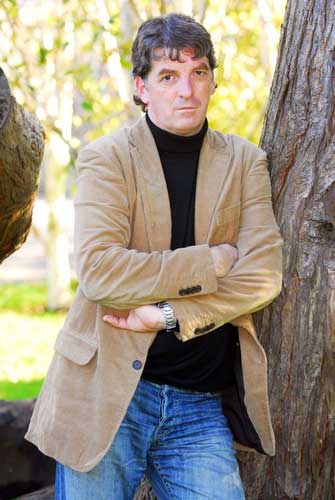
First person: I escaped Scientology after 22 years

John Duignan, 45
News in pictures
News in pictures
On Facebook
From the blogs

More than half of Afghanistan’s families live in extreme poverty

Leila is watching her baby intently, as his mouth moves trying to swallow the small blob of yellow p...

Time for a new approach to alcohol

Ambulances were called and three drunk teenagers were brought to my care. One was so drunk we had to...

Bahrain: One year on

I am used to endless lies and criticism from the BNP and its favourite blogster, as well as Islamist...

Paul Volcker stands tall against the banking lobby

Why is Europe, which likes to present itself as an opponent of speculative "Anglo-Saxon" finance, li...

Mine was an uneasy childhood. My father was schizophrenic and had bouts of manic depression. He and my mother both died when I was 10 years old, and my siblings and I moved from Scotland to Ireland, to live with my mother’s relatives.

As a teenager, I started to find the idea of an all-encompassing God and protector alluring, and in 1984, moved to a small village in Germany. Here, I discovered Scientology. I was in a bad way one afternoon, walking the streets of Stuttgart, when a young lady approached me: “Do you have a good memory?” she asked. I agreed to join her at the local Scientology centre, to find out.

The centre was filled with friendly, efficient people. It all seemed very official and scientific. I took tests which revealed I needed counselling, or “auditing”. I found the “science” aspect very seductive, and quickly became involved in the group.

After two weeks, I was taken with the teachings of [Scientology’s founder] L Ron Hubbard. He was my guru, and I started to see less of my girlfriend and friends.

I worked for the Scientologists from 9am to 11pm, for the equivalent of £15 per week. Within months of that first meeting, I was recruited to the Sea Organisation – a central management group within the association. My work for them included administration and PR.

I lived in a commune in Los Angeles with the Sea Org for a while. It was a highly disciplined, enclosed environment. We were self-sufficient: building our own computers, growing our own food – we had very little contact with the outside world. I was transferred all over the world, and in 2000 was living in Dorset when I made a discovery.

Scientology works on a strictly hierarchical basis. All through my membership, I was told there was a revelation I was being built up to, Hubbard’s theory of creation. When I became privy to the details of the story, I was shocked that this was the carrot on a stick that had kept me with the organisation for so long. His ideas seemed ludicrous, and when I stumbled upon other details of Hubbard’s biography, I was appalled.

It took five more years to gather the courage to leave. For two decades this had been my life. I had no skills, no cultural references; I’d become institutionalised. In 2005, I made my escape in the middle of the night. Facing the outside world was terrifying. But slowly, I began to rebuild my life. I went back to Ireland and got to grips with the basics: how to cook and shop. Now I have a wonderful partner, I’m enrolled at university, and I’m learning to be a human for the first time ever. It’s like having a new lease of life.

‘The Complex: An Insider Exposes the Covert World of the Church of Scientology’ by John Duignan, published by Merlin, £9.99. To order a copy (with free p&p) call Independent Books Direct on 08700 798 897

firstperson@independent.co.uk

Independent Comment
blog comments powered by Disqus
Career Services

Day In a Page

How an abortion divided America

How an abortion divided America

Single mother who took a pill to end her pregnancy is now fighting a landmark prosecution in a conservative state
Can you master a language in a weekend?

Can you master a language in a weekend?

Ed Cooke insists he can use his techniques as a memory expert to help novices learn even the hardest tongues.
The 10 best heaters

The 10 best heaters

From the DeLonghi Retro Fan Heater to the Dimplex MicroFire
Coming soon to a shelf near you: The publishing industry has gone mad for film-style trailers

Coming soon to a shelf near you

The publishing industry has gone mad for film-style trailers
Mad, bad and delightful to know: How Lord Byron became a cultural superstar

How Lord Byron became a cultural superstar

As the poet takes centre stage in the West End, Boyd Tonkin looks into the life of the outspoken champion of the poor
Did they all live happily ever after? That's up to you...

Did they all live happily ever after? That's up to you...

New digital novel will overturn centuries of literary tradition by allowing readers to choose how they would like story to end
How to look good for less – Primark in copycat row

How to look good for less – Primark in copycat row

With London Fashion Week starting tomorrow, designers are closeted in studios putting finishing touches to their collections
James Lawton: Arsène and Arsenal are living in the past

James Lawton

Arsène and Arsenal are living in the past
How Docherty's resurgent Reds beat Dutch greats

How Docherty's resurgent Reds beat Dutch greats

United have met Ajax only once before in Europe, in 1976. The key performers recall an electric occasion
Civil war at Ajax

Civil war at Ajax

A rift between two club legends has torn the Dutch giants apart
Lewis Moody: For an idea of where England are headed, look at Wales now

Lewis Moody column

For an idea of where England are headed, look at Wales now
Geoff Toovey: Little gem with huge incentive to become king of the world

Geoff Toovey interview

Little gem with huge incentive to become king of the world
Picture preview: Portrait of London

Portrait of London

Picture preview
No secularism please, we're British

No secularism please, we're British

Arguments about the role of religion in national life have recently acquired a new urgency
Harold Tillman: 'Chinese tourists can save the high street – if we let them'

Harold Tillman interview

'Chinese tourists can save the high street – if we let them'