Gordon Brown: The underdog bites back
He has had three years of unrelenting misery, and yet, against all odds, the PM is still in the game. But can he really beat David Cameron's Tories?
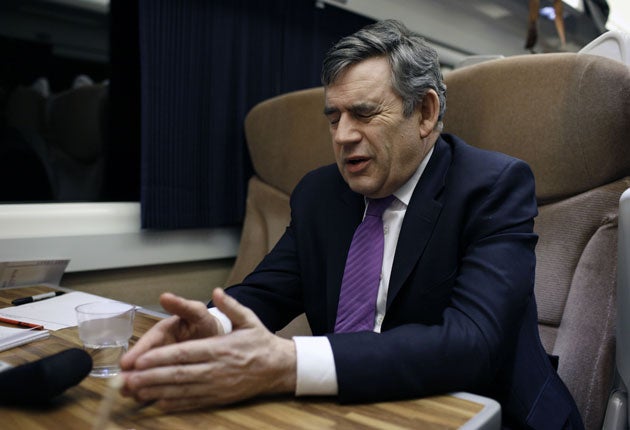
Fitting, perhaps, to join the PM's entourage at the Lincolnshire market town of Grantham, birthplace of his fearsome predecessor. The parallels are hardly difficult to find, though the unkind might suggest Mrs T knew how to win elections.
Like her, he is a Prime Minister who attracts strong emotion, and bitterly divides opinion. Through the brickbats, he presses ahead relentlessly, without recourse to reverse gear. A conviction politician, you might say, for whom, like Mrs T, surrender is a foreign land. It ended, of course, in tears for her, and most, it seems, expect the same for him, and soon.
The public apparently thinks him more than a little odd; the opinion polls suggest he is lost; even his colleagues, if we believe the regular, half-hearted putsches, believe him a hopeless case. And yet....
After a relentless, near universal kicking for almost three years since he led us up the hill on an autumn election before bottling it, following the worst recession in 60 years, and in the wake of an unprecedented crisis of confidence in MPs because of their remarkable greed, this Prime Minister is just about still in the game. Somehow.
His enemies – and his supposed allies – have been unable to dispatch him. He is like a film character, shot, stabbed and beaten, and yet not only standing, but, as he recently put it, falling forward.
Hark at Gordon Brown, as he brings his Cabinet home from Durham and its ninth away-day in 18 months, and you are left less with the sense of the walking dead, and more with that of a missionary relishing the imminent battle for hearts and minds after a long phoney war. His first, growled words are "I'm in fighting mode", and for more than 60 minutes, as the train rattles along to King's Cross, he never for a moment lets you imagine otherwise.
In a wide-ranging interview far away from last Sunday's televised stories of his upbringing in a Kirkcaldy manse, the Fife beach of his marriage proposal, and the unimaginable death of his baby daughter, Jennifer, the Prime Minister lays outs his strategy for beating the Tories, his positions on Iraq, Afghanistan, and the expenses scandal, and his response to allegations about boorish personal behaviour. His credo, if you will.
But before we leave the ITV studio of that remarkable Piers Morgan interview, Mr Brown explains why he did it. And why, in an effort to shift the view of him from cussed, humourless Scot to someone approaching a member of the human race, he will do more of the same in the run-up to polling day.
"What I say to the public has been mediated by newspapers that are very hostile to me. I've got to recognise that people want to know who you are and what you are about. It's important that people form their own impression, rather than have that impression imposed upon them. Part of it is to be honest about who you are.
"Celebrity? Celebrity is when you walk into a room, listen to what people want to hear, and then present yourself in a way you think people will want. Character is being prepared to go into the room and say: 'Look, this is what I believe in. This is what I'm for. This is why I'm against what some of you are saying.' And facing the consequences.
"I want people to understand what we're trying to achieve. I cannot allow myself simply to be presented by one or two newspaper groups, so I will take my campaign into the country in every possible way: the internet, television, public meetings. And, in the end, it will be the people's verdict."
So when he fires that starting gun for the election campaign, what will that message to the voters be?
"We've gone through a very deep global financial recession which has affected every country, and we've had this additional challenge in Britain because of what happened over MPs' expenses. So, at one and the same time, people were seeing their own living standards affected by the recession and rightly complaining that some MPs were acting not in the public interest but in their self-interest. It's hardly surprising that over that period people are waiting to see whether the Government can deliver the political change necessary, but also take us through, and out of, the recession. I think people have suspended their judgement for a general election until they were able to see what had happened with our policies.
"For most of the last two years, it's been a referendum on the Government, and nobody has thought of it as a choice. Now people are seeing it as a choice, and they are seeing it not as the Conservatives want it to be: a choice about small things, but a choice about big issues, about our future. People are taking a look at the Conservatives and are not quite sure what they're seeing – they're beginning to see through them. The Tory party want to appear centre-ground, middle-of-the-road and pro-public services, but every time they have to declare a policy or are forced back on the defensive, to say what they really believe, they expose themselves as right wing."
The list of Tory errors during the recession is long, he says, citing their refusal to back nationalisation of Northern Rock and the restructuring of the banks; and their desire to cut national debt sooner, rather than later, and calls them the old economic theories that failed in the 1980s and 90s. He's virtually unstoppable now, and it sounds almost personal. Not at all, he responds, not entirely convincingly. Is there a dichotomy between his own emotions and values, as reflected in the so-called class war strategy, and his head – the knowledge that Labour's appeal has to be broad based and focused on the middle classes? Is this divide reflected at the heart of government, with Ed Balls, Secretary of State for Schools, in one corner, and Lord Mandelson, President of the Board of Trade, in the other?
"I've got nothing personal about this. I look at the Conservative Party, look at the leadership, look at the values they espouse, look at the policies, and think the British people will judge that they haven't done what Labour did in the 1980s. We were completely reconstructed as a party in the 1980s. We changed our constitution. Our policies had ceased to reflect our values so we changed our policies while maintaining our values. People saw a completely different Labour Party emerge.
"The Conservatives have done all the public relations part. They've got the posters; they've got the slick advertising; they've got the big budgets for slogans that suggest they're different. But, in practice, when you look at the policies, there's not really much evidence that they're changed. The 2001 and 2005 manifestos are going to look very similar to the 2010 manifesto. If you ask who's best for the future, you'd be hard-pressed to give me a policy from the Conservatives that is new. The Conservatives have spent a lot of time polishing their image but not much time developing their policies."
The Labour manifesto, in essence, will concentrate, he says, on creating high-end, hi-tech, green jobs – an echo of Wilson's white heat of technology revolution? – and public services will increasingly be tailored to the individual. This, of course, sounds like the stuff politicians say, but he believes his party has earned the right to be heard – and believed.
"If you'd been writing this article 18 months ago, you would have said Britain was facing a global financial recession that would be worse than the 1980s in terms of its impact on families. What has actually happened is that we've kept people in work by intervening. We've taken the right action to take us through the recession, at all times opposed by the Conservatives. We made the right decisions about the future but, of course, we've got to show people that the policies moving forward are right for the future as well."
His impatience to get into the swing of electioneering is palpable, but there is the small matter of his evidence to the Chilcot inquiry on the Iraq war to get through first. His evidence is expected "in the next few days", and the ballot is already under way. He might be less of a draw than the man who committed us to military action, but the outcome might be rather more important.
Little has been said at the inquiry thus far which suggests he was key in the decision to go to war – or, at least, not as vital in the process as you might expect such a senior figure to be.
He steadfastly backs collective responsibility, but there are little hints his thinking was not quite the same as Tony Blair's.
For example, he never mentions weapons of mass destruction as an explicit reason to go to war until asked. Rather, he focuses on Saddam's breaches of UN resolutions over many years, and there will be those who see little difference with his predecessor on that. Except that, speaking to him, the emphasis is definitely different.
And, as if to draw a contrast with the chaos under Tony Blair, he plays on his own achievements since becoming PM. "People know we're out of Iraq now and we've got a government in Iraq that's able to manage its own security. I was very careful to set objectives in Basra and these allowed us to pass, stage by stage, control over to the Iraqi authorities. Our time ended with successful local government elections which put local people in control of their own security."
And what of Afghanistan? In a long conversation, the most significant point he makes is to say what the mission there is not. "This is not a situation where you have a popular insurgent force that is being held back by an alien military command. This is a population that does not want the Taliban to be in power but needs to be strengthened with its own forces to be able to protect itself from terror.
"What we want to do is to split the Taliban. Those people who aren't ideologically committed to the al-Qa'ida cause, those people who are prepared to renounce violence and to join the democratic process to subscribe to the Afghan constitution – we should separate those from those people who are ideologically doctrinaire, pro-Taliban, pro-al-Qa'ida.
Even as we speak, James Purnell, the former Secretary of State for Work and Pensions, whose decision to quit Government in June last year, precipitated one of the several leadership crises Mr Brown has faced, is preparing to announce he will step down as an MP at the election. This, many pundits later suggest, is because he believes Labour is set for a long period in Opposition. Isn't this type of act – particularly when he has been acclaimed worldwide for marshalling a global response to the downturn – frustrating?
"Isn't that politics? You've got to accept the rough and tough times that you live through. You've got to be resilient, otherwise it's very difficult to meet the new challenges. You go to bed at night knowing that there are a lot of problems that people are throwing at you, but get up in the morning and make sure you deal with all the challenges you face. If you were still dealing with the same problem that you had a year ago without making any progress, that would be a very bad thing."
He was 59 yesterday. Does he ever think of giving up?
"Never. It may be where I come from. I've never thought that anything was easy. You've got to work for what you get. You've got to take the blows and get up and keep fighting. It's not as difficult as some of the things that have happened in my life."
And what of allegations that he is a bully? The End of the Party, a forthcoming book by The Observer columnist Andrew Rawnsley, is believed to suggest he once struck a member of staff, was generally unpleasant to those around him, and is chronically indecisive: witness the tortured procrastination over the October 2007 poll.
"So I'm both strong and weak? That seems to be the theme. I'm strong- willed. I'm very determined. I don't take no for an answer when I want to do something. I'm tough about getting things done. It is simply a lie to say that I've ever hit anybody in my life. I may have done one or two good tackles at rugby, but the idea that is suggested in this so-called inside account is just ludicrous."
And with that, the talk turn to that most vital of subjects, Scottish football. His side is lowly Raith Rovers. They lost 4-0 at home last week in a First Division match, a game he missed because Operation Moshtarak was getting under way. But, in midweek, they went to Premier League side Aberdeen, and, against the odds, won 1-0 in a Scottish Cup replay. An omen, of sorts?
Join our commenting forum
Join thought-provoking conversations, follow other Independent readers and see their replies
Comments
Bookmark popover
Removed from bookmarks