Greg Clark: Global warming is not on our back burner
The shadow Climate Change Secretary insists the environment is still a priority for Cameron, despite its absence from the Tory leader's 10 key pledges. Jane Merrick meets Greg Clark
Back in April 2006, David Cameron handed out silver birch saplings to journalists at a press conference in which he urged voters to "vote blue, go green". The next day, the Tory leader of four months was photographed perched on the melting Svalbard glacier in Norway, his hair windswept, an arm wrapped around a huskie which was nuzzling Cameron's North Face jacket. These were the 24 hours in which Cameron imposed his environmental credentials on the world. They were followed by a pledge to help prevent climate change with "green taxes".
Tomorrow, three and a half years later, the Conservative leader will lead his party conference as prime minister-in-waiting, with Britain's "broken economy", "broken society" and "broken politics" at the top of the agenda. In Manchester, climate change has been shoved into debates on the recession.
The huskie-hugging was part of the party's decontamination strategy, which was always going to be overtaken by tougher messages on law and order. And the economy has dominated everything in politics for more than two years. But even so, environmentalists could be forgiven for thinking that Cameron has deserted them.
Last week, in an interview with The Sun to mark the newspaper's defection to the Tories, Cameron laid out 10 key pledges – none of which included the environment or climate change. In a separate interview with The Spectator, Cameron listed "the deficit, Afghanistan, the broken society and mending the mess of our politics" as his priorities.
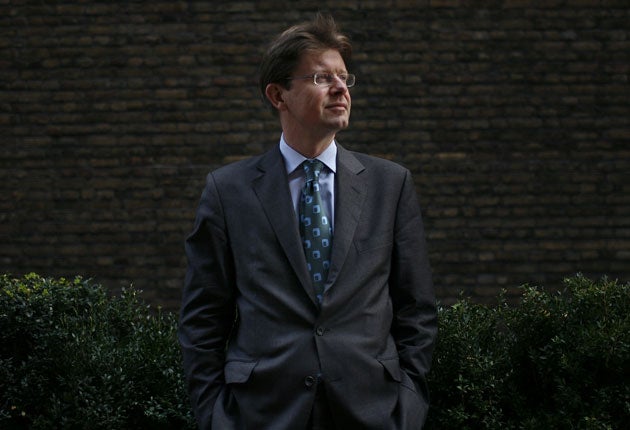
And here is Greg Clark, the shadow Secretary of State for Energy and Climate Change, presenting himself for interview with The Independent on Sunday, which has a long history of campaigning on the environment, to reassure our readers that climate change still matters to David Cameron. Can we see past the carefully calibrated PR messages and believe the Conservative leader?
It may be a statement of the obvious, but I feel the need to ask Clark anyway: aren't the Tories trying to be all things to all people?
"No, no," says Clark, who has a mix of geniality and evangelism – a bit like a country vicar. He tells me the environment is "absolutely" a priority for a Tory government. "Always has been." He adds: "When David Cameron appointed me, we had a conversation and he said to me he wanted the environment to be a very important part of the proposition we put to the public at the general election – as it always has been to David personally."
Yes, we know about the bike – the one that was followed by his chauffeur-driven car – the sledding, the trees. But there is a nagging doubt that this is all for decontamination purposes as Cameron retreats to more a populist position in preparation for power.
Some of the 10 policy pledges are obviously important, but some of them are, frankly, questionable in comparison to the global threat of climate change – such as the proposal to reduce the number of MPs.
From Clark there is a pledge that climate change will be "centre stage at the general election". He tries to insist that, far from it being overlooked by Cameron, the environment underpins every one of those other priorities. "There is a real coalition of interest in this, that people are concerned about our national security, economic security, household budgets, future jobs, the future of the planet – all of the answers to those questions actually coalesce."
This sounds wonderful – a sort of holding-hands-around-the-world notion – but it seems slightly laughable the claim that climate change is so important to the Tories that it doesn't need to be mentioned.
Clark complains that the Tory paper on energy efficiency published in January, The Low-Carbon Economy, has been lifted at length by his opposite number in government, Ed Miliband.
He says the Tories first came up with the plan for smart meters months before Labour, and that a Conservative government would have the devices rolled out nationwide by 2017, three years before Labour's deadline. In fact, this idea was first floated in the Quality of Life policy document of September 2007, drawn up by Zac Goldsmith and John Gummer, which trashed Thatcherite materialism in favour of a focus on the environment and well-being. Cameron distanced himself from some of the more radical ideas, but smart metering has entered common policy-making.
This week in Manchester, Clark will announce a "consumer energy revolution" and a plan for urgent action to "keep the lights on and decarbonise the economy" amid fears of routine blackouts by 2017 – concerns that will be raised at the UN climate talks in Copenhagen in December.
Besides smart metering, a Tory government would refer the "cartel" of six big energy companies to the Competition Commission for an independent investigation into why gas and electricity bills remain so high.
Bills would be overhauled so they tell householders, in simple terms, where they could be saving energy and money on different tariffs.
Clark says bills are currently "taken from a metal wheel spinning round in your garage – something that Thomas Edison would've recognised".
The first term of a Tory government will also push ahead with technology on carbon capture and storage – using revenue from the emissions-trading scheme to pay for the clean coal alternative.
Clark says the Tories will not drop their opposition to Heathrow's third runway under any circumstances. Instead, investment will be ploughed into high-speed rail. People should learn to love trains. It is a "good example of where, if you make people's lives better, people prefer to travel by train from city centre to city centre".
Listening to Clark is reminiscent of Cameron's early leadership phase – the speeches about letting "sunshine win the day", envisaging a world where people's lives are made better by a pleasant train journey. It is hard to reconcile this vision with the relentlessly miserable, hell-in-a-handcart messages from the current version of the Tory leadership: of everything being "broken".
Clark was elected MP for Tunbridge Wells in 2005. Before that, he was policy chief for Cameron's three predecessors – William Hague, Iain Duncan Smith and Michael Howard.
A Cambridge graduate, he worked as an adviser in the last Tory government. But he has a working-class background: the son of a milkman from Middlesbrough – a dream past to counterbalance the Old Etonian leadership. Clark married his wife, Helen, in a charity hostel for homeless women, where he was a trustee.
Clark is rather shy about his role in the Tories' 2005 election campaign, which included the sinister slogan "Are you thinking what we're thinking" on immigration. The environment was nowhere to be seen in the manifesto. "I hope that's going to be different in 2010. If it is, that is down to David Cameron, right from the beginning of his leadership putting that on the agenda."
When I ask what mistakes were made, he says the party "learnt a lot" from Howard in terms of discipline and organisation.
But is there a danger of too much discipline – or should people like Goldsmith, the would-be Tory MP for Richmond who is still committed to the Quality of Life report's conclusions, be free to express themselves?
"I think David has always been a very collegiate leader. The discussions that take place at Shadow Cabinet are very genuine, and it is clear he values that forum. This is not an authoritarian regime, by any means. But a prospective government has to be disciplined. The scale of the challenge if we were to be elected is so acute you can only do that if you are absolutely focused about your approach."
Clark appeared to criticise Cameron in 2007 over his shift away from grammar schools. When I ask if he will feel free to do this again, it is the only moment when he stiffens slightly. "I have never said anything on grammar schools that is different from the policy. David's made clear our policy."
Despite Clark's denials that Cameron is running an "authoritarian regime", the leader has ruthlessly sacked people he is close to. And despite his insistence that the Tories are committed to the environment, it must be a concern that the "vote blue, go green" message has become diluted for political expediency.
In the months before the 1997 election, Tony Blair's operation became command and control exercise, combined with trying to be all things to all people. There is no reason to think Cameron's regime is any different.
CV: From the Social Democrats to Cameron's inner circle
1967 Born in Middlesbrough.
1978 Attends St Peter's Comprehensive, South Bank, Teesside.
1986 Degree in economics, Cambridge University, where he leads student branch of SDP.
1988 Joins Conservative Party.
1989 PhD at London School of Economics.
1991 Consultant, Boston Consulting; works in Mexico, USA, Iceland and South America.
1996 Special adviser to Ian Lang, then Trade and Industry Secretary.
1999 Controller of commercial policy, BBC.
1999 Marries Helen in a charity hostel for homeless women in Soho, of which he is a trustee; they have three children.
2001 Director of policy at Conservative Party under William Hague, later Iain Duncan Smith and Michael Howard.
2003 Elected Westminster councillor.
2005 Elected MP for Tunbridge Wells.
2006 Appointed shadow minister for charities.
2008 Appointed shadow Climate Change and Energy Secretary.
Join our commenting forum
Join thought-provoking conversations, follow other Independent readers and see their replies
Comments