Jelena Jankovic: 'I feel light, almost like a butterfly on the court again'
The former world No 1 tells Paul Newman how losing muscle has taken her back to her best in time for the French Open
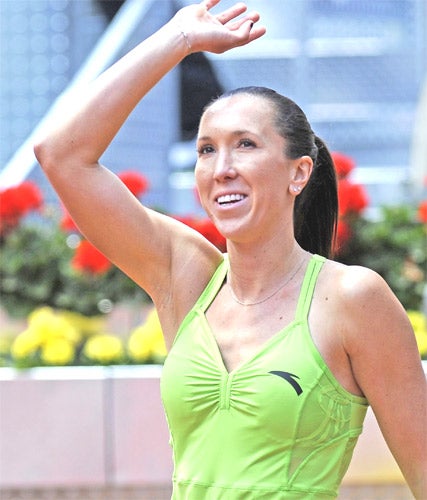
Ask Jelena Jankovic where home is and she looks puzzled. "It depends," she says. "I play all around the world. It depends on my schedule." The 25-year-old Serb was born and bred in Belgrade, lists Dubai as her current residence and is having a house built in San Diego. In tennis terms, however, when it comes to feeling at home there is nowhere quite like Nick Bollettieri's academy in Bradenton, Florida, where she spent most of her teenage years alongside the likes of Maria Sharapova and Tatiana Golovin.
The bond with Bollettieri loosened when Jankovic started to make her mark on the Sony Ericsson tour, eventually reaching No 1 in the world two summers ago. In recent months, however, after a year in which her form dipped alarmingly, Jankovic is back working with the coach she says knows her best.
"Nick has known me since I was a young girl," said Jankovic, who parted company with her previous coach, Ricardo Sanchez, after the Australian Open. "He knows my game better than anybody. I felt I wanted to come back and be independent again when I play on the court, figure things out on my own, like I did in the past.
"Nick and some of his team are helping me when I have some time between tournaments to train and work on my game. But when I go to tournaments it's usually just with a hitting partner and my mum. I think that's the right solution for now."
The new arrangements are starting to bear fruit. Jankovic, world No 1 as recently as February last year, is back to No 4 in the rankings, having fallen as low as No 9 towards the end of last year. She won the title in Indian Wells in March and this month reached the final in Rome, underlining her clay-court credentials.
Having twice reached the semi- finals at the French Open, the Serb will be among those who feel they have a real chance of victory when Roland Garros opens for business on Sunday.
Like Dinara Safina, Jankovic had to respond to frequent jibes during her reign as world No 1 about the game's supposedly best player never having won a Grand Slam title. She came closest in 2008, losing to Serena Williams in the final of the US Open and reaching the semi-finals in both Melbourne and Paris.
It was a desire to take a final step that led to her downfall the following year. Believing she needed to become stronger, Jankovic worked on her physique before the 2009 season. She emerged with more power, but, crucially, had lost the edge of speed and deftness of movement.
"I wanted to be stronger and fitter, but unfortunately it resulted in a negative way for me," she said. "I felt a lot slower and I lost my movement. These days if you lose your movement you're not on the ball and your whole game goes.
"I added a lot of muscle, but now I'm back to being myself again. This is how I am, this is how I'm meant to be. I can't be like some of the other players. Being really strong doesn't suit my game. I need my movement.
"The problem was that I tried to change so many things. I was working hard on my fitness, but my game wasn't the same. A lot of changes were being made to my game that affected me on the court. I didn't feel confident or comfortable.
"But I really feel ready again and motivated now. I'm hungry. I feel lighter on the court. I've lost a lot of weight since last year. I feel almost like a butterfly on the court again. That's really important. If you feel lighter moving around the court then your whole game changes. I'm one of the smallest players, maybe along with Justine Henin. All the other girls are so strong. They work so hard in the gym. I tried to do the same, to be bigger, to be stronger, but I couldn't move. I lost my speed and it didn't really help me, so I learnt my lesson. I know what I don't need to do. I just stick to my old training. I think that's what gives me results."
The victory in Indian Wells provided a neat illustration of Jankovic's new priorities. The Serb ran Caroline Wozniacki into the ground in the final, but was then unable to hold up the hefty winner's crystal trophy. "It was nothing to be embarrassed about," Jankovic said with a smile. "When you're a tennis player, you don't have to lift heavy weights. I couldn't lift the trophy, but that's OK."
Jankovic is a classic Bollettieri graduate, a player at her most dangerous when whacking the ball ferociously from the baseline. However, she had lost some of the aggression from her game and was playing from too far back in the court. Coming forward and playing more positively, as well as hitting her serve with greater purpose, has produced a notable upturn in her performances. "There's always room for improvement," she said. "I'm always seeking advice from Nick. He's helping me a lot, giving me tips and advice and motivating me, though he's never travelled with me."
In Rome, Jankovic joined the select group of players who have beaten Serena and Venus Williams in the same tournament, although the effort took a lot out of her as she went on to lose to Spain's Maria Jose Martinez Sanchez in the final. Jankovic has a good record against the Williams sisters, who occupy the top two places in the rankings: the Serb has won six of 11 matches against Venus and four of eight against Serena.
Having worked without a travelling coach during her initial climb up the world rankings, Jankovic is happy to have the same arrangement again. "I got to No 3 without a coach, when I was just travelling with my mum," she said. "Now I just want to feel my instincts again, feel my rhythm and just be independent. I'm feeling much better about my game and about myself. My mum is very supportive. I wouldn't say she's my coach because she doesn't really get involved so much when it comes to the tennis, but she's a very, very positive woman. She is always there."
Jankovic said the French and US Opens were the two Grand Slam titles she would most like to win, but added: "I don't want to be picky. I just want to work hard and hope things will happen. I believe in myself as a player and I believe one day I will win a Grand Slam. When I see Kim Clijsters coming back to win a Grand Slam after being out of the game you can see anything is possible."
Fairer sets? How the women's game is more competitive than the men's
Jelena Jankovic is one of 19 women who have occupied the No 1 position since the world rankings were introduced 35 years ago. Since Justine Henin was dislodged by Amélie Mauresmo in September 2004, the lead has changed hands 21 times, with Lindsay Davenport, Maria Sharapova, Kim Clijsters, Ana Ivanovic, Jankovic, Serena Williams, Dinara Safina, Henin and Mauresmo again all enjoying top spot.
Over the same period the men's No 1 ranking has changed hands just twice. Roger Federer became No 1 in February 2004, was replaced by Rafael Nadal in 2008, only to return to the top last July.
Join our commenting forum
Join thought-provoking conversations, follow other Independent readers and see their replies
Comments