Joan Bakewell: 'Elevation is rather a grand word, isn't it?'
The broadcaster and champion of older people tells Jerome Taylor what becoming a peer will mean for her causes
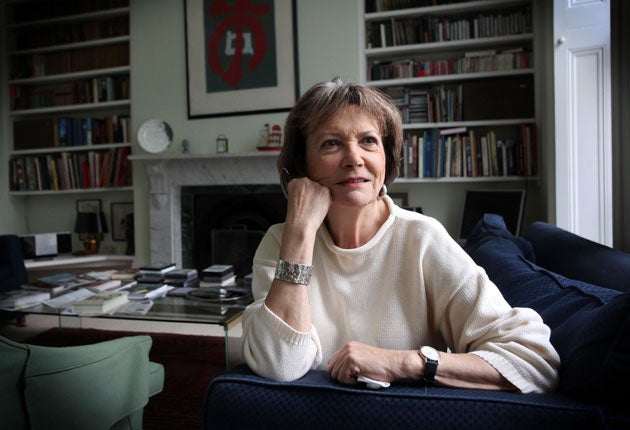
If there was ever a picture book published on north London's chattering classes, then the square in which Joan Bakewell lives would be its front cover. Each one of the three-story Regency homes in this immaculate corner of Primrose Hill has been lovingly painted in a kaleidoscope of pale shades. Pastel yellows, egg shell blues, light pinks and – in Bakewell's case – a calming olive green. It is a perfect picture postcard tribute to the successful baby boom generation.
"They weren't always like this believe me," says Bakewell, opening the door into a bright sitting room with enormous windows looking out onto the square below. "When I first moved in, Euston station still used steam trains. All these houses were covered in soot."
It is in this house that for the past 45 years Bakewell has lived through two marriages, six grandchildren and a remarkable broadcasting career that has seen her become one of the most recognisable female faces in front of a camera.
And it is where she spent her weekend celebrating her latest achievement – her elevation to the House of Lords last week. "Elevation is a rather grand word isn't it," she giggles, looking ludicrously younger than her 77 years. "It makes me sound a little like the host at mass."
There's always been something intensely cerebral, ferocious and slightly saucy about Bakewell, who began her career in the 1960s on the arts discussion programme Late Night Line-Up and has followed it with four decades of broadcasting about the arts, religion and ethics.
Most recently she was made "Voice of Older People" by the previous government following her vocal criticism of the BBC for the way it all too often moved aside older women in favour of younger talent.
It is a fight she intends to continue in the Lords. "Television packed up on me a long time ago," she says, explaining how ageism in the media is just the tip of the iceberg. "I turn up as a guest on panel shows now and again. And I recently made a programme for Panorama about older people. But that was only because I am an older person, not because I'm a journalist. It is my firm belief that people should continue working, if they wish to, for as long as they like. It benefits the whole community."
Compared to most of the 54 men and women who were added to the Lords in the latest intake, many of whom were donors rewarded for their party loyalty, Bakewell is refreshingly non-partisan.
"When you become a Lord they phone you in advance to tell you and there are all sorts of forms you have to fill out," she says. "There was one that asked me to declare what party donations I have made over the years and on each box I wrote 'None'. When I got to the end I couldn't help chuckle and think there will be other people who will find this form rather uncomfortable."
So does that mean that she approves of the way our upper house is appointed, rather than elected? Should we have some sort of Senate, entirely elected by the public? "I certainly think there should be a debate about how the second house is constituted," she says. "There was a time when I thought it should be entirely elected. But then I started to listen to some of the debates in the Lords and compared it with the behaviour in the Commons – especially Prime Minister's Questions which is disgraceful. The level of debate in the Lords is enormously well informed. They seem to have loads of experts who aren't particularly combative. Also the idea of simply replicating the party machine doesn't appeal to me."
The broadcasting veteran has yet to make up her mind what her maiden speech will be about – "the guidelines say it shouldn't be controversial", she says – but as we talk the conversation turns to university education with her grandson embarking on his first year at Bristol.
As the winner of a scholarship who went to study history at Cambridge for free in the 1950s, Bakewell is dismayed at the current Government's attitude towards higher education and particularly the way future cuts will likely hit the humanities the hardest. "I'll be there to champion humanities," she says. "Humanities open window after window on the human condition. That's what we need, and it's what scientists need too. This new tendency in education to focus entirely on vocational subjects needs to be questioned."
Bakewell's background is north-west working class, not that you'd ever know it from a cut-glass accent that owes much to her Cambridge University days and was further honed by years of working for the BBC. Born Joan Rowlands in Stockport in 1933, her father was orphaned at the age of 14 and left school to work on a foundry bench. He slowly worked his way up to management level. Her mother left school at 13 and never made it at her ambition to become an engineer. Childhood was happy but her teens were somewhat poisoned as her mother, Rose, fell into deep depression, which often manifested itself as an intense disapproval of everything her daughter did.
"She was extremely intelligent but belonged to that generation where women were expected to stay behind, look after the children and keep an immaculate house. Although she did that with an almost fanatical attention to details, she didn't find it fulfilling. We didn't know it was called depression, of course, back then but that's what it was."
The trajectory of Rose's daughter, at least, was entirely different. Sitting on her blue sofa in Primrose Hill, a recently purchased "guide to using an iPhone" resting on the coffee table in front of her, it is really quite difficult to overestimate how remarkable Bakewell's career journey has been. We take it for granted now that television is largely a place of gender equality, certainly among the young at least.
But it was down to a small handful of female journalists like Bakewell who were the first to break through the machismo glass ceilings surrounding the production of current affairs. From her autobiography, one quote above all stands out: "I don't want too many women on my staff. They burst into tears. It is a tiresome thing that women do". This was not the view of a braces-clad chain-smoking male executive at Bush House but of Grace Wyndham Goldie, the formidable head of talks and current affairs and, of course, a woman.
Getting into the newsroom was never going to be easy. Bakewell's first job at the BBC was technical studio work which she was terrible at. Deflated, she briefly tried her hand at advertising – translating American Tampax adverts into something more suitable for British ears – before returning to the BBC, and Late Night Line-Up. In a world where women tended to be relegated to children's programmes it was a radical departure. Here was Bakewell the sex bomb, long legs and superbly short skirts, but above all with a razor-sharp mind and interrogation technique that could easily hold its own against luminaries like Allen Ginsberg and Vaclav Havel. Her interview with playwright Harold Pinter sizzled with chemistry, as it ought to have done – they were about midway through their nine-year affair which later became the subject of his 1978 play Betrayal.
Thanks to the comedian Frank Muir, Bakewell's time on Late Night Line-Up resulted in her being labelled the "thinking man's crumpet" an epithet that in the fresh light of the 21st century feels utterly patronising. It is a shame the phrase stuck as what Bakewell did over the next four decades was become a formidable reporter, as arts correspondent for Newsnight in the 1980s, to exploring religion, morals and ethics in Heart of the Matter during the following decade.
I initially had no intention of bringing up the dreaded "TMC" during the interview. Instead it was Bakewell who did so, referring to it as "that phrase". But it does give her a chance to say why she thinks it really is high time to bury it for good.
"Perhaps now that I'm in the House of Lords that phrase can die," she fumes. "It's grotesque to refer to someone in their seventies like that."
An epithet she has much less trouble with is Voice of Older People. She keeps a frenetic schedule and likes to be a representative for the elderly as much through her actions and what she says.
Divorce, newspaper columns, television shows and an autobiography all took up the first five years post the big 70. Most recently, at the age of 75, Bakewell sat down to write her first novel, a historical drama. A second novel, set in the early 1960s, is nearly finished and will be published next year. "I like to keep on my toes," she says with a smile.
As the interview winds down to a close I ask whether she would ever consider taking things at a slower pace. "Certainly not," she hits back. "If the energy levels dropped I might have to, but I have no intention of slowing down." In which case, is there anything she should be doing more of? "I sometimes think I forget to have enough fun," she says. "But then, when I think about it, I am having enormous fun doing what I do."
A life in brief
* Born: 16 April 1933 in Stockport, Cheshire (now Greater Manchester)
* Early life: Born into a lower-middle class family, attended Stockport High School For Girls, now Hillcrest Grammar School, where she was head girl. Went on to Newnham College, Cambridge, where she studied Economics, then History. Has since said that her mother, a bright woman who was forced to leave school at 13 to work for a living, probably envied her daughter all the chances she had.
* Career: Joan Bakewell first became well known as one of the presenters of an early BBC 2 programme, Late Night Line-Up, in 1965 on which Frank Muir first dubbed her "the thinking man's crumpet", a moniker she dislikes but has failed to shake off. Has since been Arts Correspondent for Newsnight and a favourite on Countdown, as well as making several programmes on liberalising legislation, from abortion to gay rights and the death penalty, and on taste, decency and censorship on television. It included watching a couple having sex while they were filming a pornographic movie.
* Family: Has two children with her former husband Michael Bakewell, the BBC's first head of plays. Divorced in 1972 after 17 years. It emerged later that she had been having an affair with the playwright Harold Pinter, which formed the basis of his play Betrayal. Married the director, writer and producer Jack Emery in 1975 but divorced in 2001.
Join our commenting forum
Join thought-provoking conversations, follow other Independent readers and see their replies
Comments
Bookmark popover
Removed from bookmarks