Larry Page: A very private poster boy
He will never make a showman. But as Google's co-founder steps up to be its CEO, can he display the business nous to match his genius as an inventor?
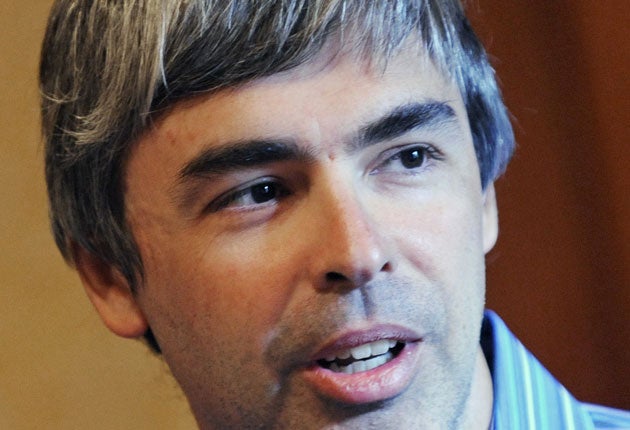
Pity about that lavish yacht Larry Page bought at Christmas.
Called Senses and measuring 193 feet from bow to stern, it features an interior by Philippe Starck and has no fewer than 10 suites for him, his lucky young wife and friends. How are they going to enjoy it now that they've made him chief executive officer of that moderately demanding company he co-founded with his friend, Sergey Brin, called Google?
He's usually smarter about his timing, even down to the year he was born in – 1973. That put him at Stanford University for postgraduate studies when Brin was there (though two years ahead of him) and the World Wide Web had exploded to the point where someone had to find a way better to harness and navigate it.
That's what they figured out, creating the algorithms to build a search engine for the internet that no one until then had even dreamed about. With $1m from family and friends, they built a company in a garage (where else?), named it Google and launched it commercially in 1998. No one knew it back then, but Google would in time change nearly everything, except (perhaps) the axis of the planet.
Actually, Page had had that dream when he was 23, or so he told the students at the University of Michigan, where he did his bachelor's degree, when he was the speaker at last year's graduation ceremony. "When I suddenly woke up, I was thinking: what if we could download the whole web and just keep the links, and I grabbed a pen and started writing." He added: "Sometimes it's important to wake up and stop dreaming."
That sounds like self-mythologising. But that address was one of only a few times Page has emerged from his nerdy shell. When Google said last week that CEO Eric Schmidt, installed to run the company in 2001, was stepping down, some wondered if Page, by replacing him, was shaping up to be the next showman guru of our computing existence à la Steve Jobs or Yahoo co-founder Jerry Yang.
Occasionally Page teases us with inklings of flamboyance. He married a former model, Lucinda Southworth, on Richard Branson's private Caribbean island of Necker in 2007 and chose Branson – a master of immodest self-promotion – as his best man. The two men like to kite surf together. Indeed, the departing Schmidt always liked to say that he had been brought in to Google in the first place to "babysit" the young ones – Page and Brin – and stop them from getting carried away with their more wayward ideas. These presumably included their enthusiasm for non-core ventures such as renewable energy. Then there are the stories of the Boeing 767 that Page and Brin own, featuring hammocks suspended from the cabin ceiling. And there is Senses.
Yet the yacht was bought second-hand by Page, which suggests that extravagance is not his natural style. (A new boat was hardly beyond his means, after all, if Forbes was right in recently estimating his personal worth in excess of $17bn.) Nor is public self-exposure. Page, according to Ken Auletta, the New Yorker writer and author of Googled: The End of the World as We Know It, is "aggressively disdainful of public relations and marketing" and in 2008 told the people at Google's PR department he would give them "a total of eight hours of his time that year for press conferences, speeches, or interviews".
"Page is a very private man," Auletta added last week, "who often in meetings looks down at his hand-held Android device (Android is Google's answer to Apple's iPhone platform), who is not a comfortable public speaker, who hates to have a regimented schedule, who thinks it is an inefficient use of his time to invest too much of it in meetings with journalists or analysts or governments."
This is the conundrum of Page, then. On the one hand he, with Brin, has had more impact on the lives of you and me than, arguably, God. Hang a damp hanky in your window and your nasty habit could be archived for ever if a Google camera-car happens by. Commit some more serious indiscretion and, thanks again to Google, it will attach itself to your reputation for life. More prosaically, turn on your laptop today to answer that urgent question that just came up and chances are you will "Google" whatever that happens to be.
But once-a-nerd-always-a-nerd may also apply here. His own biography attests to his early nerdy beginnings. Born on 26 March 1973, Page was allegedly only six when he developed his first interest in computers.
Domestic circumstances helped. Both his parents were computer science teachers at Michigan State University and he remembers his house as being messy, not least because of all the computer magazines lying around. It didn't surprise anyone that he studied computer engineering at the University of Michigan – legend has it that on campus Page built something close to an inkjet printer entirely out of Lego bricks – or that his Master's degree at Stanford was in computer science.
You could call Page a university dropout. Neither he nor Brin actually finished their Stanford studies on account of what they got up to in the aforementioned garage. Google, in fact, grew out of an earlier program developed for what was meant to be a final postgraduate thesis called BackRub that listed pages on the web according to the number of times they had been visited.
Not everyone is grateful to Google. Rupert Murdoch has called the folk there "plagiarists" and "parasites" for vacuuming content from sources such as his own newspapers and handing it to the rest of us for free. Nor does everybody believe it has lived up to Page's promise of some years ago that the mantra for his employees would always be "Don't do evil". Some say there is evil in the manner Google has broken down personal privacy. Others snipe at it for capitulating to China's censorship.
Nor is Google without significant challenges. It must overcome the old criticism that the company is a one-trick pony – forget not that its related interest include Android and YouTube – as well as the perception that it has lost some of its "hotness" of late to its neighbours at Facebook.
It may not matter that Page will never make a showman, Apple style. Amid the mounting challenges facing the company, perhaps the hardest may be keeping its basic search operations running smoothly. Fake websites have become adept at gaming the Google algorithm and getting spam pages to show high up the search engine's rankings – something that it acknowledged last night had become a bigger problem in recent months. Wall Street reacted mostly positively to the news of his becoming CEO, however, because he has displayed signs that, while he may be a nerd, he also understands that scientific brilliance means something only when accompanied by business brilliance too. If Google is lucky, Page has both in his bloodstream. He thinks he does.
"From a very early age," he said in one rare interview, "I also realised I wanted to invent things. So I became really interested in technology... and business. Probably from when I was 12, I knew I was going to start a company eventually."
A life in brief
Born: 26 March 1973, East Lansing, Michigan.
Family: Parents were software science professors at Michigan State University. He married Lucinda Southworth in 2007.
Education: BSc in computer engineering from the University of Michigan and Master's in computer science at Stanford University. He was doing a PhD at Stanford when he left in order to focus on Google.
Career: Along with his friend Sergey Brin, Page founded Google, Inc in 1998. Page and Brin ran Google as co-presidents until 2001, when they hired Eric Schmidt to be chairman and CEO. Page will replace Schmidt as CEO in April. Google's revenue last year was $23bn.
He says: "The increasing volume of information is just more opportunity to build better answers to questions. The more information you have, the better."
They say: "I am certain that the next 10 years under Larry will be even better. Larry, in my clear opinion, is ready to lead." Eric Schmidt, Google CEO
Join our commenting forum
Join thought-provoking conversations, follow other Independent readers and see their replies
Comments
Bookmark popover
Removed from bookmarks