Michael Mann: The climate scientist who the deniers have in their sights
He didn't court controversy, but is happy to make use of it
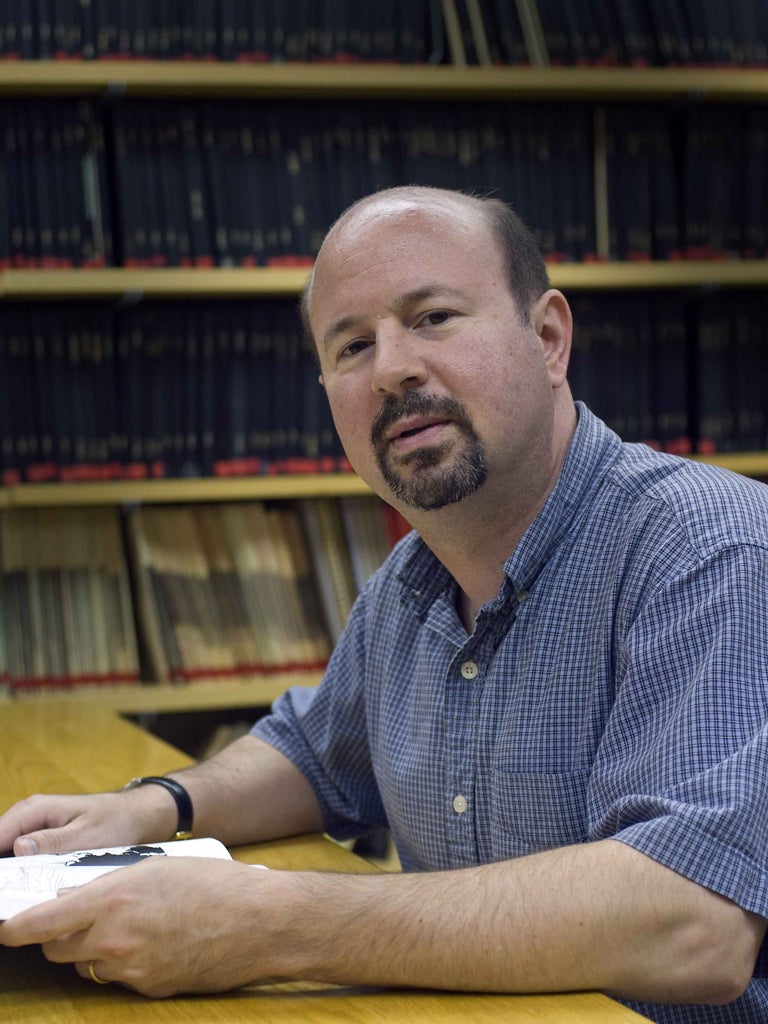
He is one of the most vilified men in the highly vilified field of climate science, yet Professor Michael Mann is surprisingly jolly. Despite being the focus of a brutal campaign orchestrated by the fossil-fuel industry and senior politicians within the US Republican Party, Mann's cheery stoicism is positively infectious.
"I've been the focus for attack by those who deny the reality of climate change for so long that it almost seems like forever," the professor of meteorology at Pennsylvania State University says. "I'm a reluctant public figure, but I have embraced the opportunity to communicate the science."
Mann became a chief target of the climate change contrarians for being the outspoken author of an iconic graph of global warming science known as the "hockey stick" – the most politicised graph in science, according to the journal Nature.
It was the hockey stick that generated much of the opprobrium heaped upon climate scientists as a result of the "climategate" emails stolen from the University of East Anglia and leaked on to the internet two years ago. Indeed, many of the leaked emails were copies of correspondence between the UEA team in the UK and Mann and his colleagues in the US.
Mann believes the theft of the emails was not the work of a random hacker, but part of a sophisticated campaign. "It was a very successful, well-planned smear campaign intended ... to go directly at the trust the public had in scientists," he insists. "Even though they haven't solved the crime of who actually broke in, the entire apparatus for propelling this manufactured scandal on to the world stage was completely funded by the fossil-fuel front groups."
The hockey stick graph appeared to demonstrate how world temperatures had remained fairly steady for several hundred years before shooting up at the end of the 20th century, just like the straight blade jutting out from the shaft of an ice-hockey stick (the analogy doesn't quite work with a curved field hockey stick).
The original study was published in Nature in 1998. Within five years, Mann had become the focus of an orchestrated campaign to undermine the entire field of climate science by rubbishing the hockey stick – a term coined by a colleague rather than Mann himself. Republican Senator Jim Inhofe picked up the hockey stick to beat climate science, famously declaring in 2003 that "global warming is the greatest hoax ever perpetrated on the American people".
Mann became the target of Freedom of Information requests and was served with a subpoena by Republican Congressman Joe Barton demanding access to his correspondence. This was followed with a further subpoena from Ken Cuccinelli, the Republican Attorney General of Virginia, and yet more FOI requests from industry front-organisations, notably the American Tradition Institute.
Climate contrarians argued that Mann and his colleagues were concealing their research methods because they had something to hide. In reply, Mann insists that he has been as open as he can about data and methodology, but the aim of these requests has more to do with intimidation than openness. "What they are trying to do is to blur the distinction between private correspondence and scientific data and methods, which of course should be out there for other scientists to attempt to reproduce.
"I think it's intentional and malicious. It's intended to chill scientific discourse, to intimidate scientists working in areas that threaten these special interests," he says. "It's the icing on the cake if they can also get hold of any more private correspondence that they can mine and cherry pick. It's a win-win for them." Why an obscure graph published in a scientific journal should enrage so many people has been the subject of much internet conspiracy (or genuine scientific debate, depending on your point of view).
The original 1998 hockey stick study by Mann and his colleagues did in fact emphasise the tentative nature of estimating past temperatures before the invention of accurate thermometers.
Faced with a lack of formal temperature records before the 19th century, they attempted to use "proxy records", such as ice cores, tree rings and changes to coral reefs. Because of the nature of the approach, their graph showed large error bars, which were drawn even wider apart the further back in time they went.
Many, indeed most climate scientists have argued that the hockey-stick graph is not central to the case for the role of man-made pollution in exacerbating global warming, and the prospect of dangerous climate change. But it has nevertheless become the iconic smoking gun for both sides of the debate, showing either that we are living through unprecedented temperature increases, or that we are being duped by the biggest scientific hoax in history.
"When we first published our Nature article in 1998, we went back six centuries," Mann says. "A year later we published a follow-up going back 1,000 years with quite a few caveats. In fact, the caveats and uncertainties appeared in the title, and the abstract emphasised just how tentative this study was because of all the complicating issues.
"It's frustrating that to some extent all of that context had been lost and the result has been caricatured. Often the errors bars are stripped away, making it appear more definitive than it was ever intended."
But if the aim of the climate contrarians was to browbeat Mann and his ilk into submission, then it clearly hasn't worked. He is publishing his own book on the hockey stick controversy later this year and he shows every sign of continuing the battle. "Scientists have to recognise that they are in a street fight," he warns.
A popular target: What critics say...
"Dr Mann's hockey stick graph is based on suspect data. Others have shown that random numbers can be put into Mann's algorithm, and they always produce a hockey stick graph."
Ken Cuccinelli, Virginia's Attorney General who wants to prosecute Mann for fraud.
"How many more times does it need to be shredded and splintered before the eco zealots who gather to froth and foam at warmist sites like Real Climate accept that their flimsy theory has been falsified beyond credibility?"
James Dellingpole, Blogger on the hockey stick graph
A life in brief
Born 28 December 1965
Education Undergraduate degrees in physics and applied maths, University of California at Berkeley, MS degree in physics, Yale University, PhD in geology & geophysics, Yale University.
Career In 1998 Mann, Ray Bradley and Malcolm Hughes compiled the "hockey stick graph" of global temperatures since 1400, based on analyses of ice cores, tree rings and other historical data, which showed a sharp rise in the late 20th century. A version of the graph in 1999 showing temperatures from 1000 featured prominently in the United Nations Intergovernmental Panel on Climate Change Third Assessment Report in 2001.
Awards In 2007, Mann and hundreds of other scientists who contributed to the IPCC report were awarded the Nobel Peace Prize
Join our commenting forum
Join thought-provoking conversations, follow other Independent readers and see their replies
Comments