Nick Clegg: 'The pillars of the establishment are tumbling'
The Deputy Prime Minster tells Andrew Grice why the crisis enveloping the Murdoch empire is an opportunity for the Liberal Democrats
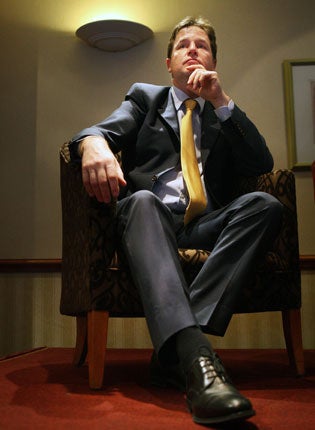
It is 6am and Nick Clegg has had a largely wakeful night thanks to his two-year-old son Miguel, a sleep resister. But he surprises his bleary-eyed aides as they head for a Eurostar train to Paris with a neat insight into the phone-hacking crisis.
"The pillars of the British establishment are tumbling one after the other," he says. He points out that the casualties could be viewed on a trip down the River Thames – News International at Wapping (hacking); the banks in the City (the financial crisis); Parliament (MPs' expenses) and nearby Scotland Yard (hacking).
The deputy prime minister senses a rare opportunity in the hacking scandal to carve out a separate niche. The Liberal Democrats have never wooed or been wooed by the media moguls. Unlike David Cameron and Ed Miliband, Mr Clegg did not attend Rupert Murdoch's annual summer party in London last month. He has twice been through the mincer of the ruthless Tory-supporting press machine – during the "Cleggmania" of last year's election and the ill-fated alternative-vote referendum in May.
On the 6.52am train from London St Pancras last Friday, Mr Clegg speaks with passion: "You have politicians falling to their knees ingratiating themselves with media moguls. You have too many vested interests tied up with each other. You have a culture of arrogance and impunity"
He was quick out of the traps last week, pressing Mr Cameron successfully for the public inquiry covering the police and the press to be headed by a judge. Mr Clegg believes the crisis offers an opportunity to clean up Britain's "rotten establishment". To reflect liberal values, of course. "The anger people feel is almost palpable. The question is how we harness that sense of outrage to build something better for the future."
Although the Press Complaints Commission is a "busted flush", he does not favour statutory regulation, which might give politicians "free rein" to shackle the newspapers. "I believe in a raucous, loud, free press."
The controversy offers Mr Clegg a welcome diversion from his party's own woes. For once, it is Mr Cameron's turn to feel the heat. But Mr Clegg knows he will not escape it for long. After a rout in May's local elections, the AV referendum and the continuing cloud of university tuition fees, Liberal Democrat activists are anxious. The voices who believe the party made a catastrophic mistake by getting into bed with the Conservatives will get louder at the party's conference in September.
"It has been really, really tough for us, this first year," Mr Clegg admits. He concedes the Liberal Democrats have taken the hit for the Coalition's unpopular policies. "Cutting public spending is something you expect from Conservative governments... There is no doubt that embarking on such a painful deficit-reduction plan was always going to be politically controversial for a party such as the Liberal Democrats."
The bad news for his critics, who fear a Liberal Democrat massacre at the next election, is that Mr Clegg is "even more persuaded today than last year" that the party made the right call by entering the Coalition.
The good news is that he is utterly convinced his party will get the credit before the next election. While he would like to reap the dividend in 2012, he admits it might take longer for far-reaching reforms to sink in and for the economy to recover fully. He believes the reforms have been "obscured" by fear of the spending cuts.
"We are condemned to govern for the long term. I look forward to us moving into a much more positive frame of mind in the years ahead.
"By 2015 we will be able to show people we have put the building blocks in place on tax, education, the early years, apprenticeships, vocational education and greater social mobility in a way that the Conservatives would never have done on their own and, at the same time, we have put the economy back on course. "
He reveals his party's new unique selling point is "compassion and competence", adding: "I don't think they fit on a leaflet... We need two shorter words." He insists: "I think the long term is really, really bright. There is a huge appetite in British politics for a party that is economically more competent than Labour and which is more progressive than the Conservatives. Only the Liberal Democrats fit that bill."
The atmosphere in the Coalition has changed since Mr Cameron allowed the Tories to launch personal attacks on Mr Clegg during the AV referendum. Yet the Liberal Democrat leader plays down the new mood. "This is not a coalition driven by sentiment but by a belief that it is right for the country for two parties to govern together in the national interest.
"It was always much more business-like than people were keen to suggest. The Coalition has settled down to what it is – two different parties with two different views on Europe, the NHS and other issues. Mostly in private, sometimes in public, we try to resolve those differences and do the right thing for the country. Of course that requires the two people at the top to be able to work with each other in a spirit of mutual respect and in a business-like manner."
But surely those personal attacks must have hurt? "You have got to be pretty resilient in politics. You also need to expect in a coalition that you go through bumps and scrapes. I don't believe you throw your teddy out of the pram... I don't feel frustrated; I just push on." In the new phase, he is more honest about the disagreements. Does he support the Prime Minister's flagship Big Society theme? "It is not my phrase, it is David Cameron's," he replies. "I talk much more about an open society."
After a whistle-stop eight-hour visit to Paris, Mr Clegg also speaks candidly about his differences with the prime minister over Europe. "We come at it from completely different directions. That doesn't mean we can't govern together," he explains on the return journey.
The former MEP is passionate about the EU, convinced that a positive approach is "a vital national self-interest". He explains: "We have got to continue to play our part to shape the European Union, not seek every opportunity to somehow distance ourselves from it." The Liberal Democrats, he says, as an internationalist party, are "a very important force in the British government". He confirms they have put the brakes on a more Eurosceptic government agenda and is proud of it. "There are views in the Conservative Party about Europe which I strongly disagree with. They can implement them when they are a Conservative-only government, but they can't when they are in coalition. Quite frankly there are [other] things on Europe that I would do. We don't agree on this."
In Paris, Mr Clegg has a packed agenda and is somehow snaked through heavy traffic in a high-speed police escort.
His foreign affairs role is one the public do not see. At present, he and Mr Cameron spend more time talking about Libya than anything else. Then there is Mr Clegg's day job: driving through an ambitious programme of political and constitutional reform, chairing the Cabinet's pivotal domestic affairs committee and resolving disputes between the two Coalition parties with Mr Cameron.
Mr Clegg, who speaks in Spanish to his wife Miriam and in Dutch to his mother, is at ease as he conducts most of his Paris meetings in French which is judged "better than Tony Blair's" by impressed officials. Mr Clegg meets François Barin, the French Finance Minister, then delivers a long speech in French to business leaders.
He has a private one-to-one lunch with François Fillon, the prime minister; answers questions at "town hall" meeting staged by the British Council; hosts a reception for defence staff at the British ambassador's residence before squeezing in interviews with the French media. It's not for show; behind the scenes, some serious business is discussed about the ever-closer Anglo-French co-operation on defence.
He doesn't entirely escape domestic matters. French journalists press him on whether the hacking scandal will damage the Coalition and a student asks whether breaking the Liberal Democrat manifesto promise on tuition fees will result in a "brain drain". He must be exhausted by the end of his long day, but his optimism is still bright. "We took a big hit in May. I don't diminish that. But the idea that the end is nigh is far from the truth."
Nor is his own end in sight, despite rumours in Liberal Democrat circles that he might judge it in the party's interests for someone else to lead it into the next election if he were too tainted by the Coalition. He is surprised when I raise the speculation, but I warn him it is bound to grow. "I am certainly going to lead the party into the general election," he insists, dismissing the rumours as "chitter chatter about what might happen in four years" and "crystal-ball gazing taking a slightly surreal turn".
Does the carping ever make him feel like giving up front-line politics to spend more time with his family? "Of course I would like to spend more time with Miriam and the kids. But no, I genuinely don't think that. I am unbelievably lucky, unbelievably privileged. In my time in government, I just want to make the best of it. I also want to be able to look back on it and say at every turn, 'I tried to do the right thing'. That is immensely important to me personally and really important for my party."
Life in brief
* Nick Clegg was born on 7 January 1967 in Chalfont St Giles, Buckinghamshire, and educated at Westminster School.
* He studied social anthropology at Cambridge University, political philosophy at Minnesota University and completed an MA in European affairs at the College of Europe.
* Between 1992 and 1995, he worked as a journalist before becoming a consultant and moving to Budapest to write about economic reform.
* In 1995, he was employed by the European Commission and worked as chief of staff to Sir Leon Brittan.
* He was elected MEP for the East Midlands in 1999, later acting as the Liberal Democrat spokesman on trade and industry.
* In 2005, he was elected as MP for Sheffield Hallam, becoming Europe spokesman in Charles Kennedy's team, and later the party's spokesman on home affairs.
* He was elected leader of the Lib Dems in 2007 and became deputy prime minister in 2010.
* He is married to Miriam, a lawyer, and has three sons.
Join our commenting forum
Join thought-provoking conversations, follow other Independent readers and see their replies
Comments