Omid Djalili: Raw, risky, scary, and funny to the bone
The British-Iranian comedian dons the shabby mantle of Fagin and steps on to the West End stage to inject the role with his distinctive multicultural mischief
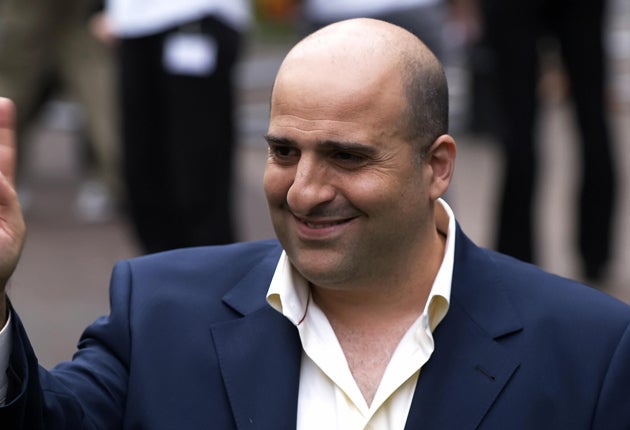
In the course of his career as a stand-up comedian, Omid Djalili has done some pretty shocking things. On his BBC series The Omid Djalili Show, he said: "I am as alarmed as anybody in this room by the sight of Arabs at airports. Even family members ..."
At the Royal Variety Performance he made a joke about a school for suicide bombers that still gives him qualms nearly three years later. He once appeared in a sketch opposite a gay Osama bin Laden. But you ain't seen nothing until you have seen him as Fagin, stripping down to his pants.
Tomorrow Djalili, the London-born son of Iranian immigrants, steps on to the stage at the Theatre Royal, Drury Lane as Dickens's Jewish petty thief. I met him fresh from his first full dress and make-up rehearsal. In taking over from Rowan Atkinson in Cameron Mackintosh's Oliver! he is stepping into the shabby boots of one of his biggest heroes. A brass plaque with Atkinson's name is still nailed to his dressing-room door. "It can stay there!" says his nervous successor. "I'll be happy just to have his name."
Before I met Djalili, his friend the comedian David Baddiel told me: "He's a massively sweet man: incredibly well-meaning, absurdly unappreciative of his own talent, and I think very genuinely funny-boned." The pair have just finished filming Baddiel's film The Infidel, about, says Djalili, "a Muslim man who grows up in a devout Muslim family only to find out when his parents die that he is adopted, and that his real parents are Hassidic Jews." It seems that everyone who works with Djalili becomes his new biggest fan. Cameron Mackintosh says it is "his ability to inhabit his characters with such comic energy ... that will make his Fagin his own".
Having spent a day watching clips of Djalili making energetic fun of himself as he cracks Iranian gags and bellydances gleefully on stage, it is a genuine shock when Fagin himself walks into the dressing-room. As Lionel Bart's musical take on Dickens's most 'orrible villain, he is sullen, scowling and deeply scary. "I'm so pleased you like the look!" he says as I recoil from his handshake and the make-up lady begins to wipe away the bruised circles under his eyes. I wouldn't say I "like" it: the look is chilling. It will frighten children.
In his surprisingly starry big-screen career, Djalili has made a dazzling array of disparate characters his own. As Heath Ledger's manservant in Casanova, as Pablo Picasso opposite Andy Garcia in Modigliani, as Uncle Amman in Meera Syal's Anita and Me ... it seems he has made a living out of playing anyone with a dark skin or a big nose. But Fagin?
"I'm not playing him completely like that all the way through," he says, slipping instantly into music hall mock-Jewish. But this is very definitely a Jewish character. "There are little bits thrown in which will hopefully delight a Jewish audience. I wouldn't want them to think, 'Oh what's he doing? He's sending us up.' So I'm kind of playing him slightly Dickensian .... He was an immigrant, and he's got a little bit of an accent like that."
In the course of a madly animated conversation, Djalili transforms into a bewildering number of comedy characters as swiftly as changing channel. He switches accent midway through a sentence and suddenly he is a Glaswegian taxi driver illustrating the finer points of racism. ("I used to think racism was all about motivation .... But then I met this taxi driver, and he said: 'If I go for a Chinese meal I say I'm going for a Chinky. But I'd never say to a Chinese person that I'm going for a Chinky 'cos he might think I wanna eat him. And that's no right.' And I thought, however well-intentioned you are, if you have that in your language ... that's racist.")
He explains the differences of performing stand-up in New York. In an instant he becomes a Brooklyn comic, his voice, face and whole body transformed: "The energy's very different. You have to be bigger. Everything's bigger. That's why in America you see some comedians who are really loved, and they're not very good comedians, they're just, 'How you doin'?! I'm gonna come up with really pedestrian material!' And people love it!"
I ask him how it feels when he is asked to be a representative of so many tribes to which he does not belong. "Some of my Pakistani friends think that by dint of the fact that I am not English and I am second-generation-something-else I am 'representin', man!'" And for that moment he is a 19-year-old London-Pakistani boy wearing an invisible bandana and low-slung trousers showing the top of his pants.
With his make-up wiped away and his wig peeled off ("See how different I am?" he says delightedly), Djalili starts to strip to his underwear. "Do you mind if I get changed while we talk?" he asks, multitasking in a hurry to get home to take his wife and three children out to dinner. He is not joking.
He has hardly ever lived outside London, he says, when I ask about his shifts of accent. Fagin's frock coat comes off, and then his waistcoat and his grubby shirt.
"I didn't get good enough grades, so I went to the University of Ulster – a place that never fills up because nobody wants to go there." Djalili's real-life shirt goes on over an extravagantly hairy barrel chest (white hairs on the front of his body; black ones on the back). "Then I did two years on the fringe and five years doing experimental theatre in Czechoslovakia." Off come Fagin's tights and on goes a pair of neat jeans over his enormous stretchy black boxers. "Yes, it's a very weird route."
Djalili's weird route to the Theatre Royal Drury Lane started some years – or perhaps generations – ago. His ancestors were travelling troubadours – an early Iranian form of stand-up comic – he discovered to his delight when he was 12. His parents moved to London in the 1960s, but were unable to return after the Iranian revolution in 1979. They were, as he is, members of the Baha'i faith, which is based on the idea of the spiritual unity of all human beings. As such he was a minority within a minority, and "always a bit of an outsider". But he doesn't mind, he says, when people assume he is a Muslim.
Born in 1965, Djalili went to the prestigious Holland Park School – the "socialist Eton" to which Tony Benn sent his children. He was a quiet boy – until he was 12. "And then," he says, "I was very ugly, so I thought I had better make people laugh." In reality, he is far from ugly – without the make-up, there's something dramatically beautiful about his eyes. Nor is he as comically tubby as the fat Iranian act makes him seem. "Make me look thin," he tells the photographer. "I just want to look thin!" He has, in fact, lost a stone, thanks to the exhausting physical rigours of musical theatre. As Baddiel said, he is funny to the bone.
It was at 15, and starring in a school play, that Djalili met his first celebrity fan. "A friend of Mel Smith's had written the play, and he [Smith] came to see it at the height of his Not the Nine O'Clock News fame. He came up to me and said, 'You're very funny. You should think about a career in comedy.' So people like him, Rowan Atkinson, Griff Rhys Jones and Pamela Stephenson were my absolute heroes. A huge influence."
It has been said that Djalili's career really took off immediately after 9/11. In fact, he says, it nearly ended there. Having won a Time Out comedy award in January 2001, he was booked for gigs on 13, 15 and 16 September. But as soon as the planes hit the twin towers, the spots were cancelled. "They said to me, 'We don't want comedy in general'," he recalls. "Then I found out that Julian Clary had taken over one of my gigs. Someone else took over another. Then I realised: 'Oh wow, that's amazing.' It was shocking. I thought that was the end of my career. I didn't go out of the house for two days after 9/11. And when I did, everybody was looking at me. Everyone. It was awful. Even people I knew. I thought, 'Wow. People genuinely think I'm responsible.'"
That September, one theatre, the Bloomsbury in London, kept him on the bill. "My manager said, 'You should write some material about this.' It was about stepping up to the plate. It was about life telling you you're here, and you're funny, and a major world event has happened which involves supposedly your people, and you have to get up and explain, and you have to make us laugh and make us think .... I can't tell you how well that show went." His career, and his risky material, soared from that moment.
The fact is, Djalili is no more a Muslim than he is Jewish. He is no less qualified to play Fagin than he is in his sketches to pretend to be Nigerian, or a public school management consultant.
"I think that if you're playing a Jewish character, and if you can find the truth of something in that character, then that's OK," he says. His transformation complete, he puts on his coat and shoes and picks up his motorcycle helmet, ready to ride home. "It's done in an affectionate way, and in a truthful way," he says. "And I think that's what it's all about, personally."
Omid Djalili stars as Fagin in Cameron Mackintosh's production of Oliver! at the Theatre Royal Drury Lane from tomorrow
The World's A Stage
30 September 1965 Born in Chelsea, London, to Iranian parents. As a child he attends Holland Park School before being kicked out for chasing pupils on his moped
1988 Studies English and Theatre Studies at the University of Ulster, where he encounters violent racism
1995 Garners acclaim at the Edinburgh Festival Fringe with stand-up show Short Fat Kebab Shop Owner's Son, in which he claims to be the only Iranian comedian
1996 Chosen as the year's "Best Comic" by ITV's Big Big Talent Show
1999 Appears in small roles in film blockbusters The World Is Not Enough, The Mummy and Notting Hill
2002 Following the 9/11 terrorist attacks, he tackles Western-Eastern relations with his new routine, Behind Enemy Lines
2003 Is named one of the top 50 funniest acts in British comedy by The Observer
2004 Records an HBO special, the first British comedian to do so since Eddie Izzard. Fans in the US include Bill Clinton
2007 The Omid Djalili Show, a mixture of sketches and stand-up, premieres in BBC1's Saturday evening slot
2008 Returns to the stage for the Edinburgh Comedy Festival and an appearance on ITV's We Are Most Amused, which celebrated Prince Charles's 60th birthday
2009 Takes over from Rowan Atkinson as Fagin in the West End production of Oliver! at the Theatre Royal, Drury Lane
Join our commenting forum
Join thought-provoking conversations, follow other Independent readers and see their replies
Comments