Serena Williams: Designs on the prize
It sometimes seems as if her fashion interests mean more to her than tennis. But not when Wimbledon comes around
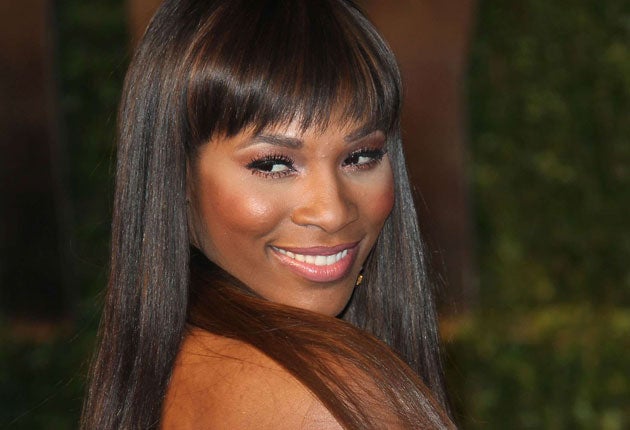
Chris Evert, the Wimbledon singles champion of 1974, 1976 and 1981, recently declared that the 2002, 2003, 2009 and 2010 champion – Serena Williams – will "go down as one of the greatest players who ever lived, no doubt about it".
This might seem like a rather predictable endorsement, by one accomplished tennis player, of another's stature in the lengthy annals of the game. After all, still some months away from her 30th birthday, the younger of the famous tennis-playing Williams sisters has won no fewer than 13 Grand Slam singles titles, and more career prize money – getting on for $33m – than any other woman ever has, in any sport.
Yet Evert's assertion, and the fact that she felt the need to stress the absence of doubt, are significant. So is her follow-up – that while Steffi Graf and Martina Navratilova have to be reckoned the finest female players of all time, "definitely Serena, as far as her tennis goes, would be considered one of the greatest players ever".
Why as far as her tennis goes? By what other criteria could Williams, who next week begins the defence of her Wimbledon title, be assessed as one of the all-time tennis greats? Evert's slight and doubtless unwitting equivocation leads us directly to the heart of the enigma that is Serena Williams.
That she has never entirely received the credit she deserves for her remarkable deeds is partly to do with the ridiculous yet by no means uncommon perception that she holds unfair advantages over most of her opponents; the advantages of strength and power.
In bygone times, Navratilova was a victim of the same skewed reasoning. She played like a man, they said, an observation that her lesbianism did nothing to diminish. For years, while the Czech-born American left no milestone unturned on her way to a record 22 Grand Slam singles titles, tennis fans found it hard to warm to her, preferring (the women no less than the men) the femininity of an Evert, an Evonne Goolagong, or that of another Czech, Hana Mandlikova.
So it is with Williams. She's not gay, but she too belts the ball "like a man". When she wipes the court with more graceful players such as Caroline Wozniacki or Ana Ivanovic, it's not "fair". Maybe it will not be until the twilight of her career, when she enters the arena as the underdog, that she will be clutched to the collective bosom. That's what happened with Navratilova.
It could, of course, be that Williams, at 29, has already entered the twilight of her career. Certainly, she has no right to be declared the favourite to win the coveted Venus Rosewater dish a fortnight today (although every bookmaker has her either out on her own or co-favourite with Maria Sharapova), for until this week's Aegon International tournament at Eastbourne, she had not played a single competitive match since winning Wimbledon last July. And not only has she endured two foot operations since then, she has also risen, within just the past few months, from what she melodramatically but not wholly unreasonably describes as her "death bed".
Her health problems started last year when she stepped on some broken glass in a German restaurant. She needed stitches in both feet, and then surgery, and then, in March, was found to have a pulmonary embolism. "If it had been left two days later it could have been career-ending – or even worse," she told the media at Eastbourne. "They told me I had several blood clots in both lungs. A lot of people die from that."
Happily, she recovered, spending her convalescence watching the Miami Dolphins (the American football team in which she has a financial stake) and hanging out with her elder sister Venus, who was also injured. "If tennis has missed us half as much as we've missed tennis we're in a good place," she said the other day, although the truth is that at times in her career she has given every indication that she could take or leave the sport that has brought her fame and fabulous fortune. It was presumably her myriad off-court distractions to which Evert was referring when she said "as far as her tennis goes".
Since 2004, Williams has run her own line of designer clothing called Aneres (her name backwards). Two years ago, she launched a collection of handbags and jewellery. There is even a line of Serena Williams fake fingernails, and, as of last year, she is a qualified nail technician. But this preoccupation with fashion, and also an oft-stated ambition to act, has generally been poorly received in tennis circles.
"Tennis is unforgiving. You can't let it slide down the list of priorities," wrote former Wimbledon champion Pat Cash just before the 2007 Australian Open, at which Williams had arrived overweight and out of practice, having scarcely played a competitive match for months, and with a miserable world ranking of 81. "The Williams sisters changed the face of women's tennis, taking power play to unimaginable levels," added Cash. "They blazed everyone else out of their path. But Serena clearly has a limited attention span. At her peak she had no patience in the way she played her tennis. Now she does not have the fortitude to stick at what she is trying to do."
Cash was reacting, angrily, to Williams's "crass" declaration on arriving in Australia that it was only a matter of time before she dominated the sport again. "Everybody knows that she and Venus had no real choice when their father, Richard, decided that much of their childhood would be spent hitting tennis balls," he wrote. "Who can be surprised that this promotes a desire to do something different?" But her prediction was an insult to the women who had risen to the top in her absence, he fumed, concluding with his own prediction that she would not "be in the mix at the sharp end of the tournament". He was not exactly going out on a limb; plenty of other tennis insiders agreed. Yet two weeks later, Williams annihilated Maria Sharapova in the final, 6-1, 6-2, to win the tournament for the third time.
Cash could hardly have been more wrong, both in the particulars of what he wrote, and the general. In fact, Serena Williams has quite astonishing fortitude, and it was forged in the childhood to which he alluded, when she and Venus were practically raised on the public tennis courts of the crime-ridden city of Compton, just outside Los Angeles, sometimes within earshot of the kind of gangland shooting that would later claim the life of their elder half-sister, Yetunde.
Theirs is perhaps the definitive story of sporting fortitude, for, with their father constantly and obsessively driving them, they overcame not only social but also racial disadvantage. Black girls from the ghetto were welcomed with firmly folded arms by the American tennis establishment, but there came a point when their prodigious talents could no longer be overlooked.
In 1997, aged 16 and ranked 304th in the world, Williams beat the world No 7, Mary Pierce, and then the No 4, Monica Seles, on her way to the semi-finals of the Ameritech Cup in Chicago. Less than 18 months later, she herself entered the world's top 10.
She is now ranked 26th, remarkably high for someone who has barely played tennis for a year, but then her Wimbledon seeding is even higher – eight – and if the bookies are to be heeded, she should be top of the pile. On the other hand, a fifth Wimbledon title would represent the mother of all comebacks. "It would be monumental (but) I don't know how it's humanly possible," reckons Chris Evert. The answer is that it's humanly possible because the human attempting it is Serena Williams.
A life in brief
Born: 26 September 1981, Saginaw, Michigan.
Family: Raised by Jehovah's witnesses and the youngest of three half-sisters and one sister, Venus. Her father Richard worked for a security firm, until he quit to coach Serena and Venus full time. Her half-sister Yetunde was killed in a drive-by shooting in 2003.
Education: After relocating to Compton, Los Angeles, Williams was home-schooled by her father and went to train under Rick Macci at his tennis academy.
Career: Made her professional tennis debut aged 13. She first won the Grand Slam (simultaneously holding all four majors) in 2003. She has 13 Grand Slam singles titles and two Olympic gold medals.
She says: "Luck has nothing to do with it, because I have spent many, many hours on the court working for my one moment in time, not knowing when it would come."
They say: "She brings crossover appeal and creates storylines even when she's not trying which is a healthy thing for our sport." US tennis player Andy Roddick
Join our commenting forum
Join thought-provoking conversations, follow other Independent readers and see their replies
Comments