Tim Franks: Is he really biased against <u>both</u> sides in the Middle East?
The BBC's man in Jerusalem and a practising Jew is stepping down. Ian Burrell hears him explain why
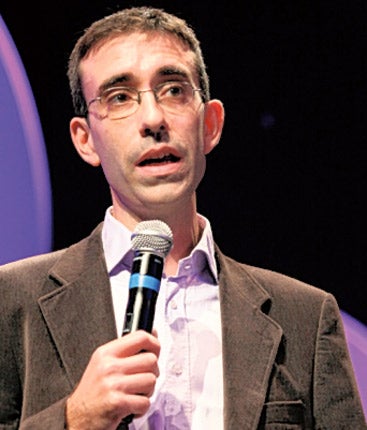
The BBC Middle East correspondent Tim Franks will this morning bid his farewell to Jerusalem with an extraordinary broadcast on the difficulties he has faced in reporting the troubled region for the corporation as a practising Jew.
"The Middle East has become occluded by prejudice... too many people have unshakeable views of others," says Franks forlornly in a special edition of From Our Own Correspondent, which is broadcast on BBC Radio 4 and the World Service.
In a heartfelt dispatch at the end of a three-and-a-half year stint in Jerusalem, Franks says that he had to face rumours that his appointment was a sop to the Israeli lobby following pressure put on the BBC by the former Israeli Prime Minister Ariel Sharon. The correspondent says that there was also a widespread assumption, from all sides in the region, that he had a political agenda. "There are many who believe that – as a journalist – I'm also guilty before I've broadcast a word: guilty of being in hock to the all-powerful Jewish lobby, guilty of being in thrall to the Palestinian culture of victimhood, guilty of stirring overheated controversy out of every spit and whistle in this corner of western Asia."
The comments give an insight into the intense pressure felt by BBC journalists in reporting from the region. They come at a time when the BBC is under fire in the Middle East over its reporting of the Israeli boarding of the Gaza aid flotilla. Palestinian groups have complained that the broadcaster's coverage had relied too heavily on Israel's version of events. Protests also took place outside the BBC in Manchester where Talat Ali, 40, an organiser from the Palestine Solidarity Campaign, said: "We are not happy with the biased news given by the BBC."
Conversely, the corporation also routinely faces criticism from those who accuse it of being biased against Israel. Last year, the BBC's long-standing Middle East editor Jeremy Bowen was rebuked by the BBC Trust, the corporation's governing body, which partly upheld complaints over his reporting. One of the complaints concerned a piece for From Our Own Correspondent in which Bowen was found to have inadequately sourced a comment that the Israeli settlement of Har Homa near Jerusalem was illegal. The criticisms of Bowen by the BBC Trust were widely covered in the Israeli media as evidence of bias in the corporation's output. But the finding also angered many of Bowen's colleagues, who criticised the Trust for succumbing to political pressure.
The Bowen case highlighted some of the tensions to which Franks refers in his valedictory broadcast. "From the start", the challenge he faced in reconciling his faith with his duties as an impartial journalist was a matter of "apparently burning import for a good number of friends, acquaintances and people whom I'd never met", he says. "That it was so perhaps illuminates one small corner of the cloud of smog that envelops the Middle East."
Franks says that as soon as he was appointed to the job, people in his synagogue expected him to cover the region from a pro-Israeli perspective. "At last you'll be able to put our side of the story," they told him. A non-Jewish family friend voiced the opinion that "my appointment had come about because of the pressure the previous Israeli Prime Minister Ariel Sharon had applied to the director-general of the BBC [Mark Thompson]".
At the start of last year Thompson found himself under pressure when he decided that the BBC should not broadcast a Disasters Emergency Committee appeal for Gaza. The director-general went to the unusual lengths of explaining his decision to licence fee payers in a blog. "After looking at all of the circumstances, and in particular after seeking advice from senior leaders in BBC Journalism, we concluded that we could not broadcast a free-standing appeal, no matter how carefully constructed, without running the risk of reducing public confidence in the BBC's impartiality in its wider coverage of the story."
Franks, who has a degree in Chinese from Oxford University, is a highly experienced BBC foreign correspondent who joined the World Service 20 years ago. He was Washington correspondent in the wake of the attacks on the World Trade Centre in 2001 and spent five years as Europe correspondent, based in Brussels. He has presented the Radio 4 programmes The World at One and The World This Weekend.
In his piece for From Our Own Correspondent Franks admits to "feeling flat and depressed" that fellow worshippers at his Jerusalem synagogue did not show signs of being upset by violence in which "Jewish rioters wreaked their vengeance on Palestinians" following the eviction of some Jewish settlers in the West Bank (a story that Franks had reported). "I do not believe I had covered the story for radio or TV any differently because I was a Jew. But was I feeling more bleak the following day because this was violence perpetrated by Jews? Well, perhaps."
Franks is not the BBC's first Jewish Middle East correspondent and among his predecessors is the late Michael Elkins, an award-winning New York-born journalist who emigrated to Israel as a Zionist and filed reports for the BBC between 1965 and 1982. When the Arab lobby complained about his work he replied: "My reports are a matter of public record. If anyone can find a pattern of bias, let him say so."
Vaughan Smith, founder of the Frontline Club, a London-based club dedicated to independent journalism, said that the lobbying of reporters was becoming increasingly sophisticated. "Governments and their agencies have become incredibly sophisticated as they have learnt how to do this and many of those doing this work are ex-journalists."
Franks, who is about to begin a new life as a sports correspondent, signs off from Jerusalem with the conclusion that though the Middle East is "unique" the two sides are there to stay and are going to have to change their ways and learn to live with each other. "Neither is going to cease being without a bloody cataclysm. No competing narrative is going to vanquish the other. We need to move on," he says.
"It is the Middle East but no, it is not the Middle Ages. These days we should all try to live by a different code, shouldn't we?"
'From Our Own Correspondent' is on BBC Radio 4 at 11am
Faith under pressure: Tim Franks
Franks says covering the region as a Jew left him, at times, 'flat and depressed'
20 years since he joined the World Service
Franks's appointment was rumoured to have been influenced by the former Israeli Prime Minister Ariel Sharon
Join our commenting forum
Join thought-provoking conversations, follow other Independent readers and see their replies
Comments