George H W Bush
41st president - 1989-1993
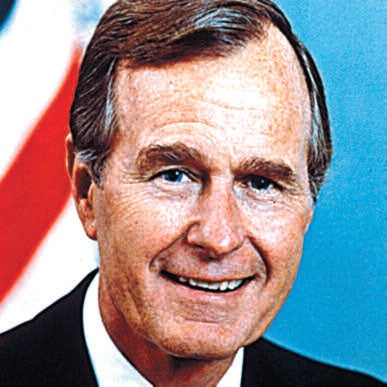
The four years of George Herbert Walker Bush's presidency were among the most momentous of the 20th century, including the fall of the Eastern Bloc and the Berlin Wall, the unification of Germany, the first Gulf War, and the disintegration of the Soviet Union. Bush may have helped usher the Cold War to an end, but he was largely viewed as a pragmatic caretaker president – a safe pair of hands – and he ultimately lacked the vision required to build a new world order in place of the old. He himself disarmingly confessed to having a problem with what he called "the vision thing" in 1988. The sad thing was, he was right.
Born in Massachusetts in 1924 and brought up in Connecticut, Bush began a life of privilege and comfort as the son of financier and Republican senator Prescott Bush. He was schooled at the Phillips Academy in Andover, Massachusetts, which groomed him for Yale, but the Second World War set him on a different course. At 18, he became the youngest pilot in the US navy, flying 58 combat missions against the Japanese, and received the Distinguished Flying Cross for bravery. On his return in 1945 he married Barbara Pierce (who shared her ancestry with the 14th president, Franklin Pierce). They produced six children, George W, Pauline Robinson ("Robin", who died of leukaemia in 1953), Jeb, Neil, Marvin and Dorothy.
After the war, Bush Sr took up his place at Yale, where he was elected president of his fraternity, captained the Yale baseball team, and like his father, was initiated into the Skull and Bones secret society. He graduated in economics in 1948, and moved to Texas to make his fortune as an oil man. His long career in public life included service as a congressman; ambassador to the United Nations; chairman of the Republican National Committee; US envoy to China; and director of the CIA.
Bush first sought the Republican nomination for president in 1980, but when that campaign failed he became Ronald Reagan's running-mate and then vice-president. When he ran again in 1988, no sitting vice-president had been voted into the White House since Martin Van Buren in 1837. Reagan's popularity was high; the economy appeared to be in good shape (although "Reaganomics" had spawned sizeable deficits which would in due course come home to roost), employment was high and, with Reagan's blessing, Bush ran with ease against the liberal Democratic candidate Michael Dukakis.
In his inauguration speech, he spoke of making the US a "kinder and gentler nation", adding: "in man's heart, if not in fact, the day of the dictator is over." Happy to maintain the status quo on the domestic front ("Read my lips: no new taxes", he had said in 1988 – a promise he was later to break), Bush concentrated on foreign policy, namely dismantling the Communist regimes of Eastern Europe and overthrowing Panama's corrupt leader, Manuel Noriega.
When Saddam Hussein invaded Kuwait in August 1990, fears that Iraqi forces would push on into Saudi Arabia, the world's largest oil producer, drove Bush to demonstrate the full extent of his diplomatic and military clout by organising an unprecedented coalition for a counter offensive, backed by the United Nations. In 1991, he sent in 425,000 American troops, joined by 118,000 troops from allied nations, and, after weeks of air and missile bombardment, the land operation dubbed Operation Desert Storm routed Iraq's million-man army in little more than 100 hours.
Northern Kurdish leaders took heart from American statements that the US would support an uprising, and began fighting in the hope of toppling Saddam once and for all. But Bush decided he did not want to get bogged down in conquering and then governing Iraq, and withdrew his troops. The day of the dictator was not, in this instance, over. Saddam Hussein remained in power to wreak murderous revenge on the Kurdish fighters, and Bush's inauguration speech began to ring hollow.
At home, the US had slipped into recession, and in 1990 Bush was forced to break his campaign promise and raise taxes. The decision alienated conservative Republicans, and, come the 1992 election, many other voters began to wonder if the Democratic candidate Bill Clinton might be better placed to restore prosperity.
The end of the Cold War meant that foreign policy, which had been Bush's strength, was no longer so important. His domestic record was thin: aside from pushing the Clean Air Act and the Americans with Disabilities Act – an important piece of civil liberties legislation – through Congress, Bush had failed to initiate many new laws. He ran a lacklustre campaign in 1992 (hampered by a strong third-party candidate, Ross Perot), and the younger, more energetic Bill Clinton romped to victory.
In his own words
"I'm a conservative, but I'm not a nut about it."
"Read my lips: no new taxes."
"I stand for anti-bigotry, anti-Semitism, and anti-racism."
"A new breeze is blowing, and a world refreshed by freedom seems reborn; for in man's heart, if not in fact, the day of the dictator is over. The totalitarian era is passing, its old ideas blown away like leaves from an ancient, lifeless tree."
"Iraq must withdraw from Kuwait completely, immediately, and without condition. Kuwait's legitimate government must be restored. The security and stability of the Persian Gulf must be assured. And American citizens abroad must be protected. Out of these troubled times, our fifth objective – a new world order – can emerge: a new era – freer from the threat of terror, stronger in the pursuit of justice, and more secure in the quest for peace."
"Remember Lincoln, going to his knees in times of trial and the Civil War and all that stuff. You can't be. And we're blessed. So don't feel sorry for – don't cry for me, Argentina."
( Attempting to describe his "New England Values" during a 1992 speech).
"The day will come – and it is not far off – when the legacy of Lincoln will finally be fulfilled at 1600 Pennsylvania Avenue, when a black man or woman will sit in the Oval Office. When that day comes, the most remarkable thing about it will be how naturally it occurs."
In others' words
"If ignorance ever goes to $40 a barrel, I want the drilling rights on George Bush's head." Jim Hightower, agricultural commissioner of Texas
"The President saw a chance to take on the two central problems of our age – the struggle for freedom and the threat of nuclear war – and he seized it. No apologies for that." James Baker
"George is a damn good guy, but he doesn't come through well. It's a case of choking. It takes 11 hours to get George ready for an off-the-cuff remark."Robert Strauss
"For all the credit that President Bush deserves for his magnificent leadership after the Iraqi invasion, the truth is that his administration not only resisted imposing sanctions on Iraq before 2 August, but, by giving Mr Hussein the impression he could invade his defenceless neighbour with impunity, made the aggression more likely."
Stephen J Solarz
Mintiae
George Bush threw up into the lap of Japanese Prime Minister Kiichi Miyazawa in the middle of a state dinner in Japan in 1992, then slid off his chair. To this day, the word " Bushusuru" (to "do the Bush thing") is slang for vomiting in Japanese.
He was the first incumbent vice-president to be elected as president since Martin van Buren in 1837.
He is the only president to have been director of the CIA.
After losing the 1992 election, Bush retired to Texas and – to prove that "old guys can still do stuff" – undertook a number of parachute jumps, well into his seventies. He had first jumped during the Second World War, when his bomber was hit by anti-aircraft fire south of Japan. Bush managed to bail out of his burning plane but his two crewmen were killed.
He was the youngest pilot in the US navy during the Second World War.
When he headed west to make his fortune in oil, he moved into an apartment in Odessa, Texas with his wife and young son George W, where they shared a bathroom with a mother-daughter prostitute duo.
Join our commenting forum
Join thought-provoking conversations, follow other Independent readers and see their replies
Comments
Bookmark popover
Removed from bookmarks