A small bite for a monkey... a giant leap for mankind
Hope for paralysis victims as animal is trained to control robotic arm using only its thoughts
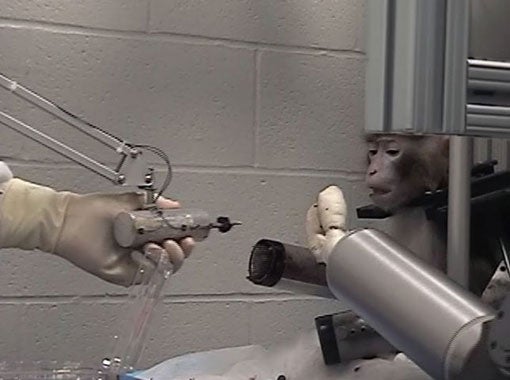
Two monkeys have been trained to eat morsels of food using a robotic arm controlled by thoughts that are relayed through a set of electrodes connecting the animal's brain to a computer, scientists have announced.
The astonishing feat is being seen as a major breakthrough in the development of robotic prosthetic limbs and other automated devices that can be manipulated by paralysed patients using mind control alone.
Scientists eventually plan to use the technology in the development of prosthetics for people with spinal cord injuries or conditions such as motor neurone disease, where total paralysis leaves few other options for controlling artificial limbs or wheelchairs. They hope one day to develop robotic machines that feel like a natural extension of the human body, which would enable the technology to be adapted for a wide variety of purposes, from driving a car to operating a fork-lift truck.
Andrew Schwartz, professor of neurobiology at the University of Pittsburgh, said that the monkeys were able to move the robot arm to bring pieces of marshmallow or fruit to their mouths in a set of "fluid and well-controlled" movements.
"Now we are beginning to understand how the brain works using brain-machine interface technology," said Dr Schwartz, whose study is published online in the journal Nature.
Video courtesy of Andrew Schwartz/ Univerisity of Pittsburgh
"The more we understand about the brain, the better we'll be able to treat a wide range of brain disorders, everything from Parkinson's disease and paralysis to, eventually, Alzheimer's disease and perhaps even mental illness," he said.
The study is part of a larger effort to find ways of tapping into the brain's complicated electrical activity that controls the movement of muscles. Eventually, scientists hope to develop a way of detecting brain patterns that signify a person's intentions regarding the movement of a limb.
The technology is known as the "brain-machine interface" which hopes to connect the silicon hardware of the microprocessor with the carbon-based "software" of the human nervous system so that machines can be controlled by the mind.
"Our immediate goal is to make a prosthetic device for people with total paralysis. Ultimately, our goal is to better understand brain complexity," Dr Schwartz said.
The monkeys in the experiment had been initially trained to control the robot arm with a joystick operated by the animals' own hands. Later on, the monkeys' arms were gently restrained and they were trained to use electrical patterns in the motor centre of their brain – which controls muscle movements – to operate the robotic arm.
The scientists said that they were astonished to find how easy it was for them to train the monkeys to move the robotic arm, which appeared to be readily accepted by the animals as a useful eating tool.
The scientists used electrodes that monitored a representative sample of about 100 brain cells out of the many millions that are activated when the motor centre is involved in muscular movement. The electrical patterns were sent to a computer which had been programmed to analyse the patterns and use them to control the movement of the robotic arm, which consisted of a shoulder joint, an elbow joint and a claw-like gripper "hand".
"The monkey learns by first observing the movement, which activates the brain cells as if he were doing it. It's a lot like sports training, where trainers have athletes first imagine that they are performing the movements they desire," Dr Schwartz said.
The robotic arm used in the experiment had five degrees of freedom – three at the shoulder, one at the elbow and one at the hand, which was supposed to emulate the movement of the human arm. The training of the monkeys took several days using food as rewards.
Previous work by the group has concentrated on training monkeys to move cursors of a computer screen but the latest study using a robotic arm involved a more complicated system of movements, the scientists said.
John Kalaska, of the University of Montreal, said that the experiment is the first demonstrated use of "brain-machine interface technology" to perform a practical behavioural act such as feeding. "It represents the current state of the art in the development of neuroprosthetic controllers for complex arm-like robots that could one day, in principle, help patients perform many everyday tasks such as eating, drinking from a glass or using a tool," Dr Kalaska said.
"One encouraging finding was how readily the monkeys learnt to control the robot... Equally encouraging was how naturally the monkeys controlled and interacted with the robot," he said.
"They made curved trajectories of the gripper through space to avoid obstacles, made rapid corrections in the trajectory when the experimenter unexpectedly changed the location of the food morsel, and even used the gripper as a prop to push a loose treat from their lips into their mouth," Dr Kalaska said.
In 2000, scientists at the Massachusetts Institute of Technology were the first to show that it is possible to record the neural activity in a monkey's brain and send it over the internet to control the movement of a remotely controlled robotic arm in a laboratory 600 miles away. The team also used microelectrodes implanted into the monkey's brain but it did not involve using the robot arm for a useful task such as feeding.
Dr Kalaska said the next task was to develop a way of sending sensory information back to the monkey through the robotic arm so that the animal knows how hard to grip an object, which is essential for human interactions.
"For physical interactions with the environment, the subject must also be able to sense and control the forces exerted by the robot on any object or surface so that, for instance, they can pick up an object with a strong enough grip to prevent it slipping from the robotic hand but not so strong as to crush it," he said. "These and other technical issues are challenging, but not insurmountable."
Join our commenting forum
Join thought-provoking conversations, follow other Independent readers and see their replies
Comments
Bookmark popover
Removed from bookmarks